Twenty years ago, collecting watches was a quiet thing. A handful of obsessives who knew each other by name, a few dealers in Geneva and New York, a closed loop most of the public never noticed. The market today operates on a different scale entirely. When a major auction house holds a luxury watch sale, the bidding draws the kind of global attention you'd expect for a Picasso at Christie's or a 1962 Ferrari with the right racing pedigree. The shift is real, and it's changed how serious collectors and first-time buyers think about what's actually inside a watch case.
A lot of credit for that shift belongs to the auction houses themselves. They stopped running sales and started building narratives. They publish research that genuinely teaches collectors something. They construct stories around specific pieces in a way that turns a sealed-bid auction room into something closer to theater. The result is predictable. Collectors fight harder for the rarest examples, and prices follow. Which leaves an obvious question hanging: what actually makes a watch qualify as the most expensive watch in auction history? The answer comes down to four things working in concert. How rare the piece is. How well it was built. Who owned it before. And what era it represents to the people doing the bidding. Get those four to line up and certain timepieces leave the rest of the market behind.
Why Are Some Watches So Expensive at Auction?
Rarity and Limited Production
Rarity is the foundation everything else stacks on top of. A watch made in extremely small numbers, or as a one-off commission, generates a kind of competitive heat that's almost impossible to fake. Some of the most valuable pieces ever auctioned exist as a single example. Others were made in runs so small that every surviving piece could fit on a single shelf with room to spare.
Limited production gets really powerful when it combines with discontinued references or complications nobody bothers to make anymore. Sometimes that's because the technique was too expensive. Sometimes it's because the artisans who knew how to make it retired without anyone to take their place. When supply effectively stops and demand keeps building, auction results climb with it, especially for the most expensive watch brands that already have decades of collector trust earning compound interest.
Historical and Cultural Significance
Beyond pure scarcity, history changes the math in ways that aren't always obvious from the outside. Watches tied to specific technological milestones, brand anniversaries, or actual turning points in horology tend to pull real premiums at auction. The early perpetual calendars. The first minute repeaters that actually worked reliably. The split-seconds chronographs from when the mechanism was still being figured out by hand. Collectors value those pieces for the craftsmanship, sure. But they also value them for what they meant inside the development of watchmaking as a discipline.
Cultural relevance plays into the same equation. A timepiece that captures something specific about an era (the golden age of Swiss watchmaking in the mid-twentieth century, the post-war boom in mechanical innovation, the rise of sports chronographs in the 1960s) resonates with collectors who see watches as small artifacts of human ingenuity rather than just accessories. That resonance is part of why a luxury watch sale can blow past every estimate the auction house published in the catalog.
Provenance and Famous Ownership
If there's one factor that swings auction outcomes harder than anything else, it's provenance. A watch that once belonged to a known historical figure, a film star, or a pioneer inside the industry carries a story that lives beyond the object. That story turns a watch into something closer to a piece of history, and it can be the difference between a strong result and a record that gets written about for years.
In several landmark cases, provenance alone has multiplied auction estimates by multiples nobody saw coming. Serious collectors at that level aren't really buying a watch. They're buying a story that no amount of money can replicate, which is exactly why bidding gets aggressive at the top end.
Condition, Originality, and Preservation
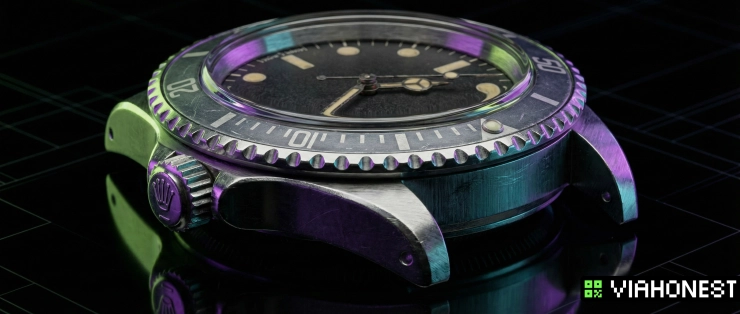
Condition still matters, even when historical weight is sitting on the other side of the scale. Original dials. Original hands. Untouched cases. Movements that haven't been swapped or modified. Every one of those details changes the price ceiling when bidding gets serious. A watch that's kept its factory-original components and shows honest wear (the kind that proves it lived a real life) outperforms a heavily restored example almost every time.
Auction houses have responded by pushing harder on transparency. Detailed condition reports. High-resolution photography that lets you see the back of a movement. Sometimes even forensic analysis to verify a contested detail. That openness has educated buyers and driven prices higher on the genuinely exceptional pieces that surface, because now the market can actually tell the difference.
Top Brands Behind the Most Expensive Auction Watches
Patek Philippe: The Benchmark for Record Prices
You can't have a serious conversation about auction records without starting with Patek Philippe. The brand's whole philosophy (limited production, technical depth, building watches that hold value for generations rather than years) has put it at the top of high-value sales by almost any measure you'd want to use. It's also one of the most expensive watch brands in the world, full stop.
Patek Philippe pocket watches with serious complications, and the brand's top-tier wristwatches, keep dominating the upper tier of auction results year after year.
New benchmarks get set, then broken, then set again, usually when mechanical excellence and historical weight show up inside the same piece.
Rolex: Iconic Models With Cultural Weight
Rolex sits in an interesting position. The brand produces watches at volumes most haute horlogerie houses can't match, which by traditional logic should hurt collector value. Specific vintage models prove the opposite, especially the early sports references that have pulled extraordinary results at auction over the past two decades.
What separates Rolex from the rest is cultural reach. Plenty of Rolex models are instantly recognizable to people who couldn't name another watch brand on the planet, and that wider recognition broadens the bidding pool in ways the rest of the market struggles to match. When somebody outside the collector world wants to enter the market, they usually start with a Rolex they've seen on someone they admire. That gateway effect is real money.
Audemars Piguet, Omega, and Other Notable Brands
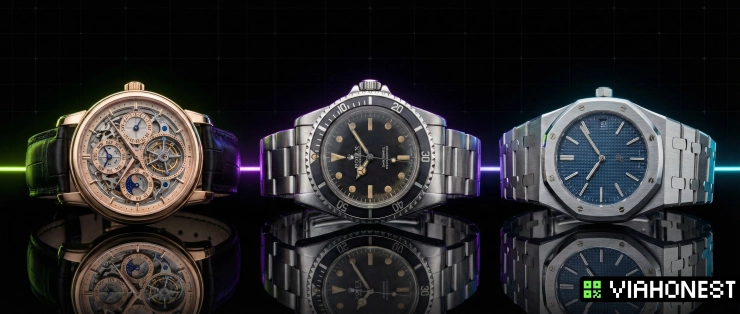
Audemars Piguet and Omega show up regularly in the upper reaches of auction history too. Audemars Piguet's early complicated pieces and rare Royal Oak variants pull serious collector attention, especially when condition lines up with provenance. Omega benefits from a different angle entirely: deep historical ties to space exploration (the Speedmaster is on the moon, after all), military service, and competitive sport.
Independent makers and heritage brands break into the spotlight occasionally too, usually when an exceptionally rare or historically important piece surfaces from a private collection nobody in the public knew about. Those moments don't happen often, but they reset expectations when they do.
Why Collectors Trust These Brands
What ties all these brands together is a set of overlapping traits. Consistent quality across decades. Deep archives that let collectors verify what they're buying.
Strong documentation. Global recognition. Stack those together and you reduce the risk a serious buyer is taking on, which is exactly why these brands keep showing up as contenders whenever a new auction record gets set.
The Most Expensive Watches Ever Sold at Auction: Key Case Studies
The Ultimate Complication Pocket Watch: Patek Philippe Henry Graves Jr. Supercomplication (No. 198.385)
One of the most famous results in the history of watch auctions belongs to the Patek Philippe Henry Graves Jr. Supercomplication, a grand complication pocket watch the American banker Henry Graves Jr. commissioned for himself. The piece is legendary for the sheer technical ambition of it (24 complications packed into a single case), and for the way provenance and craftsmanship merged into something that genuinely can't be replicated.
When it crossed the block at Sotheby's Geneva in November 2014, it brought CHF 23.2 million (around $24 million at the time). That single result reshaped expectations for what top-tier horology could pull at auction, and a long list of subsequent records can be traced back to the moment that hammer fell.
A Legendary Vintage Chronograph: Rolex Cosmograph Daytona "Paul Newman" (Ref. 6239)
A defining piece for the vintage chronograph world is the Rolex Cosmograph Daytona "Paul Newman" Ref. 6239, a reference whose so-called "exotic dial" configuration became one of the most pursued details in the entire collector market.
The story peaked when Paul Newman's own Daytona Ref. 6239 came up for sale. It sold for $17,752,500 including buyer's premium, which turned a single watch into a cultural symbol of modern collecting and demonstrated, for anyone still doubting, that provenance can multiply demand by a factor most people wouldn't have predicted before they saw the final hammer price.
The All-Time Auction Record: Patek Philippe Grandmaster Chime (Ref. 6300A-010), Only Watch 2019
The current headline record belongs to the Patek Philippe Grandmaster Chime Ref. 6300A-010, a unique piece made specifically for the Only Watch 2019 charity auction in Geneva. Combine a true one-off execution with the global spotlight Only Watch reliably attracts, and you get a bidding environment that doesn't follow the usual market rules.
At the auction held in Geneva in 2019, the watch sold for CHF 31,000,000. That's the figure most sources cite when they call something the most expensive watch ever sold at public auction.
Marketplaces and Online Platforms for Collectible Watch Sales

How Digital Platforms Are Reshaping Watch Auctions
For most of the last century, serious watch transactions happened a few times a year inside in-person auction rooms in a handful of financial cities. Those events still matter. They just don't dominate the market the way they used to. Digital platforms have shifted how collectors actually buy and sell at the high end, and the shift is irreversible. A seller in Singapore can reach a buyer in Sao Paulo without anyone getting on a plane or paying a dealer to broker the introduction. The geography of the market collapsed.
That collapse also poured liquidity into a market that used to feel frozen. Instead of waiting six months for the next big sale to come around, sellers can list watches year-round, test where the market actually values a piece, and react to real demand in something close to real time. For collectors, that translates into a wider field of choice, sharper price discovery, and more chances to find references that might never have appeared in a traditional auction catalog.
Online Auctions vs. Fixed-Price Marketplaces
Online platforms generally split into two categories that behave very differently in practice: auction-based and fixed-price marketplaces.
Online auctions take the competitive dynamics of a traditional saleroom and translate them into a digital format. The bidding window stretches across days instead of compressing into minutes, which gives participants real time to research a piece, consult an expert they trust, and make a considered decision rather than a panicked one. The result tends to be pricing that's still competitive but more rational, especially when a watch is rare enough that the math actually matters.
Fixed-price marketplaces operate on different mechanics. Sellers post an asking price grounded in market data. Buyers compare listings across references, conditions, and production years. A lot of collectors find this format more approachable, particularly when they're stepping into the secondary market for the first time and don't want to learn the rhythm of auction dynamics on the fly.
Both formats serve different jobs. Auctions work best for ultra-rare or headline pieces where competitive bidding is what drives the result. Marketplaces handle the consistent, high-quality transactions that move the broader collectible watch market every week.
Expanding Access to Rare and Niche Models
One of the under-appreciated changes online platforms brought is access itself. Rare watches used to live inside private networks of dealers and collectors who all knew each other, and getting into those networks took years. Today, digital marketplaces surface niche references, regional variants, and overlooked models that would otherwise stay invisible to anyone outside those small circles.
That visibility shift cuts both ways and helps both sides. Sellers reach highly targeted buyers who actually understand why a specific dial variation, case material, or production year affects value. Buyers can hunt for watches that line up precisely with their collecting focus rather than taking whatever the local dealer happens to have under glass.
Over time, that openness has helped stabilize pricing and shrink the information asymmetry that used to define the market. The result is a market that's more efficient and noticeably more welcoming to serious new participants who don't have a twenty-year head start in the room.
Data, Pricing Transparency, and Informed Decisions
Modern platforms run on data the old market never had. Historical sales results. Comparable listings. Condition benchmarks. All of it helps buyers and sellers make calls based on something more solid than gut feel. Transparency around past transactions cuts speculation down to size and pushes pricing toward something realistic, which matters a lot in a market where small details can swing values significantly in either direction.
For sellers, reliable data makes it easier to position a watch correctly, whether the goal is a quick sale or maximizing long-term return. For buyers, that same transparency builds confidence and takes some of the fear out of overpaying in an environment where the competition is real.
Authentication, Escrow, and Buyer Protection
As transaction values climb, trust becomes the defining factor in whether a platform survives or quietly dies. Authentication isn't optional anymore. It's the baseline expectation. The leading marketplaces now run multi-step verification that includes serial number checks, hands-on expert inspections, and a full documentation review before a piece even goes live for buyers to see.
Equally important are the payment mechanics. Escrow-style systems hold funds until the watch has been authenticated and delivered as described, which protects both sides of the transaction and aligns the incentives. That structure is what makes high-value online transactions viable at scale in the first place.
ViaHonest is built on this trust-first approach. Verified listings, transparent seller profiles, and secure transaction flows let collectors buy rare watches with real confidence, and let sellers list valuable pieces without compromising on security or credibility.
A Natural Entry Point for Buyers and Sellers Alike
For collectors looking to acquire their first significant timepiece, online marketplaces offer the education, accessibility, and safeguards that used to require an established network to access. For experienced sellers, they offer a more streamlined way to reach qualified buyers while keeping control over pricing and timing in their own hands.
As the collectible watch market keeps maturing, online platforms have stopped functioning as an alternative. They've become a central pillar of how rare watches actually change hands now.
For collectors looking to sell a watch, online platforms offer flexibility that traditional auctions simply can't match. Sellers choose their own timing, control the pricing strategy, and reach a global audience without having to wait for a seasonal auction calendar that may not line up with when they actually want to move a piece.
Conclusion

Look at the most expensive watches in the world sold at auction over the last twenty years and the same patterns keep appearing. The pieces that pull record prices are exceptionally rare, carry real historical weight, have documented provenance, and arrive at auction in condition that's held up against the years. Combine those four factors with the credibility of established brands and trusted auction houses, and you get the market that's been pushing prices higher ever since.
The investment appeal of high-end watches doesn't show any signs of cooling off. As global wealth grows and collectors get more educated about what they're buying, competition for the finest examples gets sharper rather than softer. For anyone considering a luxury watch sale, or weighing whether now is the moment to sell a watch or acquire something historically significant, the platform you choose matters as much as the piece itself.
ViaHonest offers a modern, secure way to participate in this evolving market. Sellers get a reliable place to list valuable watches. Buyers get the confidence to invest in authenticated, transparently presented timepieces backed by verification they can actually trust before they ever wire the money.