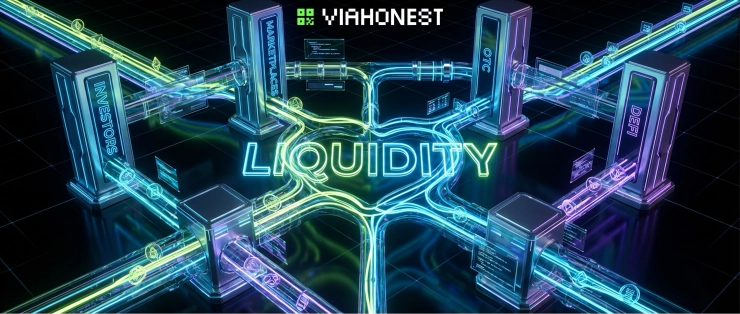
Most tokenized RWA projects don't fail at issuance — they stall because nobody can exit. Secondary market liquidity is the bottleneck that decides whether tokenized assets become a real asset class or remain illiquid digital certificates.
Liquidity determines whether holders can efficiently enter and exit positions, whether institutional desks can operate at scale, and whether capital markets trust the underlying infrastructure enough to allocate meaningful volume. In other words, tokenization alone does not create a market — secondary trading does.
That's why modern RWA marketplaces need a liquidity stack (institutional venues, OTC execution, AMMs, and hybrid pools). ViaHonest is building exactly this multi-layered approach so issuers and investors can access both retail on-chain flow and institutional-grade execution without sacrificing transparency or compliance.
Liquidity Models and Trading Frameworks in the Secondary RWA Market
How the RWA Secondary Market Is Structured
A functional rwa secondary market follows a multi-step lifecycle:
- Primary tokenization — An issuer creates a digital representation of a realworld asset (e.g., credit, real estate, equipment, invoices, treasuries).
- Issuance and distribution — Tokens are allocated to initial buyers via offerings, sales, or institutional placements.
- Listing and verification — Assets are added to marketplaces or regulated systems for secondary availability.
- Secondary trading and settlement — Investors freely trade positions, providing liquidity and price transparency.
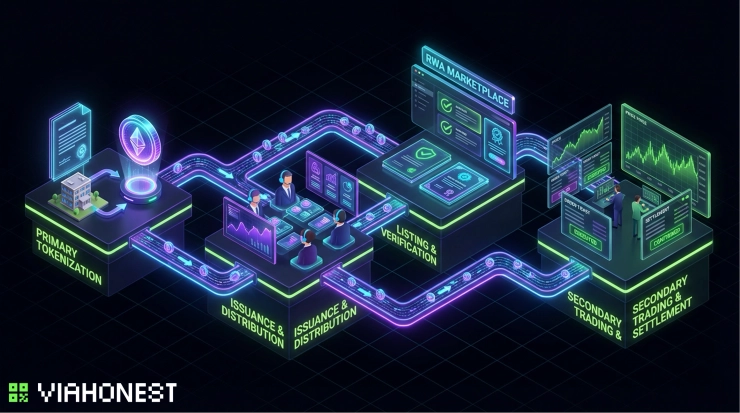
Each phase requires infrastructure capable of supporting compliance, provenance, and market access. The diversity of RWA structures — incomeproducing assets, credit portfolios, fractional real estate, revenue-sharing deals — means the secondary market must support multiple liquidity models.
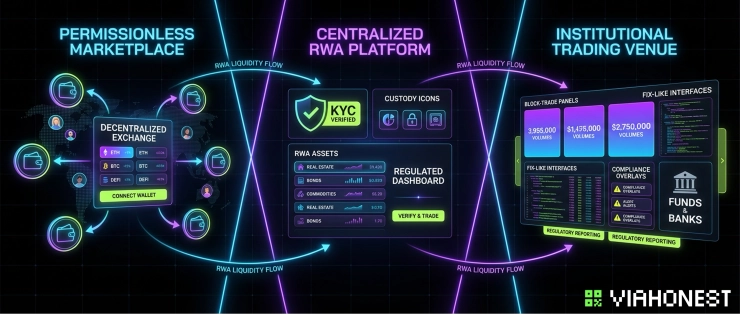
Permissionless Marketplaces
Open marketplaces allow decentralized trading of tokenized assets, giving users global access, instant settlement, and transparent order flows. These platforms often use automated tools, wallet-based identity, and standardized token models to support broad participation. Permissionless systems democratize liquidity, particularly for retail and on-chain native users seeking exposure to yield-bearing RWAs.
Centralized RWA Platforms
Centralized platforms, typically operating under regulatory oversight, offer listing, custody, KYC, and broker-dealer mechanisms. Their advantage lies in trust: investors expect rigorous due diligence and standardized reporting. Liquidity here is driven by curated inventories and institutional-grade execution tools.
Institutional Trading Venues
Regulated ATSs, digital asset exchanges, and specialized institutional desks serve funds, banks, and credit originators. These venues enforce compliance frameworks, handle large block trades, and support integration with traditional financial infrastructure. For portfolio managers and allocators, institutional venues provide reliability, settlement security, and access to audited issuers.
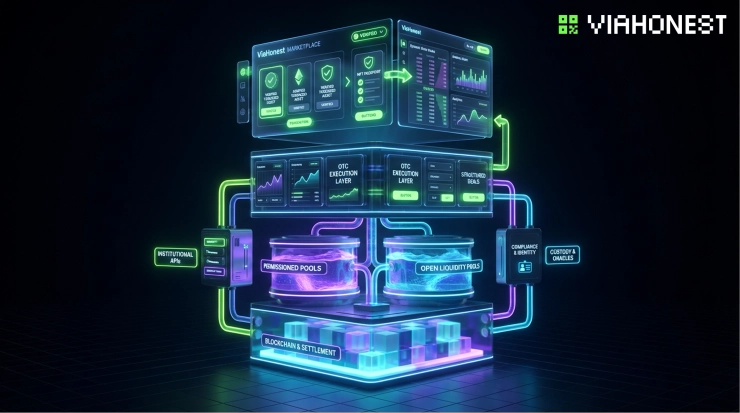
ViaHonest provides a unified liquidity stack: OTC execution, permissioned access flows, and pool-based secondary liquidity — built to support compliant secondary trading for tokenized assets.
If you're launching RWAs or sourcing secondary liquidity, connect with ViaHonest to discuss onboarding and trading access.
Order Books, Auctions, and AMM Models
Secondary trading relies on different market-making mechanisms:
- Order-book systems allow buyers and sellers to set bids and asks, ideal for assets with predictable demand.
- Auction mechanisms — batch auctions or dutch auctions — establish fair pricing for newly listed or infrequently traded assets.
- AMM frameworks introduce algorithmic pricing, enabling continuous liquidity even when counterparties are not present.
AMM-based liquidity is gaining traction in tokenized markets due to guaranteed execution and transparent pricing structures. Hybrid systems increasingly merge order books with AMM depth to support both institutional block trades and on-chain retail flows.
OTC Trading and Liquidity Pools
The Strategic Role of OTC RWA Transactions
Over-the-counter markets play a crucial role in real-world asset tokenization, especially as institutional participants enter the space with larger mandates, risk controls, and bespoke requirements. Unlike open marketplace trading, otc rwa transactions give participants the ability to negotiate directly, structure deals with precision, and execute large allocations without introducing price slippage or signaling intentions to the broader market.
For example, ViaHonest's OTC execution tooling is designed for larger allocations where order books and AMMs can't handle size without impact — e.g., five-figure+ (such as $50k+) notional deals, depending on the asset type and participant requirements. The goal is simple: negotiate size and terms privately, then settle with an auditable on-chain trail — without signaling intentions to the broader market.
OTC executions typically support:
- Large block trades where moving the order to a marketplace order book could meaningfully shift the price.
- Institutional credit transfers, including loan participations, revenue-backed obligations, and asset-backed financing.
- Private credit transactions involving multi-lender structures, waterfall payment rights, or specific covenant packages.
- Portfolio rebalancing at scale, enabling funds to transfer whole pools of tokenized assets without fragmenting liquidity.
- Custom settlement terms, such as delayed settlement, multi-stage delivery, escrow conditions, or integration with off-chain legal contracts.
For many asset managers, OTC channels offer familiarity — they resemble private placements, loan assignments, and bilateral credit structuring that institutions already use in traditional markets. Tokenization adds automation, faster settlement, and a cryptographically verifiable audit trail, but the core mechanics of negotiated execution remain intact.
How OTC Infrastructure Works in Tokenized Markets
Modern OTC infrastructure for RWAs includes:
- Matching engines that connect buyers and sellers seeking specific exposures.
- Encrypted negotiation interfaces for discussing price, size, and terms without broadcasting information across the network.
- Programmable settlement workflows, where smart contracts enforce delivery-versus-payment, collateralization, or rights transfer.
- Identity and compliance layers, ensuring that only qualified, KYC-verified participants can engage in certain categories of OTC transactions.
- Integration with custodians and legal frameworks, enabling token settlement to align with real-world enforceable claims.
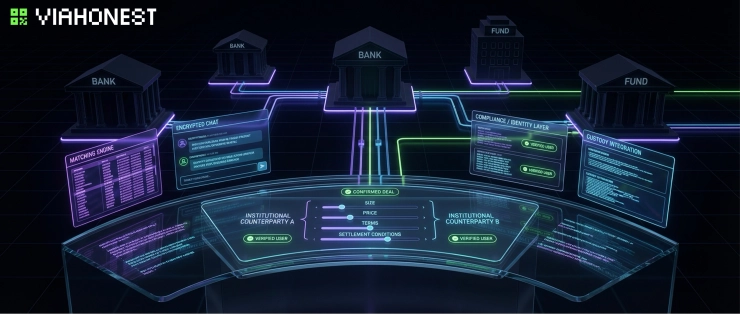
OTC markets serve as the backbone for institutional adoption because they allow large, complex, or sensitive transactions to occur efficiently and with minimal market impact.
Liquidity Pools: The Engine of Continuous Secondary Trading
While OTC handles negotiated, large-scale deals, liquidity pools provide the opposite: continuous, always-on, automated liquidity for day-to-day secondary trading. These pools are the core infrastructure of on-chain capital markets, making tokenized assets tradable even when direct counterparties are not present.
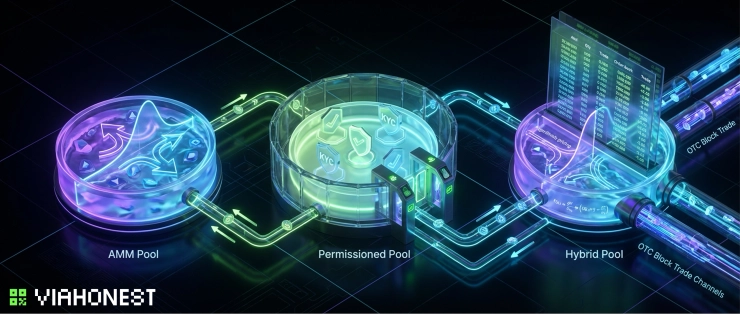
There are three primary liquidity pool models relevant to tokenized RWAs:
1. AMM Liquidity Pools
Automated Market Makers (AMMs) rely on mathematical pricing formulas — typically variants of the constant product or hybrid curves — to quote bid/ask prices on-chain. They enable users to swap tokens directly with the pool's reserves rather than with other traders.
For tokenized assets, AMMs offer:
- Guaranteed execution regardless of market demand at that moment
- Transparent pricing rules, visible and verifiable by anyone.
- Efficient small-to-medium trade sizes, ideal for retail and mid-sized institutional flows.
- A neutral liquidity provider structure, where LPs earn fees without acting as manual market makers.
For RWAs specifically, AMM designs often require modifications to accommodate price oracles, valuation anchors, and compliance restrictions, but the fundamental benefit remains the same: 24/7 liquidity.
2. Permissioned Liquidity Pools
Regulation typically mandates that only qualified or verified participants can trade certain categories of tokenized assets. Permissioned pools solve this by combining automated pricing mechanics with participant whitelisting.
Benefits include:
- Controlled liquidity environments, aligning with jurisdictional requirements.
- KYC/AML screening embedded directly into smart contracts.
- Safeguards against unauthorized flows, crucial for regulated credit, real estate, or institutional-grade RWAs.
- The ability to attract institutional LPs, who require compliant, risk-managed environments.
These pools blend the openness of on-chain settlement with compliance rigor — allowing institutions to provide liquidity confidently.
3. Hybrid Liquidity Pools
Hybrid models combine AMM pricing with order-book depth or OTC functionality. They are particularly valuable for RWAs, where both automated liquidity and negotiated block trades must coexist.
Platforms like ViaHonest implement this exact model to bridge the gap between retail AMM liquidity and institutional block trades — so smaller flows can clear continuously on-chain, while larger allocations execute through negotiated or order-book depth without breaking price discovery.
Hybrid pools may include:
- Dynamic pricing that adjusts using oracle-based NAV or valuation feeds
- Institutional market-making overlays, providing depth beyond what AMM curves can offer
- Off-chain settlement instructions, integrated into smart contracts
- Liquidity segments dedicated to retail vs institutional flows
This model ensures that tokenized assets enjoy both continuous execution and the ability to handle large, structured transactions.
How DeFi Liquidity Enhances RWA Trading
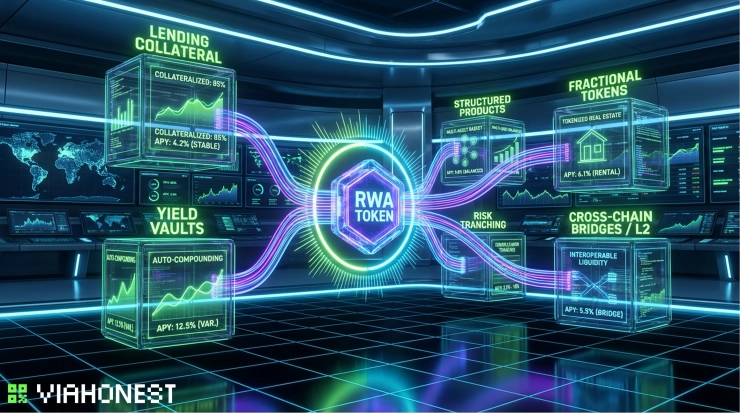
As tokenized RWAs deepen their integration with decentralized finance ecosystems, defi liquidity dramatically extends the utility and tradability of these assets. When RWAs plug into DeFi rails, they can be:
- Used as collateral in lending markets
- Deposited into yield strategies, vaults, or structured products
- Integrated with risk tranching systems
- Fractionalized into liquid micro-positions
- Routed across bridges or L2 networks for cheaper/faster settlement
This composability is a major advantage over traditional markets, creating liquidity synergies and new product categories. It also broadens the investor base by enabling on-chain users to interact with tokenized assets using familiar DeFi primitives.
Benefits for Investors and Market Participants
By combining OTC infrastructure with automated liquidity pools, the tokenized RWA ecosystem offers a spectrum of execution options:
- Speed — instant on-chain settlement for AMM trades; faster structured closings for OTC deals.
- Transparency — pools and settlement contracts provide auditable on-chain data.
- Tighter spreads — AMM curves and competition between LPs compress trading costs.
- Reduced market impact — OTC channels prevent slippage for large trades.
- Customizable execution paths — investors choose between automated liquidity, negotiated terms, or hybrid flows.
Together, OTC systems and liquidity pools form the dual engine of sustainable secondary markets. They ensure that no matter the trade size, regulatory constraints, or asset type, liquidity is always accessible across multiple channels.
The Role of Marketplaces in Supporting Secondary Trading
Marketplace Liquidity as the Core of the Ecosystem
The ability to list, verify, and trade tokenized assets depends heavily on marketplace infrastructure. Marketplace liquidity ensures that once an asset is tokenized, there is a venue where buyers and sellers can efficiently interact.
Marketplaces also bring:
- standardized deal workflows
- transparent audit trails
- real-time data on pricing and settlement
- regulatory-grade compliance layers
- integration with custodians, oracles, and identity services
Without functional marketplaces, the RWA sector would face fragmentation and inconsistent access to liquidity.
How RWA Marketplaces Provide Transparency and Trust
Modern RWA marketplaces go beyond listing — offering provenance tracking, asset verification, documentation storage, issuer disclosures, and transaction analytics. They help investors evaluate risk and ensure that secondary trades reflect the true performance and status of underlying assets.
ViaHonest: Building a Transparent and Sustainable Secondary Market
ViaHonest enhances secondary RWA liquidity through a comprehensive on-chain trading ecosystem designed for both retail and institutional participants.
Key features include:
- NFT passports — immutable identity records tied to each tokenized asset, ensuring traceability and authenticity.
- Verifiable ownership history — blockchain-based records that confirm provenance and reduce counterparty risk.
- On-chain listing and delisting mechanisms — allowing issuers and sellers to manage inventory transparently.
- Integrated OTC execution tools — enabling structured or large-scale transactions without disrupting open-market pricing.
- Institutional B2B connectivity — APIs and compliance-ready modules that allow funds, brokers, and lenders to plug into the ViaHonest ecosystem.
- Permissioned liquidity pools — enabling regulated participants to provide or access liquidity while maintaining compliance obligations.
Together, these tools create the conditions for a vibrant secondary market, where asset quality is verified and liquidity is consistently available.
ViaHonest also lowers the barrier to participation: sellers can onboard and list tokenized assets, while buyers gain seamless access to vetted opportunities. Market participants — whether individuals or institutions — can register on ViaHonest to access the full liquidity infrastructure and begin trading RWAs through a unified marketplace experience.
RWA as a New Liquid Asset Category
Liquidity is the foundational element that transforms RWA tokenization from a promising technology into a functioning financial market. With scalable tokenized assets liquidity, real-world asset tokens become easier to trade, easier to price, and easier to integrate into investment strategies. Robust secondary markets unlock institutional demand, create reliable exit pathways, and align digital assets with familiar market mechanics.
As tokenized markets mature, RWAs are rapidly emerging as a new class of liquid assets — combining the transparency of blockchain with the stability of traditional instruments. The rwa secondary market is evolving into a sophisticated ecosystem where investors can access yield, hedge risk, and manage portfolios with unprecedented efficiency.
Platforms like ViaHonest are central to this transformation. By delivering verified provenance, secure trading infrastructure, and deep liquidity access — including OTC channels, institutional integrations, and compliance-ready pools — ViaHonest is helping to build a transparent, sustainable, and efficient secondary market for the next generation of tokenized finance.
In this environment, on-chain mechanisms and traditional financial frameworks converge, giving rise to a new marketplace where liquidity is not just an advantage — it is the defining characteristic of the future of RWAs.