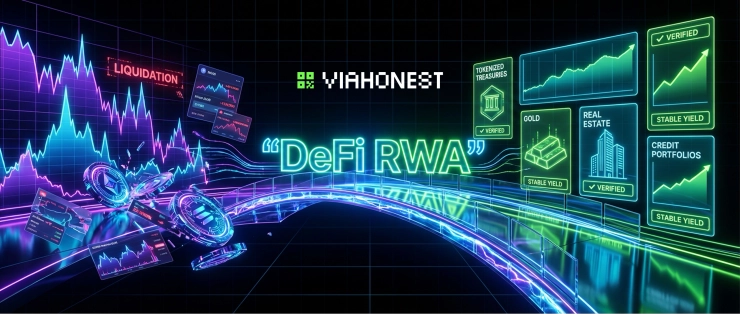
When decentralized finance first gained traction, it operated as a crypto-native economy fueled almost entirely by digital tokens and speculative liquidity. But as the industry expanded, the downside of volatility became impossible to ignore. The liquidity crunches and market shocks that followed 2022 exposed a core weakness: without stable, verifiable asset backing, the entire ecosystem remained fragile.
This realization pushed builders, institutions, and investors toward a new foundation — one powered by defi rwa, where real-world assets supply the transparency, resilience, and predictability that early DeFi lacked. As asset tokenization matured, U.S. Treasury bills, gold, real estate, and other tangible stores of value became programmable on-chain, creating the first truly sustainable layer of decentralized finance.
This shift only works when tokenized assets are verifiable, auditable, and built on compliant rails. Platforms like ViaHonest provide the missing layer — asset onboarding, provenance tracking, and transparent "asset passports" — so DeFi protocols and investors can rely on RWA collateral without treating tokenization as a black box.
Why DeFi Needs Real-World Assets: Solving Volatility for Investors
DeFi's early growth was driven by innovation, but its instability was tied to one recurring problem: volatility without real value backing. Tokenizing realworld assets solves this by connecting on-chain liquidity to off-chain income streams that do not depend on market hype or speculative token emissions.
For example, U.S. investors can now access tokenized treasuries, corporate bonds, or income-producing real estate directly on-chain, bringing durable returns and institutional-grade credibility to decentralized markets. Traditional treasuries offer yield shaped by macroeconomic factors rather than short-term crypto cycles, while real estate produces rental income that remains steady even during market turbulence.
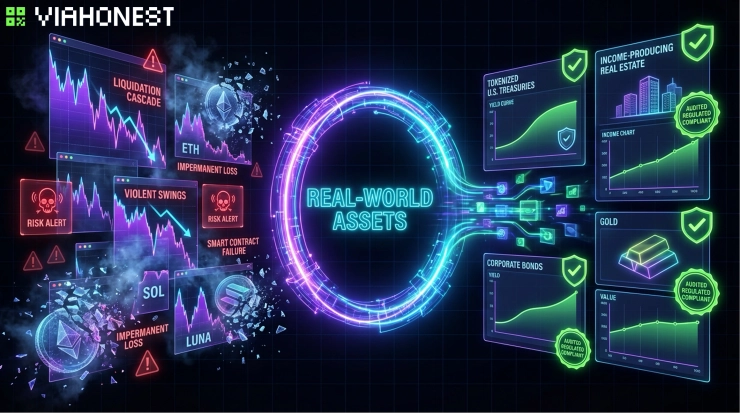
By incorporating regulated, audited, and legally recognized financial products, RWA-backed DeFi introduces transparency, stability, and predictable liquidity — three pillars essential for scaling decentralized finance into a mainstream financial layer.
How RWA Yield Works: Real Income Powering On-Chain Returns
The transition from speculative token incentives to real-economy income is one of the most transformative shifts happening within decentralized finance. While early yield farming relied on inflationary token emissions and rapid capital cycling, RWA-driven strategies are grounded in tangible cash flows, making them both more predictable and more aligned with traditional investment models.
Want to access RWA yield with transparent collateral?
ViaHonest helps investors and DeFi teams source verified tokenized assets (e.g., treasuries, commodities, real estate) with auditable provenance and clear onboarding standards.
Real Sources of Yield
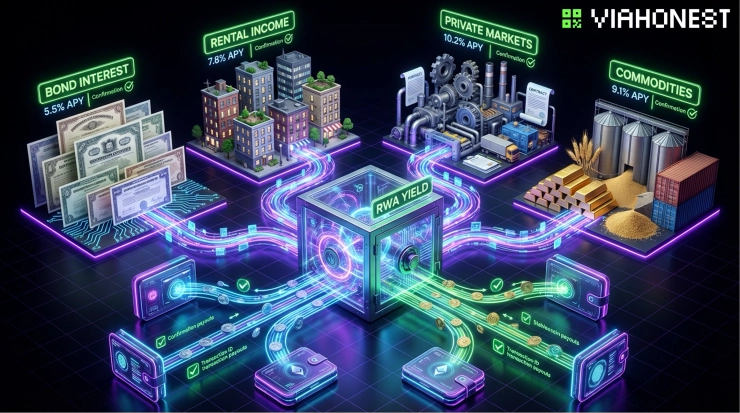
RWA yield generation originates from the same mechanisms that power traditional financial markets — but with blockchain providing programmable transparency and frictionless access. Key income streams include:
1. Bond Interest Payments
Tokenized versions of T-bills, investment-grade corporate bonds, and short-term notes deliver yield through government-backed or corporate interest rates. Because these instruments are legally recognized and historically low risk, they produce consistent returns that DeFi protocols can reliably distribute.
2. Rental Income From Real Estate
Commercial and residential properties typically provide stable monthly cash flows. When tokenized, these income streams can be fractionally distributed among holders, allowing users to earn proportional yield without directly buying or managing property. DeFi integrations automate payouts and reporting.
3. Revenue From Private Market Investments
Fractional shares in private credit, infrastructure, renewable energy projects, or equipment leasing can generate steady yield that is independent of crypto market cycles. Through tokenization, these typically illiquid markets become accessible in smaller, more manageable allocations.
4. Commodity-Linked Income
Assets like tokenized gold, agricultural products, or industrial metals can participate in financing activities, storage yield, or structured products that generate return streams for holders.
How DeFi Distributes RWA Yield
Once assets are tokenized, DeFi protocols can distribute revenue using automated smart contracts that track ownership, calculate proportional payouts, and route the real-world income on-chain. This eliminates several layers of middlemen found in traditional finance — from custodians to transfer agents — reducing both cost and latency.
Depending on the model, yield may be:
- Auto-compounded into more tokens
- Streamed continuously via real-time distribution protocols
- Paid periodically (daily, weekly, or monthly) based on the underlying asset's income schedule
- Converted into stablecoins before distribution for reduced volatility
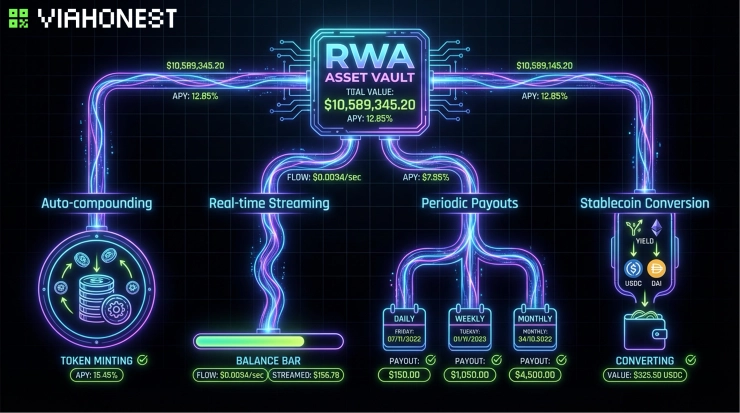
This methodology transforms traditional yield — typically slow, opaque, and accessible only through financial institutions — into something programmable, transparent, and globally available.
RWA Yield vs. Traditional DeFi Yield
The distinction between these two forms of income is fundamental:
| Early DeFi Yield | RWA-Backed Yield |
|---|---|
| Based on token emissions or liquidity incentives | Based on real cash flows from bonds, real estate, or other assets |
| Often unsustainable and hyper-volatile | Sustainable, regulated, and economically grounded |
| Dependent on crypto cycles and speculation | Largely independent from market sentiment |
| High APYs but high risk | Moderate APYs but significantly lower systemic risk |
In short, RWA yield replaces speculative incentives with economic fundamentals, not only lowering risk but providing the long-term stability needed for institutional adoption.
The Impact on Liquidity and Capital Efficiency
Because RWA yield is predictable, DeFi protocols can more accurately model collateral values, lending rates, and risk parameters. Stable cash flows reduce liquidations, increase borrowing capacity, and improve liquidity conditions across the ecosystem.
Additionally, fractional ownership allows users to diversify across multiple yield-bearing assets — something prohibitively expensive in traditional markets. This further spreads risk and enhances overall market resilience.
Collateralization: How Real Assets Secure the DeFi Economy
Collateral mechanics are at the center of lending, stablecoins, and liquidity protocols. Historically, these systems relied on volatile tokens like ETH or governance tokens, which increased liquidation risk during downturns.
Tokenized real assets change this dynamic. RWA collateral can include treasury-backed tokens, tokenized gold, or real estate shares, all of which hold value through off-chain legal claims. These assets can secure loans, stabilize stablecoins, and reduce systemic risk.
A key innovation is the rise of on-chain treasuries, where audited and tokenized government bonds are held within smart contracts that maintain realtime transparency. Smart contracts automate collateral ratios, risk management, and interest distribution — removing the manual, opaque processes seen in traditional finance.
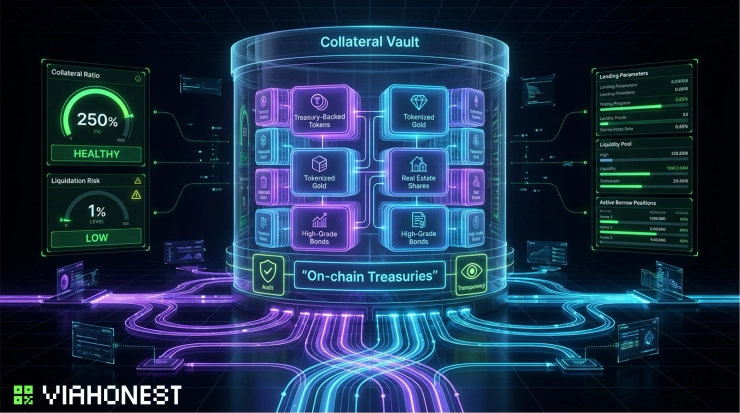
The result is a lending environment that mimics the reliability of traditional collateral (like T-bills or property) but with blockchain-level liquidity and auditability.
Risks and Advantages for Participants
As RWA-backed DeFi expands, the participant landscape now includes not only crypto-native users but also traditional investors, institutions, asset managers, and fintech issuers. To understand the true value proposition of this emerging financial layer, it's essential to evaluate both the advantages and the associated risks in a balanced and comprehensive way.
Advantages: Stability, Predictability, and Institutional-Grade Infrastructure
1. Stability Rooted in Tangible Value
One of the strongest advantages of RWA integrations is the shift from purely algorithmic or speculative value toward assets with real-world backing. U.S. Treasury bills, high-grade bonds, and income-generating real estate bring decades — sometimes centuries — of historical performance data and risk modeling.
For participants, this means that tokens represent claims on assets that maintain value through macroeconomic cycles rather than relying on crypto sentiment.
2. Predictable Income Streams
RWA yield models rely on cash flows backed by legal enforceability, such as interest payments, rental revenue, or contractual receivables. This creates:
- More consistent APYs
- Enhanced risk-adjusted returns
- Better portfolio planning for both retail and institutional users
In contrast to volatile DeFi rewards that can collapse unexpectedly, RWA yields follow established financial structures, giving investors a clearer understanding of expected returns.
3. Attracting Institutional Liquidity
Institutional capital requires:
- Clear asset provenance
- Auditable structures
- Regulatory frameworks
- Custody solutions
- Transparent risk models
RWA ecosystems check these boxes, unlocking participation from banks, private credit funds, wealth managers, and corporate issuers. This institutional involvement increases liquidity and lowers volatility across DeFi markets — benefiting all participants.
4. Improved Capital Efficiency Through High-Quality Collateral
RWA assets generally have lower risk profiles and higher stability, which allows them to be used as superior collateral within lending markets. Overcollateralization ratios can be optimized, liquidations become less frequent, and collateral valuation becomes more predictable. This strengthens the entire DeFi credit market and creates new opportunities for borrowing, hedging, and leveraging.
5. Greater Transparency Through On-Chain Auditability
Every transaction, claim, and collateral movement is logged on-chain. With platforms like ViaHonest enabling asset passports, onboarding audits, and realtime provenance tracking, users can verify collateral legitimacy without relying solely on intermediaries.
Transparency increases trust — and trust accelerates adoption.
Risks: Regulatory, Technical, and Liquidity Considerations
1. Regulatory Uncertainty
Tokenized assets often fall into categories governed by securities, banking, or commodities regulation. In the U.S., compliance frameworks for on-chain securities are still evolving. Risks include:
- Potential reclassification of asset types
- Changes to licensing requirements
- Limitations on who can buy or issue certain tokenized products
- Additional reporting or custody rules
Projects mitigate this by working with licensed custodians, adopting transfer restricted tokens, and integrating KYC/AML procedures where needed.
2. Dependence on Oracles and Off-Chain Data Feeds
RWA valuation requires accurate real-world pricing data. If an oracle provides incorrect, delayed, or manipulated inputs, DeFi protocols may:
- Miscalculate collateral ratios
- Trigger unnecessary liquidations
- Underestimate or overestimate risk
To reduce oracle risk, leading platforms use multi-source pricing, cryptographic proofs, and oracle redundancy architectures.
3. Liquidity Constraints and Redemption Friction
While blockchain assets trade instantly, the underlying real-world assets may not. Redeeming tokenized bonds or real estate shares may involve:
- Settlement delays
- Custodian processing times
- Bank transfers
- Compliance checks
This creates a liquidity mismatch, where the token is more liquid than the real asset backing it. Platforms typically manage this through liquidity buffers, secondary markets, and transparent redemption rules.
4. Counterparty and Custodial Risk
Even though smart contracts automate much of the on-chain logic, the physical asset still requires a trusted custodian. Risks include:
- Custodian insolvency
- Mismanagement
- Legal disputes
- Fraud or improper asset handling
To address this, reputable RWA platforms partner with regulated custodians, use bankruptcy-remote structures, and provide verifiable reporting that proves the existence and ownership of the underlying assets.
5. Smart Contract and Protocol Risk
Despite conservative design, smart contracts remain vulnerable to bugs or exploits. If an RWA protocol is compromised, attackers could manipulate yield streams or collateral balances. Risk mitigation practices include:
- Multi-layer security audits
- Insurance coverage
- Real-time monitoring systems
- Bug bounty programs
- Modular and upgradeable contract architectures
Balancing Risk and Reward
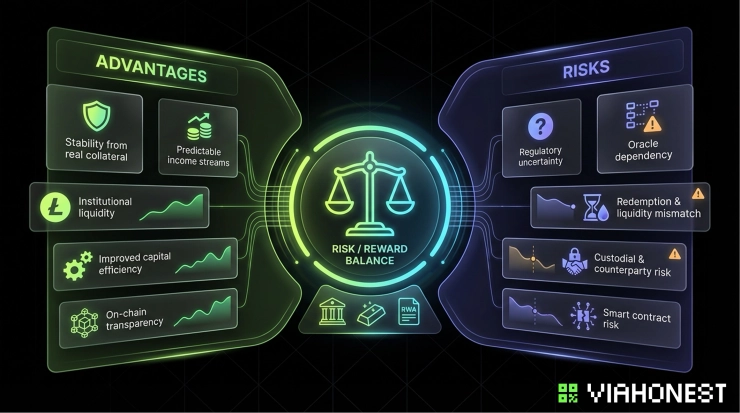
The RWA-driven model delivers a new equilibrium for decentralized finance:
- More safety than legacy DeFi
- More openness and programmability than traditional finance
- Better yield stability and transparency than many conventional investment vehicles
Participants — retail or institutional — gain exposure to asset-backed systems that combine regulatory-grade protections with the efficiency and automation of blockchain technology.
How to Start Investing in Tokenized Assets with ViaHonest
Getting started with tokenized assets is less about "finding yield" and more about verifying what actually backs the token. ViaHonest is built for that: it standardizes asset onboarding, provides auditable provenance, and attaches a transparent asset passport so investors can evaluate collateral before taking risk.
A simple path to begin:
- Register to access curated tokenized assets and view verification details (passport, provenance, structure).
- Review the asset's backing and transparency signals (issuer info, ownership trail, collateral proofs, redemption rules).
- Allocate to the asset directly or via DeFi integrations (lending pools, stablecoin reserves, liquidity markets) where applicable.
- Track performance and risk in one place-on-chain activity plus the real-world audit trail.
For DeFi protocols, this means instant access to validated on-chain treasuries and collateral that can be integrated into lending pools, stablecoin reserves, liquidity markets, or automated yield strategies.
For individual users, ViaHonest offers two roles:
- Buyers and investors can register to access curated, verified tokenized assets and portfolio tools.
- Sellers or asset issuers can onboard real assets, create tokenized structures, and supply collateral to DeFi systems.
The entire flow — from issuance to proof-of-ownership — is transparent, enabling a level of trust that traditional asset platforms struggle to provide. As adoption grows, platforms like ViaHonest will form the connective tissue between institutional finance and the decentralized economy.
DeFi as the New Layer of Traditional Finance
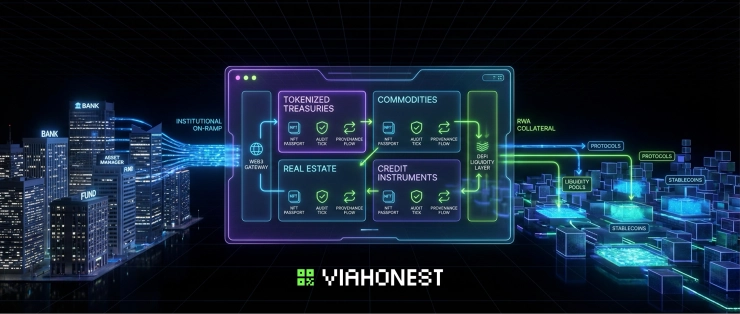
Real-world assets are rewriting the narrative around decentralized finance. Instead of functioning as a speculative niche dependent on unstable liquidity, DeFi is becoming a resilient financial layer powered by assets that the traditional economy already trusts. Tokenization merges the programmability of blockchain with the security and predictability of real collateral, forming a foundation capable of supporting mass adoption.
As this convergence expands, defi rwa ecosystems will continue to mature, offering reliable returns, diversified portfolios, compliant asset structures, and global access. The institutions joining this movement aren't just experimenting — they're building the core infrastructure for the next generation of financial markets.
Platforms like ViaHonest are not just connecting blockchains and assets — they're connecting the future of finance itself.