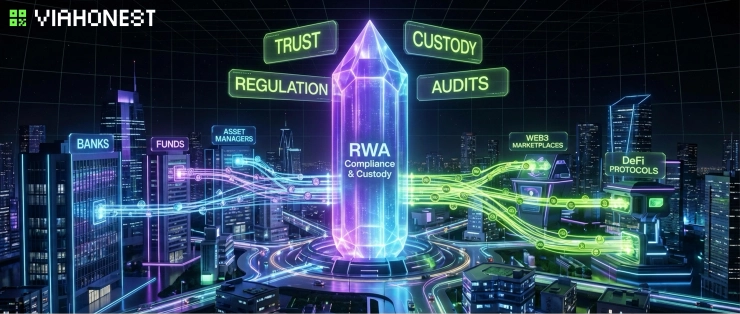
The tokenization of real-world assets (RWA) is entering a period of rapid expansion, promising improved liquidity, streamlined settlement, and broader investor access. Yet despite this momentum, the industry faces a fundamental challenge: without verifiable processes and enforceable regulatory standards, institutional capital simply will not enter the market. This is why rwa compliance has become the defining factor for scale.
For traditional investors, trust is not a "nice-to-have" — it is the bedrock of capital markets. In the context of RWA, trust is earned through legal clarity, verifiable asset backing, transparent custody, and rigorous investor protections. When RWA platforms align on these pillars, they transform tokenization from an experimental technology into a credible, regulated financial infrastructure.
This article explores why compliance, custody, and transparent verification mechanisms are critical for the RWA ecosystem, and how ViaHonest has built a compliance-first architecture that supports both institutional and retail users. For sellers and issuers seeking a trusted place to bring on-chain assets — and for buyers looking for safe access to tokenized opportunities — ViaHonest offers an environment engineered for confidence.
Why Regulation Is Critical for RWA
RWA Operate at the Intersection of Blockchain and Traditional Capital Markets
Tokenized real-world assets are unique because they sit precisely where two highly regulated worlds meet: blockchain infrastructure and traditional capital markets. Unlike typical crypto assets — many of which derive value solely from protocol economics — RWAs represent legal claims to off-chain assets. These assets may include real estate, corporate debt, trade finance instruments, physical collectibles, commodities, or revenue streams.
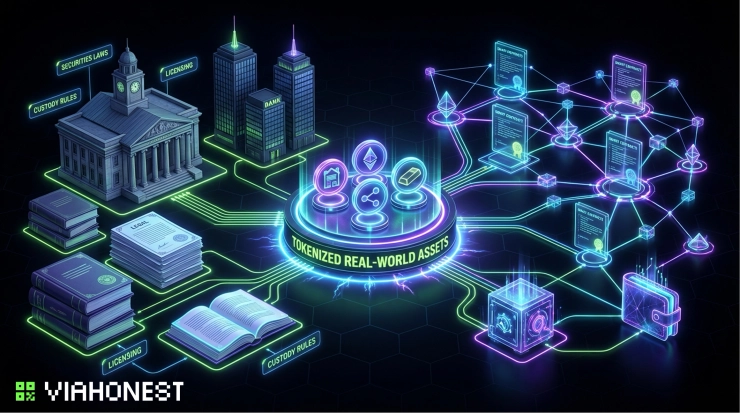
Because of this direct linkage to regulated financial instruments, RWA platforms must satisfy both on-chain regulatory expectations (digital asset compliance, custody rules, transfer restrictions) and off-chain requirements (securities laws, licensing, reporting, and consumer protection frameworks). Failing at either layer undermines the integrity of the entire product.
Put simply: tokenization does not eliminate regulation — it inherits it.
How Securities Laws Apply to Tokenized Assets
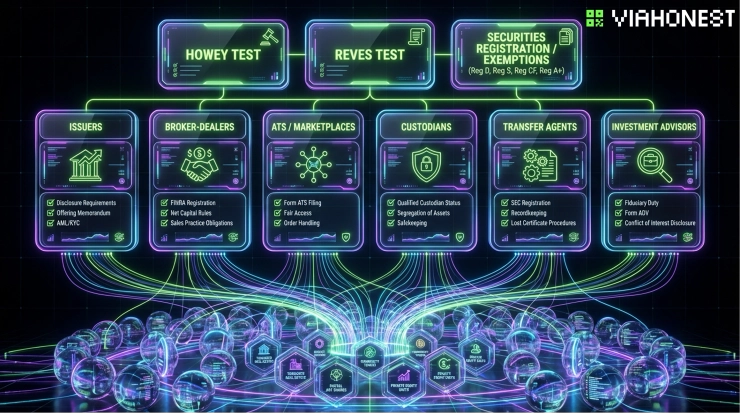
In the United States, the SEC relies on tools such as the Howey Test, the Reves Test, and a substantial body of case law to assess whether an asset qualifies as a security. Many RWA tokens — particularly those tied to incomeproducing assets — fall within these definitions.
This classification has major implications:
- Issuance must follow securities registration or exemptions (Reg D, Reg S, Reg CF, Reg A+)
- Platforms may need broker-dealer or ATS (Alternative Trading System) licensing
- Transfers must comply with investor eligibility rules
- Reporting and disclosures must mirror traditional financial standards
Even tokenized real estate or commodity-backed assets can fall under securities rules if investor expectations involve profit sharing or managerial efforts.
Therefore, RWA platforms must work with legal specialists to structure offerings that meet SEC, CFTC, and state-level requirements.
The Role of Licensing, Market Infrastructure Rules, and Investor Protections
In traditional finance, every market actor must operate within a defined regulatory perimeter:
- Issuers must disclose risks and maintain accurate records
- Broker-dealers must ensure best execution and protect customer assets
- Custodians must meet strict capital and cybersecurity standards
- Transfer agents must maintain accurate ownership ledgers
- Investment advisors must follow fiduciary and suitability rules
RWA platforms that replicate these roles on-chain must adopt similar controls. This includes establishing clear lines of responsibility — something many early crypto projects lacked.
Bringing assets on-chain without the accompanying operational, reporting, and governance requirements risks creating "shadow markets" prone to fraud, mispricing, and manipulation.
Why Lack of Compliance Is an Existential Threat to RWA
Without regulatory alignment, tokenized markets face serious challenges:
1. Legal Uncertainty Around Ownership
If a regulator determines that a tokenized asset was issued improperly, ownership rights could be invalidated. Investors may end up holding tokens that have no enforceable claims to the underlying asset.
2. Consumer Protection Risks
The absence of standardized disclosures allows misrepresentation, inadequate risk communication, or outright fraud.
3. Market Structure Instability
Without mandated audits, operational controls, or capital requirements, platforms operate with systemic fragility — one failure undermines market trust across the sector.
4. Barriers to Institutional Participation
Banks, funds, and large asset managers cannot touch assets that lack compliance frameworks. Even if they see the economic value of tokenization, they are legally barred from engaging with non-compliant platforms.
5. Enforcement Actions and Forced Shutdowns
Multiple crypto companies have faced injunctions, fines, or operational freezes due to unregistered securities offerings or improper custody practices. RWA platforms operating without compliance risk the same fate.
Regulation Is Not a Constraint — It Is the Only Path to Scale
The market for tokenized RWAs is projected to reach trillions of dollars, but only if it aligns with regulatory expectations. Institutions are more than willing to adopt blockchain-based market infrastructure — but not at the cost of violating securities laws, custody requirements, or investor protection standards.
Compliance is what transforms tokenization from a "crypto experiment" into a robust extension of global financial markets.
In other words:
Regulation is not an obstacle to RWA growth. It is the permission structure that unlocks real institutional scale.
Custodial Models and the Importance of Qualified Custodians
Comparing Custody Approaches
In the RWA ecosystem, custody extends far beyond holding tokens. It represents the safeguarding of legal ownership, rights, and claims to underlying assets.
There are three primary approaches:
1. Self-custody
- Users hold their own private keys.
- Offers autonomy but introduces operational and legal risks.
2. Custodial wallets
- A platform manages keys on behalf of users.
- Suitable for retail but not sufficient for regulated institutional flows.
3. Institutional custody
- Qualified custodians manage both crypto tokens and off-chain asset documentation.
- Essential for compliance with US regulations.
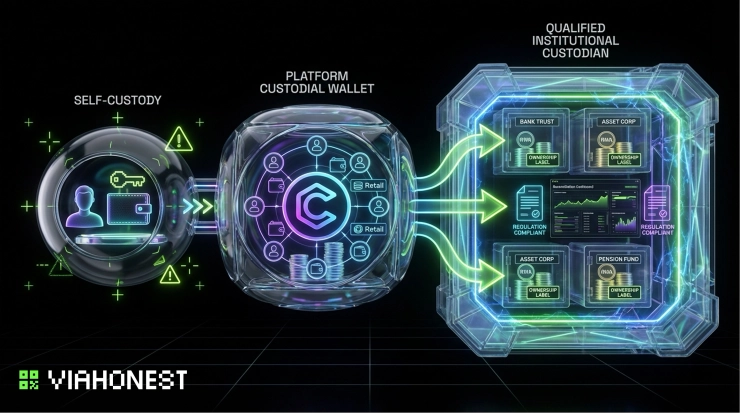
It is this third category — institutional custody, often referred to as rwa custody — that underpins institutional adoption.
The Role of Qualified Custodians
In the US, the SEC and FINRA impose strict oversight on financial intermediaries that hold customer assets. Qualified custodians include regulated banks, trust companies, and registered broker-dealers meeting defined capital and operational standards.
Their responsibilities include:
- Maintaining secure, segregated customer accounts
- Recording beneficial ownership
- Ensuring reconciliation between on-chain and off-chain records
- Providing audit-ready documentation
- Implementing cybersecurity and disaster-recovery protections
Unlike typical crypto custody, RWA custody requires safeguarding not only tokens but also legal rights, transfer agreements, promissory notes, and other documentation establishing claims to real-world assets.
Institutional investors will not engage without qualified custodians ensuring that every token corresponds to a legally enforceable claim.
The Role of KYC/AML and Smart-Contract Audits
Why KYC/AML Is a Protecting Force — Not a Restriction
Some crypto participants see identity verification as friction. But within tokenized asset markets, kyc aml crypto processes are essential safeguards.
Because real-world assets fall under regulated financial frameworks, KYC/AML is not merely a regulatory checkbox — it is protection for all stakeholders.
For RWA platforms, KYC/AML covers:
- Issuer screening: verifying the entity offering the asset
- Investor verification: ensuring accreditation or eligibility
- Counterparty monitoring: preventing bad actors from entering the ecosystem
- Ongoing compliance: sanction screening, risk scoring, and unexpected activity review
Institutional investors cannot legally interact with platforms that lack robust KYC/AML infrastructure. For retail users, these processes reduce fraud, improve platform integrity, and provide peace of mind.
Smart-Contract Audits and Cybersecurity
While regulatory compliance governs the legal layer, security audits govern the technological one.
Audited smart contracts provide:
- Verification of logic and transfer rules
- Protection against exploits and vulnerabilities
- Independent assurance that token behavior matches asset documentation
- Increased transparency for all participants
Independent engineers, cybersecurity specialists, and code reviewers ensure that the on-chain representation of assets behaves consistently and securely.
Transparent, auditable code is a powerful trust signal for both institutional and retail participants.
Proof-of-Reserves and Independent Attestations
What Proof-of-Reserves Means for RWA
In a market where tokens represent real-world assets, verifying that those assets actually exist is essential. This is where proof of reserves becomes indispensable.
Proof-of-reserves mechanisms demonstrate that every token in circulation is fully backed by an underlying asset, cash flow, or collateral.
How Independent Auditors Validate RWA
Independent verification is typically performed by rwa auditors, who evaluate:
- The existence and condition of physical assets
- The validity of legal documentation
- On-chain/off-chain reconciliation
- Compliant asset valuation methodologies
Verification models include:
- Merkle-tree attestations: cryptographically verifiable proofs of backing
- Periodic auditing reports: delivered by licensed accounting or attestation firms
- Issuer attestations: confirming ongoing asset management and custody practices
Why Proof-of-Reserves Is a Non-Negotiable Standard
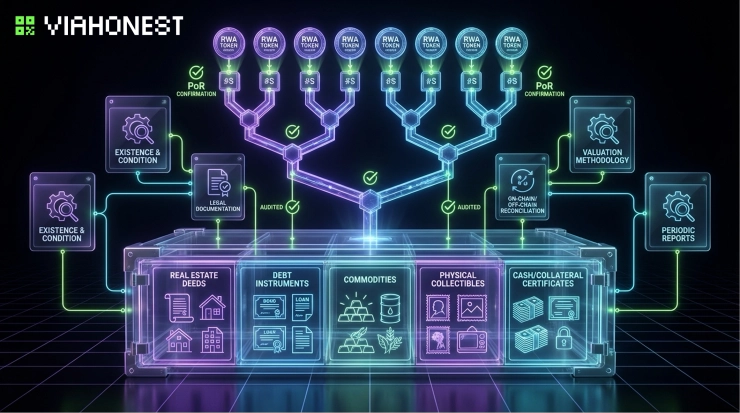
Without reserves verification, tokenized markets risk falling into the same pitfalls that contributed to several major crypto failures. PoR, by contrast, transforms tokenization into a regulated, institution-ready product.
The message to investors is clear: the assets are real, accounted for, audited, and available to redeem.
How ViaHonest Implements a Compliance-First Approach
A Platform Engineered for Trust
ViaHonest has designed its infrastructure around regulatory clarity, auditability, and transparent ownership verification. The platform safeguards both buyers and sellers through multilayered controls that ensure every tokenized asset entering the marketplace is legally sound, verifiable, and trustworthy.
Key elements of the ViaHonest architecture include:
1. Full Regulatory Integration
ViaHonest performs legal due diligence on every issuer and every asset before tokenization. Only assets that meet regulatory and documentation standards are listed, creating a curated marketplace rather than an open, unverified catalog.
2. Secure Custody and Verified Ownership
ViaHonest partners with regulated custody providers, ensuring that every token reflects enforceable ownership rights — an essential requirement for institutional participation.
3. NFT Passports and Provenance
Each asset receives a digital provenance passport — an NFT that contains immutable evidence of ownership history, audits, and asset metadata. This brings unprecedented transparency to secondary markets.
4. Embedded KYC/AML Processes
Both issuers and investors undergo streamlined KYC/AML verification, creating a protected environment where all parties are validated.
5. Independent Audits and Proof-of-Assets
ViaHonest collaborates with independent auditors who authenticate the existence and validity of underlying assets before tokens are issued
An Invitation to a Trusted Marketplace
For sellers and issuers, ViaHonest provides a reliable, compliant environment to onboard assets — allowing them to tokenize with confidence and reach a global digital investor base. For buyers, the platform offers a curated selection of verified assets backed by transparent documentation and institutional-grade security.
Users can register today on ViaHonest to participate in a marketplace built on trust, verification, and regulatory strength.
How Trust Creates Liquidity
The bridge between traditional finance and Web3 will not be built through novel technology alone — it requires the rigorous compliance infrastructure that institutions expect. From rwa compliance to custody, auditing, identity verification, and transparent reserve validation, trust is the engine that powers adoption.
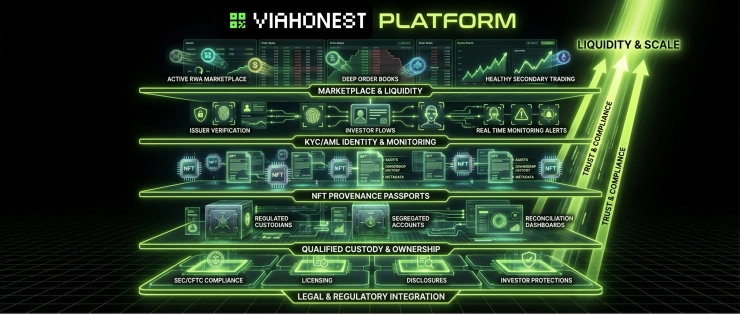
When investors believe in the legal clarity, security, and asset backing of tokenized products, adoption accelerates. And with greater adoption comes deeper liquidity, healthier secondary markets, and broader access to capital.
Platforms like ViaHonest are shaping this future by embedding trust at every layer of the tokenization process. Through compliance-first architecture, independent validation, and secure custody, they are creating the foundation for a safer, more transparent, and more liquid on-chain economy — one that unlocks the full potential of real-world assets for investors worldwide.