
The global demand for handmade products continues to grow as buyers increasingly value authenticity, craftsmanship, and personal stories behind the items they purchase. In an era of mass production, handmade goods stand out by offering uniqueness, quality, and emotional connection. This shift in consumer behavior has made it easier than ever to sell handmade crafts online and reach customers far beyond local markets or craft fairs.
However, with opportunity comes complexity. Makers often struggle to choose the right platform: some marketplaces offer massive traffic but high competition, others provide control but require marketing skills and trust-building from scratch. Fees, audience fit, credibility, and long-term growth all play a role in deciding where and how to sell.
So what is the best place to sell handmade items today? The short answer is: it depends on your product, your audience, and the level of control and transparency you want. In this guide, we'll break down the most effective platforms, explain their strengths and limitations, and show how combining marketplaces with transparent selling tools can unlock sustainable growth for handmade sellers.
The Harsh Reality of Selling Handmade Online
Selling handmade products online is harder than most platforms admit. The moment a product starts gaining traction, it becomes visible not only to buyers — but to factories, resellers, and copycats.
On large marketplaces, successful handmade designs are often copied within weeks. Mass producers can recreate the look, cut costs dramatically, and flood search results with cheaper alternatives. Competing with factories that operate at a fraction of your production cost is nearly impossible.
This puts handmade sellers in a constant defensive position. Even when your work is original, buyers often can't tell the difference between a true handmade item and a factory-made copy listed as "handcrafted." Price pressure increases, margins shrink, and trust erodes.
In this environment, craftsmanship alone is not enough. Without a way to prove originality and authenticity, handmade sellers are forced to compete on price — a battle they are structurally designed to lose.
What Matters When Choosing a Websites to Sell Handmade Items

Choosing where to sell handmade products online is not just a technical decision — it's a strategic one that influences how your work is perceived, priced, and trusted. Many makers initially focus on platform popularity or traffic size, but long-term success comes from a more balanced evaluation that considers audience quality, economic conditions, credibility, and growth potential together.
When these elements work in harmony, the platform becomes not just a sales channel, but a foundation for a sustainable handmade business.
Target Audience and Niche Alignment
Every platform attracts a different type of buyer, and not all buyers value handmade products in the same way. Some audiences are primarily price-oriented, while others are actively seeking originality, craftsmanship, and personal stories.
The closer a platform's audience aligns with your niche, the less effort you need to explain your value. Buyers who already appreciate handmade goods are more receptive to custom work, limited editions, and higher price points. This is especially important for categories like furniture, decor, and art, where the story behind the item often matters as much as the object itself.

A smaller but well-aligned audience frequently outperforms a massive, unfocused one. Platforms that allow sellers to clearly communicate authenticity, materials, and process naturally create better conditions for meaningful buyer engagement and stronger conversions.
Fees, Commissions, and Control Over Pricing
Fees are an unavoidable part of selling online, but their structure varies widely. Listing fees, commissions, payment processing costs, and optional promotion tools can quietly erode margins if they are not considered as a whole.
Beyond costs, pricing control is critical. Handmade sellers thrive when they can price based on craftsmanship, time, and material quality rather than being pushed into price competition. Platforms that encourage constant discounting or algorithm-driven price comparison make it harder to communicate real value.

When sellers can clearly justify pricing through detailed descriptions and proof of authenticity, buyers become less price-sensitive. This creates room for healthier margins and allows handmade work to be positioned as a premium alternative rather than a commodity.
Trust, Credibility, and Seller Protection
Trust sits at the core of every successful handmade sale. Buyers want reassurance that an item is truly handmade, accurately described, and sold by a responsible creator. Without that confidence, hesitation grows — especially for higher-priced or custom products.
Some platforms rely primarily on reviews, which take time to accumulate and are difficult for new sellers. Others offer limited seller protection or unclear dispute resolution processes, creating risk on both sides of the transaction.
To bridge this gap, many sellers now strengthen their presence with independent transparency tools. Integrating ViaHonest allows creators to attach verified product histories, creation details, and authenticity records directly to their listings. Instead of asking buyers to trust a claim, sellers can support it with clear, structured proof.
This added layer of credibility is especially powerful on competitive platforms, where multiple listings may look similar at first glance. Transparency becomes a differentiator that builds confidence and shortens the decision-making process.
Ease of Use and Customization
For most handmade sellers — especially solo makers — time and energy are limited resources. A platform should simplify daily operations, from uploading products to managing orders and communicating with customers.
At the same time, ease of use should not come at the expense of identity. Handmade businesses grow stronger when sellers can present their work in a way that reflects their values and style. The ability to customize product pages, highlight process details, and tell a cohesive story plays a major role in building recognition and loyalty.
When platform templates are restrictive, sellers often compensate by adding external layers that enrich their listings. Using ViaHonest alongside an existing platform makes it possible to add depth and transparency without changing sales workflows or forcing buyers to navigate away from the purchase experience.
Scalability and Long-Term Growth
The right platform should support not only your current stage, but also where you want your business to go. What works for a handful of sales may not work when demand increases or when you introduce higher-value or limited-edition items.
Sustainable growth depends on repeat buyers, brand recognition, and trust that compounds over time. Platforms that support transparency and direct buyer relationships tend to scale more naturally, because customers understand the value behind the product — not just the price.
For sellers with long-term ambitions, registering products early on ViaHonest creates a durable foundation of credibility. As your catalog grows, each verified item strengthens your reputation. For buyers, this consistency builds confidence, making repeat purchases feel safe and intuitive.
In summary, the best platform is not simply where you can list handmade products — it's where your craftsmanship is understood, trusted, and fairly valued. When reach, pricing control, usability, and trust work together, handmade sellers can compete on authenticity instead of price. Combining established platforms with transparency tools like ViaHonest allows creators to grow with clarity, confidence, and long-term stability.
Websites to Sell Handmade Items
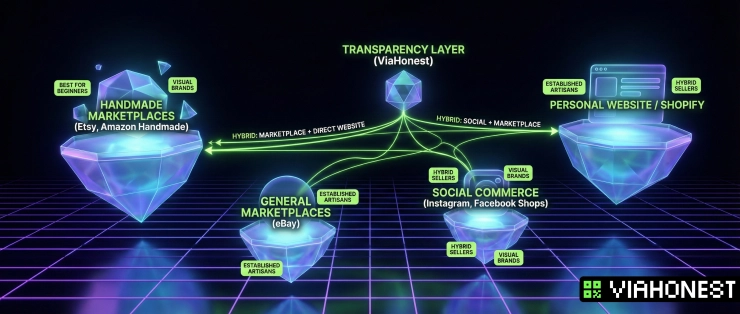
Most websites to sell handmade items promise reach, visibility, and sales. What they rarely address is what happens after your product starts selling. Once demand appears, handmade sellers face a reality where originality is easy to copy and difficult to defend.
Below is an honest look at the main platforms — not through marketing claims, but through the risks handmade sellers actually face.
Handmade-Focused Marketplaces
Etsy
Etsy is often seen as the default place to sell handmade items. In practice, it is one of the most competitive environments for creators.
When a handmade product performs well, similar listings often appear quickly. Many of them are not handmade at all but mass-produced replicas designed to look authentic. Factories can reproduce visual designs at a fraction of the cost, making price competition nearly impossible for individual makers.
The platform offers limited ways to prove originality beyond descriptions and photos. For buyers, this makes it difficult to distinguish a true handmade item from a factory-made imitation. For sellers, it means competing not on craftsmanship, but on price.
Amazon Handmade
Amazon Handmade places handmade sellers inside a system built for scale and efficiency, not for protecting creative ideas.
Once a product concept is validated, it becomes visible to a global supply chain capable of reproducing it faster and cheaper. Even when sellers follow Handmade requirements, buyers still compare listings primarily by price and delivery speed.
Amazon verifies sellers, but not individual products. There is no persistent way to show that a specific item is the original version rather than one of many visually similar alternatives available elsewhere.
General Online Marketplaces to Sell Online
eBay
eBay allows handmade listings, but it does not separate them meaningfully from mass-produced goods.
Handmade products often appear next to imported items and reseller listings that look nearly identical. In such an environment, authenticity claims carry little weight unless supported by external proof.
For sellers, this creates constant pressure to justify higher prices without having tools to clearly demonstrate originality or uniqueness.
Personal Websites and Direct Sales
Shopify
Running a personal website gives sellers full control over branding and pricing, but control does not equal trust.
When buyers encounter a standalone handmade store, they must decide whether to believe the seller's claims without any independent verification. This hesitation becomes stronger when similar-looking products are available on large marketplaces for less.
Without an external trust layer, originality remains a statement — not a fact buyers can verify.
Social Media and Social Commerce
Social platforms allow handmade sellers to show process, personality, and behind-the-scenes work. This visibility helps build connection, but it also exposes successful ideas.
When a product gains traction on social media, it often attracts copycats just as quickly. Viral attention accelerates imitation, while offering no structural way to prove which version is original.
Social commerce drives discovery, but it does not protect value.
The Structural Problem All Platforms Share
Despite their differences, these platforms have one thing in common: they do not protect originality.
If your handmade item sells well, it will be copied.
If it is copied, competitors with lower production costs will undercut you.
If buyers cannot verify authenticity, price becomes the deciding factor.
This is the reality handmade sellers face across marketplaces, websites, and social platforms.
Where ViaHonest Changes the Equation
ViaHonest does not compete with these platforms — it fixes what they lack.
By registering handmade items on ViaHonest, sellers attach a digital passport to each physical product using QR codes, NFC tags, or unique serial numbers. This passport verifies that a specific item exists and belongs to a real creator.
This creates a clear distinction between originals and copies:
- Factory replicas from AliExpress cannot replicate the passport
- Buyers can verify authenticity before purchasing
- Originals remain identifiable over time
- Bloggers and reviewers gain proof to feature
- Handmade products become verifiable assets, not just listings
ViaHonest works alongside Etsy, Amazon Handmade, Shopify, eBay, and social platforms — but it solves the one problem none of them address: proof of originality.
The Real Choice Handmade Sellers Face
The question is no longer where to sell handmade items.
It is how to protect them.
Marketplaces provide exposure.
Websites provide control.
Social media provides attention.
ViaHonest provides proof — and proof is the only advantage that cannot be mass-produced.
Selling Handmade Through Specialized Transparency Platforms
How to Prove Your Handmade Product Is Not a Copy
The core problem for handmade sellers today is not visibility — it's proof. Buyers cannot reliably tell whether an item is genuinely handmade or a mass-produced replica listed under the same keywords.
This is where ViaHonest changes the rules. Instead of relying on claims, photos, or platform trust alone, sellers can attach a verifiable digital passport to each handmade item.
ViaHonest allows creators to register individual products using unique identifiers such as QR codes, NFC tags, or serial numbers. Each item receives its own record that confirms originality, creation details, and ownership history.
Unlike factory copies from platforms like AliExpress, these registered items cannot be duplicated or faked at scale. The passport proves that a specific physical product exists and belongs to a verified creator.
For buyers, this removes doubt. For sellers, it creates a competitive advantage that price-based competitors cannot replicate.
| Without Verification | With ViaHonest |
|---|---|
| Buyers rely on seller claims | Buyers see verified proof |
| Easy to copy visually | Impossible to clone digitally |
| Competes directly with cheap factories | Competes on authenticity |
| Price pressure from mass producers | Premium justified by proof |
| No protection after first sale | Identity preserved over time |
| Originals and copies look the same | Originals are distinguishable |
Why Trust and Transparency Matter in Handmade
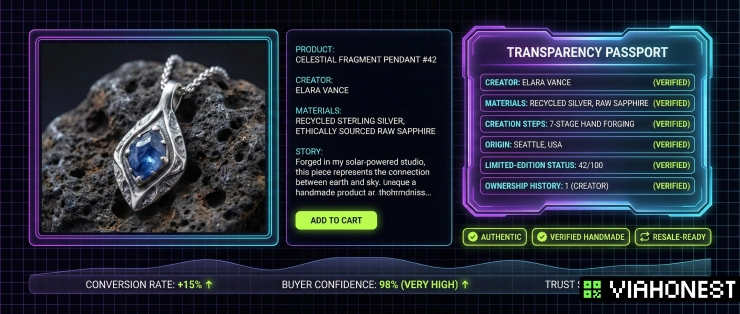
Handmade buyers are not just purchasing a product — they're buying a story, values, and authenticity. As prices rise, so does the need for proof: where it was made, who made it, and how.
Proof of Authenticity and Creation History
Modern buyers increasingly expect transparency. Showing materials, production steps, and origin builds confidence and justifies premium pricing.
This is where ViaHonest fits naturally into the handmade ecosystem. ViaHonest allows sellers to attach verified product histories, creation details, and authenticity records to their items. For sellers, this means higher trust and better conversion. For buyers, it means confidence and clarity.
Used alongside marketplaces or personal websites, ViaHonest acts as a trust layer rather than a replacement — making it easier for customers to choose handmade over mass-produced alternatives.
How to Choose the Best Platform for Your Handmade Products
Product Type
- Furniture and decor benefit from detailed storytelling and transparency.
- Jewelry and accessories thrive on visual platforms.
- Art and collectibles often need authenticity verification.
Production Volume and Price Range
Limited-edition or high-ticket items perform better where trust and differentiation matter more than speed. High-volume sellers may prioritize reach and logistics.
Shipping and Logistics
International shipping, fragile goods, or custom orders all affect platform choice. Some marketplaces simplify logistics, while others leave full control to the seller.
How to Increase Handmade Sales Online
Verification also creates content and hype. Bloggers, collectors, and reviewers are far more likely to feature handmade products when originality can be proven. A registered item with a digital passport gives creators something to show, explain, and stand behind — turning authenticity into a marketing asset rather than a silent assumption.
High-Quality Photos and Storytelling
Professional images combined with real stories dramatically improve engagement. Show process, materials, and scale to help buyers visualize ownership.

Detailed Descriptions and Honest Pricing
Clear descriptions reduce returns and build trust. Pricing should reflect craftsmanship, time, and materials — buyers who value handmade understand fair pricing.
Reputation and Trust Signals
Reviews, guarantees, and transparency tools all contribute to credibility. Sellers who openly show how products are made convert better and retain customers longer.
This is why integrating transparency — through platforms like ViaHonest — often leads to higher conversion rates and repeat purchases.
Conclusion
Choosing where to sell handmade items is no longer just about traffic or fees. In a market flooded with copies and factory-made replicas, the real challenge is proving that your work is original. Without verification, handmade sellers are forced into price competition with producers who will always be cheaper.
For long-term growth, successful sellers combine reach with credibility. Tools that support transparency and authenticity help handmade businesses stand out in crowded markets. Whether you're a seller looking to showcase your craftsmanship or a buyer seeking confidence in what you purchase, solutions like ViaHonest create safer, more trustworthy handmade commerce.
In a market full of copies, transparency is not optional. Platforms like ViaHonest give handmade sellers the only scalable way to prove originality, protect value, and turn craftsmanship into sustainable profit.