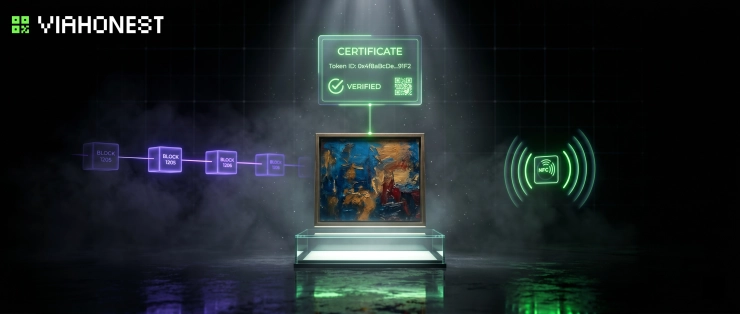
A web3 marketplace for physical goods is an online marketplace where multiple sellers offer real, shippable products, but each item can also carry a digital identity linked to a blockchain. In practice, that identity may be tied to a unique token certificate, a QR code, or an NFC tag, so a buyer can verify origin, ownership history, and authenticity more easily than on a standard product page.
That is the key difference from a regular marketplace. A traditional marketplace primarily connects buyers and sellers, manages listings, and processes transactions. A Web3 model can keep those familiar marketplace functions, while adding wallets, smart contracts, and product-level provenance that is not limited to one platform's internal database. In Web3 systems, wallets can also work like reusable logins across apps, and smart contracts can automatically enforce certain rules once conditions are met.
This is why the idea is useful beyond digital collectibles. An NFT can represent a specific real-world item, not just a digital image, and that matters in product categories where authenticity, scarcity, provenance, or resale value influence the buying decision. In other words, an nft marketplace for real items is not about replacing the product with a token; it is about pairing the product with a verifiable digital record that travels with the item. This is often described as a phygital NFT model, where the physical product and its digital proof work together as one connected ownership experience.
What a marketplace actually does
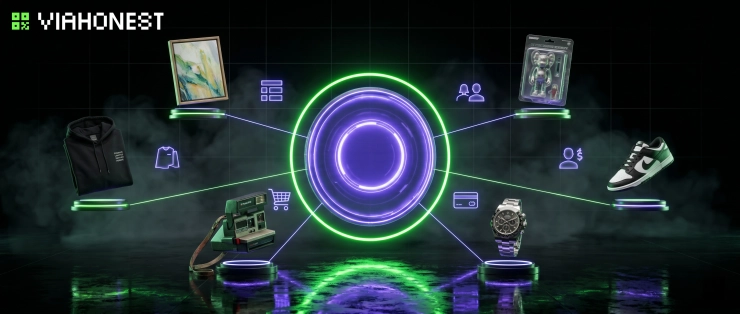
At its core, a marketplace is an intermediary. It brings supply and demand together, standardises listings, and simplifies checkout and transaction processing for many different sellers and buyers at once. That is why platforms such as Amazon, Etsy, and eBay became so powerful: they reduce friction in discovery, comparison, and purchase.
A normal marketplace is usually very good at four things: aggregating listings, attracting traffic, processing payments, and creating standardised buyer-seller flows. But most trust signals on those platforms still sit inside the platform itself: seller ratings, reviews, product pages, dispute resolution rules, and internal transaction records. If a listing disappears, a seller is banned, or a buyer wants item-level provenance outside that platform, the proof is often fragmented or inaccessible.
That is where a real product marketplace built with Web3 tools tries to extend the model. It does not replace ecommerce fundamentals like merchandising, logistics, pricing, or customer service. Instead, it adds a new trust layer around the product itself.
How Web2 and Web3 ecommerce marketplaces differ
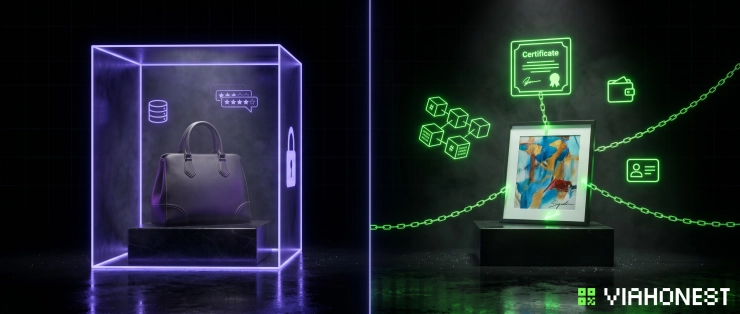
The easiest way to understand the difference is this: Web2 marketplaces centralise trust in the platform, while Web3 marketplaces can distribute part of that trust into public records, programmable rules, and portable credentials tied to the item and the holder. That does not make Web3 automatically better in every category, but it can make authenticity-sensitive categories more legible and easier to verify.
| Dimension | Typical Web2 marketplace | Web3 marketplace for physical goods |
|---|---|---|
| Core role | Connects buyers and sellers and streamlines transactions. | Does the same, but can also attach blockchain-based identity and rules to each item. |
| Where trust lives | Mostly in platform reviews, policies, and internal databases. | Can extend trust to item-level records, wallet-linked ownership, and publicly verifiable token data. |
| Ownership history | Often visible only inside the marketplace workflow, if at all. | Can be recorded as a transferable, time-stamped history tied to the item. |
| Resale economics | Secondary sales often bypass the original creator or brand. | Smart contracts can automate creator royalties on resale within the marketplace flow. |
| Access and onboarding | Familiar and simple, but closed to the platform's own identity and payment stack. | Can combine familiar sign-up with wallets, crypto-based sales, and portable accounts, though UX can still be more demanding. |
| Biggest limitation | Trust often depends on seller promises, platform rules, and central moderation. | Better provenance, but still requires product tagging, strong issuance controls, and good user experience. |
It is also worth noting that product-level digital identity is moving into the mainstream, not staying in crypto-only niches. The European Union has positioned the Digital Product Passport as a key part of its ecodesign framework, describing it as a digital identity card for products that stores and shares important lifecycle data and is accessible electronically to consumers, businesses, and authorities. That is not the same thing as an NFT marketplace, but it points in the same direction: physical products are increasingly expected to carry richer digital records.
The commercial takeaway is simple. Not every mug, T-shirt, or commodity product needs a blockchain certificate. But categories with counterfeiting risk, premium positioning, limited drops, creator-led demand, or meaningful resale are much closer to the sweet spot.
How it works
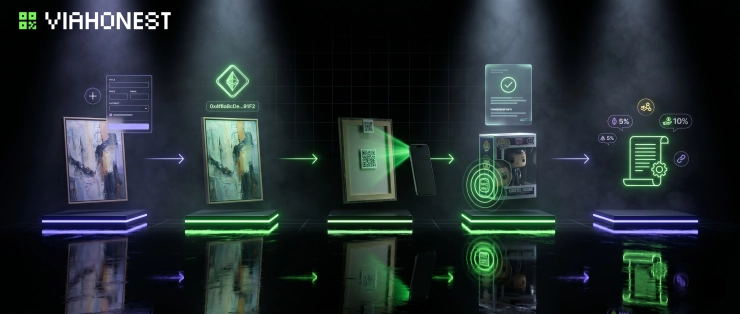
A marketplace with this model usually starts with a standard ecommerce action: the seller creates a listing. The difference is that the marketplace can also mint or issue a unique digital certificate for that specific item. ViaHonest says that when a seller publishes a product, the platform mints a unique token certificate linked to the physical object and a QR code; when the buyer scans the tag, they can see an on-chain page confirming authenticity and ownership.
That certificate layer matters because an NFT is uniquely identifiable, which makes it useful for blockchain product authentication when the certificate is issued and linked to the real item correctly. Official Ethereum educational materials note that NFTs are individually unique and can represent a specific real-world or digital item, with ownership that is publicly verifiable. In commerce terms, that means the digital record can function like a persistent certificate rather than a screenshot, PDF, or seller promise that is easy to lose or forge.
The scan layer is what makes the model usable in real life. Standards work from GS1 explains that a single web-enabled barcode can direct users to an intelligent product identity in the cloud, help ensure authenticity more easily, and track a product from manufacture to consumer purchase. It can work through visible 2D carriers such as QR codes, and it can also be combined with NFC.
That is where an NFC Forum style tap-to-verify layer becomes useful, especially for NFC product authentication in categories where buyers need quick proof that the item and its certificate are connected. The organisation notes that NFC is a short-range wireless technology used in billions of devices, and its materials explicitly describe authenticity verification as a common use case. It also notes that legitimacy data can be added to NFC tags, and that NFC can serve as a key enabler for product passport systems. In an nfc marketplace workflow, the buyer does not need to type serial numbers or trust packaging alone; they can tap the product or packaging and inspect the linked record.
Then comes the transaction and ownership layer. Smart contracts are simply programs that run on a blockchain and automatically enforce rules written into code. A marketplace can use those rules for certificate issuance, transfer events, and royalty logic. ViaHonest says sellers can set a royalty percentage and receive automatic payouts each time an item is resold through the platform flow. It also says the platform supports crypto-based sales, escrow-style protection, and funds released after confirmation.
What this creates is a marketplace with authenticity certificate features baked into the item lifecycle rather than added as an afterthought. A buyer can inspect the record before purchase, use it after purchase, and carry it into resale if the marketplace supports a secondary market. That is the practical meaning of physical goods with blockchain certificate systems: not "crypto for crypto's sake," but a more durable proof layer around the product.
There is one important caveat. Blockchain does not authenticate a physical product by magic. Smart contracts cannot access real-world facts on their own, and product truth still depends on how carefully the certificate is issued, how securely the QR or NFC link is attached, and how well fulfilment and returns are managed in the real world. The strongest implementations combine on-chain records with disciplined off-chain operations.
Why this matters for sellers
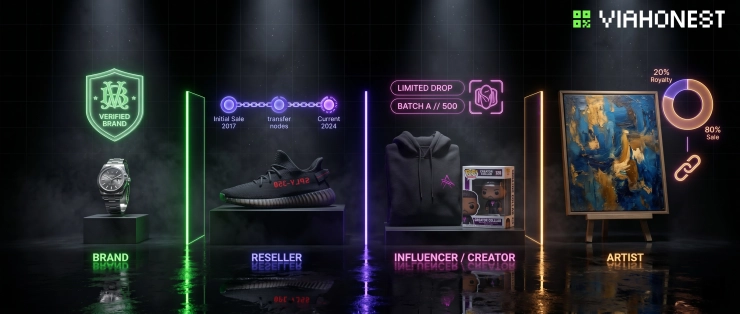
For sellers, the pain is rarely "I wish my catalogue were on a blockchain." The real pain is simpler: copied products, weak trust, expensive middle layers, zero participation in resale, and too much friction between audience and checkout, A marketplace like this can also help sellers sell physical products with crypto while keeping the buying experience connected to authenticity, ownership, and resale proof. ViaHonest's public seller-facing materials are built around exactly those complaints, describing common seller frustration with noisy platforms, copied work, limited exclusivity, and no upside when products are flipped on the secondary market.
Brands
Brands benefit because product authenticity becomes easier to demonstrate at item level. Instead of relying only on packaging, listing copy, and customer service, the brand can attach a digital identity to the product and use scans to reinforce provenance, originality, and post-purchase engagement. That matters in markets where counterfeits damage both margin and reputation.
Resellers
Resellers benefit because provenance and secondary-market confidence become part of the sales story. If a product can be scanned and its history checked, the reseller has a stronger basis for pricing, defending legitimacy, and reducing buyer hesitation. ViaHonest explicitly presents resellers as a core audience and frames authentication, transparent ownership history, and trusted resale as part of the value proposition.
Influencers
Influencers and creator-led businesses benefit because the product itself can carry the creator's identity and drop logic. Limited supply, serialised releases, and resale royalties fit merchandise, exclusive drops, and community-led launches particularly well. ViaHonest's home and seller pages specifically position creators and influencers as users who can launch verified merch, art, collectibles, apparel, and limited drops.
Artists
Artists benefit because provenance and resale economics are often core to the value of the work. A digital certificate tied to a physical piece can support originality claims, while marketplace-level royalty rules can give artists a structured way to share in future value if the work changes hands again. ViaHonest says resale royalties can be set once and then transferred automatically on subsequent sales.
The main seller-side advantages look like this:
- More defensible authenticity. Product claims can be backed by an item-level record instead of screenshots and receipts alone.
- Better resale participation. Smart contracts can automate royalties on secondary sales when the resale happens in the compatible marketplace flow.
- Portable reputation signals. ViaHonest says storefronts, ratings, and reviews are open and portable rather than trapped in a closed profile.
- Lower-friction launch paths. ViaHonest says listing is free, wallets can be auto-generated, and sellers do not need deep technical knowledge just to get started.
- New payment and drop mechanics. Crypto-based sales, limited mint logic, and confirmation-based release of funds can support global and creator-led commerce models.
If your goal is to test the model without building a full ecommerce stack from scratch, the softest next step is not a massive launch. It is one clean, limited listing. ViaHonest's public materials suggest exactly that kind of low-friction entry: start selling, book a free demo, or launch your first drop with a listing flow that auto-generates a wallet and layers in authenticity and royalty mechanics from the beginning.
Why buyers trust this model more
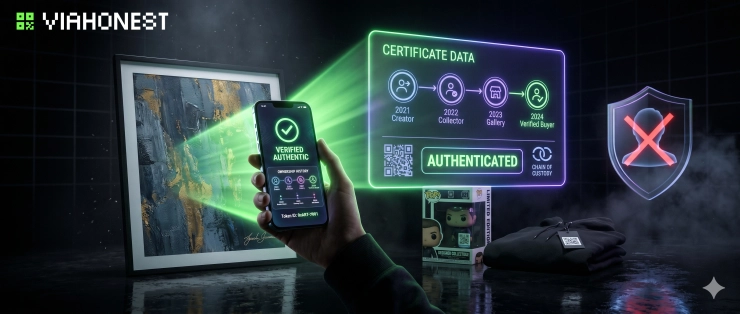
Buyer trust is not a theoretical issue. According to OECD and EUIPO, counterfeit goods accounted for an estimated USD 467 billion in global trade in 2021, and the risk now spans sectors from clothing and footwear to automotive parts, medicines, cosmetics, toys, and food. In that environment, "looks real" is not a serious trust model.
A Web3 product marketplace tries to reduce that uncertainty by giving buyers more than listing photos. They can inspect the product's digital identity, scan a code or tag, and review provenance and ownership signals attached to the item. ViaHonest explicitly frames the buyer value proposition around transparent provenance, secure transactions, informed purchase decisions, and trusted resale.
For buyers, that trust gain usually comes from three upgrades at once. First, the product gets a machine-readable, scannable identity. Second, the ownership and authenticity record can persist beyond a single listing. Third, the same record can help with resale, gifting, collecting, or long-term storage of proof. That is especially useful for art, sneakers, collectibles, limited merch, and other categories where after-purchase trust still matters.
The buyer-side trust advantages are straightforward:
- Independent verification signals. The buyer can scan or tap to inspect a product-linked record rather than relying only on seller text.
- Clearer provenance. Tokenised records can preserve origin and ownership history more systematically than ad hoc screenshots or receipts.
- Better resale confidence. Persistent proof can make future resale easier and more credible.
- More product context. Digital product identity frameworks can carry instructions, sustainability data, conformity information, and other useful metadata, not just proof of authenticity.
There are real trade-offs too, and they matter if you want to explain the model honestly:
- Onboarding still matters. Web3 experiences can introduce extra education and UX friction compared with standard ecommerce.
- The tag-to-item link must be secure. A QR code or NFC tag helps only if issuance and attachment are well controlled.
- Blockchain does not replace fulfilment. Shipping, returns, customer support, and legal rights still need normal commerce operations.
- A certificate is not the whole experience. Buyers still need fair pricing, clear policies, and trust in the seller as well as the record.
How does the authenticity certificate work after resale?
The value of the model is that the certificate can move with the item instead of expiring with the first listing. If the marketplace supports secondary sales, the same token-linked record can continue to document ownership changes and royalty events over time.
Why ViaHonest is a practical example of the model
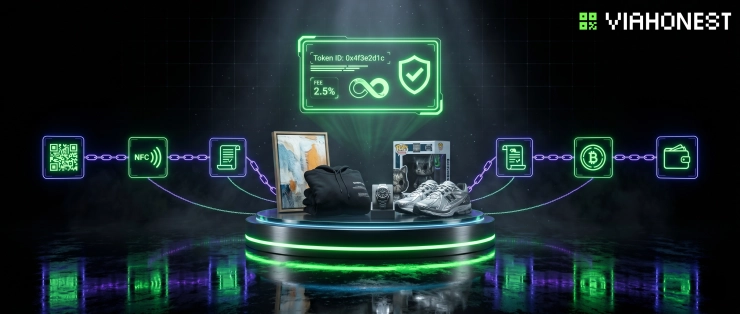
ViaHonest is a practical case because its public materials describe exactly the bridge that many sellers and buyers actually need: verified digital authenticity, QR-linked item identity, secure and transparent transactions, crypto-based sales, resale royalties, and onboarding that does not require users to be deeply technical. It explicitly presents itself as a marketplace for brands, creators, and collectors, and frames the product around trusted resale and provenance for real goods.
For internal linking, the cleanest reader journey is also obvious: move from this article to the Start Selling page if you want to list products, to the About page if you want to understand the trust model, and to related blog guides on launching a new product, selling merchandise, selling art, and sneaker resale if you want category-specific examples. ViaHonest's own site architecture already supports that kind of path across product pages, categories, blog content, and seller case studies.
If you want to move beyond theory and understand how this model performs in practice, the most realistic way is to test it in a controlled scenario rather than treat it as a full launch. On ViaHonest, that can be as simple as creating a single listing and attaching a product-level identity to it. This allows you to see how verification, provenance, and ownership signals actually function inside a real transaction flow, not as abstract concepts. The focus at this stage is not scale, but behaviour: do buyers ask fewer questions, does trust form faster, and does the presence of verifiable proof reduce friction in the decision process. In that context, the platform is not the point of the paragraph, but the environment where the model can be observed and evaluated under real market conditions.
In that sense, a web3 marketplace for physical goods is not a replacement for ecommerce fundamentals. It is a stronger trust layer for categories where authenticity, ownership, and resale actually affect conversion. That is why the model matters now, and why companies like ViaHonest are positioning it as the next step in real-world commerce rather than a niche crypto experiment.
A good article on this topic should not treat Web3 like magic, because it is not. The real point is simpler and more commercial: when the product itself needs stronger proof, better provenance, cleaner resale logic, or richer post-purchase trust, blockchain can become useful for physical commerce rather than distracting from it.
FAQ
Is ViaHonest free to start?
ViaHonest says listing is free and that it charges a flat 2.5% service fee only after a successful sale, with no monthly subscription required.
How do royalties work?
According to ViaHonest's seller materials, the seller sets a royalty percentage once, and then each compatible resale can automatically send that share through a smart contract. That makes royalties part of the marketplace logic rather than a manual side agreement.
What can I sell?
ViaHonest positions the marketplace around verified merch, art, collectibles, apparel, sneakers, and limited drops, and its category pages also highlight physical collectibles and art as core use cases. More broadly, this model fits products where authenticity and provenance influence demand.
Can I sell to U.S. buyers?
ViaHonest describes itself as offering global access across a multi-vendor marketplace, so the model is clearly intended for cross-border participation. In practice, selling to U.S. buyers still depends on normal business factors such as shipping, taxes, category-specific compliance, and your own fulfilment setup.
Do I need my own website?
Not necessarily. One reason marketplaces exist is to reduce launch friction, and ViaHonest's own materials frame the seller flow as a quick-start storefront model rather than a build-your-own-stack requirement. Having your own website can still be valuable later, but it is not a prerequisite for testing demand.
Do buyers need Web3 experience to purchase?
ViaHonest says users do not need technical Web3 knowledge to start, that wallets can be auto-generated during registration, and that account creation can also be done through email/password and social sign-in, in addition to a MetaMask connection. That design choice lowers the barrier for mainstream buyers and sellers.