
If you’re wondering how to launch a new product — or what to consider when launching a new product before investing time and money — here’s the simple answer: prove demand before you scale, translate that demand into a focused go-to-market strategy, make sure your business can fulfil what you promise, and then launch in a way that creates fast learning without damaging trust.
In 2026, “launch day” is rarely the hard part. The harder part is earning attention in a saturated market and converting that attention into repeatable revenue. One signal of this saturation is the growth of digital advertising in the United States: Interactive Advertising Bureau reports internet advertising revenue reached about $258.6B in 2024, up 14.9% year over yea — more brands competing for the same scroll, search, and inbox. At the same time, budgets are not expanding at the same rate: Gartner found average marketing budgets fell to 7.7% of company revenue in 2024 (down from 9.1% in 2023), putting pressure on teams to be sharper, not louder.
The most common first-launch mistake isn’t “bad ads” or “wrong colours.” It’s the absence of a strategy that connects goals, organisational readiness, and constraint — so teams either rush, overbuild, or copy a generic checklist that doesn’t match their reality.
This article gives you a practical plan, the core risks to manage, and tactics to increase your odds of a durable launch. It also shows how modern technolog — especially infrastructure built for verification and automatio — can reduce risk and strengthen customer trust.
What to Consider When Launching a New Product
Before you pick a date, decide what must be true for your launch to succeed. Launch planning frameworks emphasise that goals, readiness, and constraints should shape every tactical decisio — not the other way around.
Key considerations include:
- Validated demand. Post-mortem analysis of failed startups shows “not targeting a market need” is a top failure driver (cited in 42% of cases in one study), so treat demand as a hypothesis you must prove.
- Clear positioning. April Dunford defines positioning as how your product is a leader at delivering something a well-defined set of customers cares abou — context that shapes expectations, competitors, and pricing.
- A go-to-market model that matches your product. A go-to-market (GTM) strategy is typically defined as a comprehensive plan to bring a product to market, including market analysis, target customer definition, pricing, distribution, and sales strategy.
- Organisational launch readiness. Launch readiness extends beyond the product into sales, support, documentation, delivery, and lega — areas that can fail even when the product itself is “done.”
- Trust and authenticity mechanics. OECD estimates counterfeit and pirated goods were about $467B in global trade in 2021, and research by the OECD and the European Union Intellectual Property Office shows e-commerce channels can be misused to distribute counterfeits (often via small parcels).
- Compliance and claims discipline. If you sell physical goods, safety rules and written certification can apply depending on product type. And if you use “Made in USA” marketing claims, the Federal Trade Commission explains that unqualified claims require the “all or virtually all” standard plus substantiation.
- A defendable brand identity. If your name and logo are part of the value, the U.S. Patent and Trademark Office notes you may have a trademark and can protect it through federal registratio — worth considering before you scale awareness.
In practice, many founders now incorporate verification infrastructure into their launch strategy from the beginning. Marketplaces such as ViaHonest allow sellers to connect physical goods with verifiable digital records and structured transaction flows, helping buyers confirm authenticity and reducing the uncertainty that often accompanies online purchases of new or limited products.
For launches involving collectibles, limited editions, premium merchandise, or creator-driven products, this type of infrastructure can significantly improve buyer confidence at the moment of purchase.
Steps to Launch a New Product
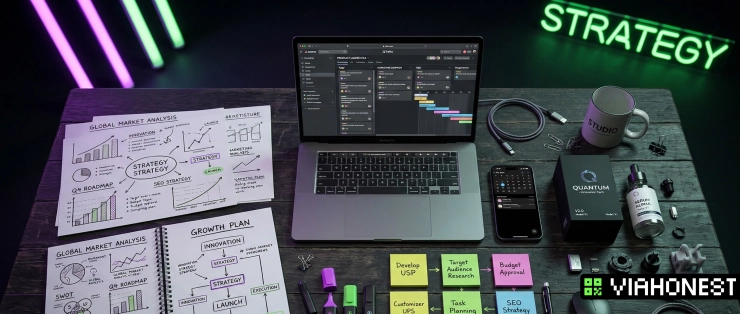
These are the steps to launch a new product in a way that reduces uncertainty early and allows sellers and founders to scale what works.
Define success and choose your rollout approach
Start with a measurable success definition: what does “win” look like in 30, 90, and 180 days? Pragmatic Institute argues that without specific goals, launch performance can’t be measured, budgets become misaligned, and internal credibility erodes.
Next, pick a rollout approach. A phased rollout is often safer than an all-at-once release, because it exposes the product to real usage while limiting downside. The U.S. Digital Service highlights that releasing at small scale before general availability helps uncover production issues and pain points through real-world use. Harvard Business Review also frames the choice between step-by-step rollout and “all in” release as a critical decision, particularly when distribution costs and competition are high.
Validate the offer with the smallest credible test
Use the build–measure–learn loop: build the smallest version that can test your biggest assumption, measure behaviour, and learn whether to pivot or persevere. This can look like landing pages, smoke tests, prototypes, pilot programmes, preorders (where suitable), or limited drop — anything that yields a signal before you commit to scale.
A practical lens is the MVP. Eric Ries defines an MVP as the version of a new product that collects the maximum validated learning with the least effor — so you learn fast, not perfect slow.
Build positioning and messaging that lower the cost of understanding
Positioning answers, “What is this, for whom, and why is it better?” Messaging turns that into pages, product listings, and sales conversations. Dunford notes that positioning is not the same as a tagline; it sets the context that makes your claims believable.
Operationally, you want one core narrative that stays consistent across your website, email, social posts, customer support scripts, packaging, and post-purchase onboardin — so customers aren’t forced to decode competing stories.
Prepare the operational backbone before you create hype
A launch checklist is less about bureaucracy and more about avoiding avoidable failure. Industry launch frameworks consistently show that structured checklists help organise work, align teams, prevent missed steps, and anticipate operational risks before launch.
Build an operational backbone you can trust:
- inventory or capacity planning,
- fulfilment and delivery timelines,
- returns/refunds policy,
- customer support workflows,
- product documentation (FAQs, setup, troubleshooting),
- analytics for key funnel steps (view → add to cart → purchase → repeat).
For many independent creators and early-stage brands, building this operational stack independently can be complex. Marketplaces such as ViaHonest aim to simplify this process by integrating listing infrastructure, payment processing, escrow protection, and global delivery workflows into a single platform — reducing the operational burden typically associated with early product launches.
Create a cross-functional launch cadence
McKinsey & Company notes that collaboration is a major driver of successful commercial launches and describes high-performing organisations establishing cross-functional launch teams to orchestrate activities across functions. You can apply the same principle at any size: assign one accountable launch owner, define decision rights, run rehearsals, and schedule a launch “war room” cadence for the first two weeks so decisions happen quickly and consistently.
Launch, monitor reality, and iterate quickly
On launch day, your goal is stability plus learning. Watch for friction points (poor conversion, high return intent, repeated support questions), then fix the highest-impact issues first. A phased release makes this easier because you can contain exposure while you improve the experience.
If you sell online, plan for disputes. Mastercard notes chargebacks require organised evidence and strict timelines; preventing them with clear policies and strong transaction records is usually cheaper than fighting them.
Tips for Launching a New Product Successfully

Here are tips for launching a new product that consistently improve outcomes without inflating your budget.
- Make trust a design goal, not a marketing claim. The IAB’s outlook for the digital ad ecosystem highlights privacy regulation and consumer expectations as forces pushing brands toward trust and transparency as competitive advantages.
- Prefer controlled learning over “big reveal” energy. Lean Startup methodology treats progress as validated learning; it reduces expensive overbuilding by forcing clear hypotheses and measurable tests.
- Keep teams aligned on one story. Collaboration is a launch asset: consistency across product, marketing, and support reduces confusion and shortens time-to-value.
- Protect your downside with phased releases. Where reputational damage is costly (premium goods, safety-sensitive products, regulated categories), a smaller initial rollout reduces risk.
- Be disciplined with claims. The FTC’s health products guidance emphasises that claims must be truthful, not misleading, and supported by appropriate evidence (especially relevant for health-related products).
- Design for authenticity when it matters. OECD and OECD/EUIPO research shows counterfeiters exploit online channels; if authenticity is part of the value, you need verification and provenance, not just branding.
What Are the Risks of Launching a New Product?

Many founders ask what are the risks of launching a new product, especially when entering competitive marketplaces or selling to first-time buyers. They cluster into demand risks, execution risks, and trust risk — and each category can sink an otherwise “good” product.
- Demand risk. Building something people don’t want. “Not targeting a market need” was the top cited reason in 42% of cases in one post-mortem analysis.
- Momentum risk. Early sales that don’t translate into repeat behaviour. A Nielsen innovation report warns that two out of three new product introductions fail to sustain first-year sales performance over the next two years.
- Financial risk. Overspending before you’ve proven traction. “Ran out of cash” appears repeatedly in failure analysis, often tied to weak product-market fit and late pivots.
- Operational risk. Fulfilment delays, quality issues, or support overload that erode reviews and drive refunds. Launch readiness includes far more than the product itself.
- Fraud and dispute risk. Scams erode buyer confidence and create merchant overhead. The FTC reports consumers lost over $12.5B to fraud in 2024, with online shopping issues among commonly reported fraud categories.
- Counterfeit and authenticity risk. Counterfeit trade is large, and e-commerce can be misused to distribute fake — especially painful for categories where provenance drives value.
- Compliance risk. Safety testing and certifications can apply, and marketing-origin claims have specific legal standards.
How ViaHonest Can Help You Launch Your First Product

If your first product is a physical good (especially limited drops, collectibles, premium merch, or resale-friendly items), your biggest launch risk may not be marketin — it may be trust at the moment of purchase. Fraud losses in US consumer markets are significant, and counterfeit distribution is a documented online challenge, so trustworthy transaction design can become a go-to-market advantage.
For founders and sellers launching today, infrastructure can become a competitive advantage. Platforms like ViaHonest introduce verification, traceability, and structured transactions directly into the launch process — helping reduce trust friction from day one.
For sellers, ViaHonest can help you launch with more predictable unit economics and protection:
- Faster setup and lower initial friction. ViaHonest describes quick onboarding (including an auto-generated wallet) so first-time founders can list without heavy technical setup.
- Clear fees and resale upside. The platform states there are no listing fees and a 2.5% fee on completed sales, and it supports seller-set resale royalties through smart contracts.
- Authenticity-first listings. ViaHonest says each product receives a unique on-chain ID and buyers can verify authenticit — useful in categories where copying and counterfeit listings appear fast.
- Escrow mechanics for fewer disputes. ViaHonest describes escrow-style payments where funds are held until confirmation, and its technical writeups describe escrow automation via smart contracts.
For buyers, the same infrastructure can make “Is this real?” and “Will I get what I paid for?” easier to answer:
- Verification and provenance. ViaHonest describes using identifiers such as QR codes to bind physical items to their digital records and record ownership history.
- Lower anxiety at checkout. When verification and transaction structure are built into the experience, buyers don’t have to rely only on screenshots, DMs, or personal reputatio — factors that often drive hesitation in resale markets.
This is also a natural moment for a light call to action. If you’re preparing your first launch, you can register on ViaHonest as a seller to list your product and run a controlled drop; and buyers can register to purchase items with verification and clearer transaction protections.
Conclusion

Ultimately, how to launch a new product successfully is a systematic process: validate the market need, define a clear strategy and rollout shape, line up operational readiness, and manage risks deliberately. The evidence on failure is consisten — weak demand, cash strain, execution gaps, and trust breakdowns are repeatable patterns you can plan against.
Modern launches increasingly compete on transparency, trust, and automatio — because those qualities reduce disputes, protect brands, and make buyers more confident. If you want a safer and more scalable foundation for your first launch, create your account on ViaHonest and launch your first product on infrastructure designed for transparent, protected, and scalable commerce.