
If you've been wondering how to flip shoes for real income rather than a few hundred dollars a year, here's the part most beginner guides skip: serious sneaker reselling stopped being about luck on a single drop years ago. The people actually making money at it are running portfolios. A mix of pairs with different risk profiles, different time horizons, and different margin ceilings, managed the way someone might manage a small investment account. The hype-chasing flipper makes money one month and loses it the next. The portfolio reseller smooths out the volatility and builds something that compounds.
There's a well-documented case in the personal finance world of a sneaker reseller pulling around $10,000 a month in profit from a side hustle setup. The number gets quoted a lot, but the actual mechanics rarely do. It isn't a lucky raffle hit or a viral TikTok. It's a system. Inventory tracked like spreadsheet positions. Pairs sourced through reliable channels and held until the math says sell. A portfolio that absorbs the misses because the wins were big enough to cover them.
This guide walks through how to build that kind of system. We'll cover whether reselling shoes is actually profitable in 2026, what a sneaker resale portfolio looks like in practice, the step-by-step on getting started without burning your initial capital, how to flip shoes for the kind of margins that justify the time, and how to scale once the basics are working. By the end you'll have a framework that beats the gut-feel approach most beginners default to.
Is Reselling Shoes Profitable in 2026?

The short answer is yes, with conditions. Sneaker reselling is profitable for people who treat it as a business and quietly unprofitable for most of the people who treat it as a hobby. The difference shows up in six factors that decide whether you actually make money or just generate transaction volume that looks like a business on the surface.
- Sourcing access. If you can consistently get pairs at retail through raffle wins, retailer relationships, or release-day strategy, the math works. If you're constantly buying second-hand at near-resale prices, your margins are already gone before you list.
- Capital efficiency. Reselling rewards the people who can turn $1,000 into $1,500 in 60 days and recycle that capital eight times a year. Tying up money in pairs that sit for six months kills the compound math that makes the business work.
- Realistic margin expectations. After platform fees, shipping, payment processing, and taxes, a pair you flip for 30 percent over retail often nets closer to 12 percent. Anything advertising 200 percent ROI as typical is showing you the gross number, not the net.
- Time investment. Sourcing, authenticating, photographing, listing, answering messages, packing, shipping. The hours add up. If your effective hourly rate is below what a regular job would pay you, the business isn't profitable in the way that matters.
- Market timing. Sneaker resale runs in cycles. Hyped categories cool, overlooked categories heat up, and the people who track those shifts capture the spreads. The people who don't end up holding inventory through cooling cycles.
- Risk management. Counterfeits, chargebacks, and platform suspensions are real risks that hit unprepared resellers regularly. The ones who survive have systems for handling all three before they happen.
So is reselling shoes profitable in 2026? For someone willing to treat it as a portfolio business with real discipline, the answer is consistently yes. For someone hoping to make easy money on hype, the answer is increasingly no, because the market has matured and the easy margins have been compressed.
What Is a Sneaker Resale Portfolio?

A sneaker resale portfolio is exactly what it sounds like: a managed collection of pairs treated as a balanced set of assets rather than individual flips. Borrowing the logic from investing makes the structure clearer.
The Core Layer
These are pairs with steady, predictable demand and reliable resale prices. Air Jordan 1 retros in established colorways, classic Dunk Lows, popular New Balance silhouettes. They don't deliver explosive returns, but they sell consistently and they let you turn capital over fast. The core layer is what funds the rest of the portfolio.
The Growth Layer
Medium-risk pairs with strong upside if held for the right window. Recent collaborations from established designers, women's exclusive releases, retro reissues with cultural relevance. These pairs sit in your inventory for 2 to 6 months and deliver bigger margins, but they require more research and more patience.
The Speculative Layer
High-risk, high-reward pairs. Hyper-limited collaborations, regional exclusives, early access to designer partnerships. These pairs can deliver 200 to 500 percent margins, but they can also flatten quickly if the cultural moment doesn't materialize the way you expected. The speculative layer should be the smallest slice of your portfolio, not the biggest.
The Long-Hold Layer
Grail pairs you buy specifically to hold for 3 to 5 years. These aren't liquid assets. They're the equivalent of a position you put away and check on twice a year. Done right, this layer compounds quietly while the rest of the portfolio handles your day-to-day cash flow.
The right mix between layers depends on your capital base, your risk tolerance, and how much time you can actually put into the business. Most successful resellers run something like 50 percent core, 30 percent growth, 15 percent speculative, 5 percent long-hold. Adjust from there as you learn what works in your specific situation.
How to Start Reselling Shoes: Step-by-Step
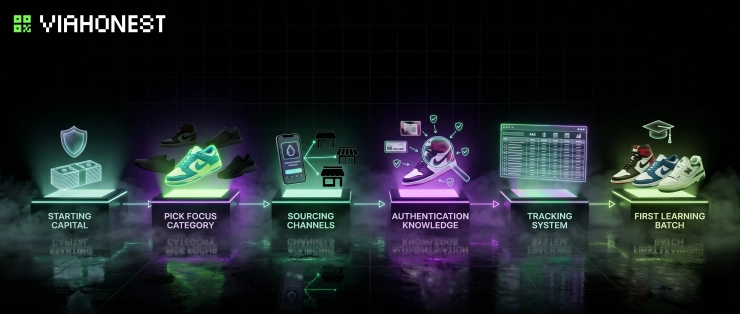
Starting from zero is the hardest part for most people. Here's the actual sequence that works, not the romanticized version that gets sold in YouTube videos.
Step 1: Decide on a starting capital that you can afford to lose
$500 to $1,500 is a realistic starting range for most US resellers. Less than $500 limits you to fewer than three pairs at a time and makes it hard to learn from a representative sample. More than $1,500 in your first month exposes you to losses that hurt before you've developed the judgment to avoid them.
Step 2: Pick a focus category
Trying to flip across every category at once means you'll learn slowly across all of them. Pick one to start. Dunks. Jordan 1s. New Balance. Asics. Whatever the category, spend the first few months learning that single market deeply before branching out. The resellers who consistently profit tend to specialize, at least at first.
Step 3: Set up sourcing channels
Download the SNKRS app and the apps for major retailers that hold raffles. Sign up for retailer email lists. Identify the 3 to 5 stores in your area that get raffle allocations. Learning the sourcing landscape takes weeks, and most beginners try to skip this step in favor of buying secondhand at near-resale prices, which kills their margins permanently.
Step 4: Set up authentication knowledge before you spend anything
Study verified reference photos for the pairs you'll be flipping. Learn the box label format. The inside tag layout. The stitching patterns. The font on the sole. Counterfeits in 2026 are good enough that buying without this knowledge is genuinely risky, even from sources that seem reliable.
Step 5: Build a tracking system before your first purchase
A simple spreadsheet works. Pair name, size, source price, expected resale, fees estimate, date acquired, date sold, actual net profit. The resellers who don't track each position have no way to know whether they're actually profitable across volume. Many discover after a year that they've been break-even or worse.
Step 6: Make your first 3 to 5 purchases as a learning batch
Don't try to win on your first round. Try to learn. Pick pairs that have predictable demand so you can see the full cycle from purchase to sale clearly. The lessons from these early transactions are worth more than the modest profit you'll make on them.
When you're ready to list your first pairs, registering on ViaHonest gives sellers a structured environment with verification and authentication built into the listing itself, which removes the biggest friction point new resellers face when buyers question whether the pair is real.
How to Flip Shoes for Maximum Profit

Knowing how to flip shoes for actual margins rather than transaction volume comes down to a handful of practices that separate the consistently profitable from the consistently busy.
- Buy on completed sales data, not active listings. Active listings tell you what sellers hope to get. Completed sales tell you what buyers actually paid. Pricing your buy based on the wrong number is the single most common margin-killing mistake.
- Always factor every cost before deciding. Platform fees, shipping, payment processing, taxes if applicable. The gross-to-net gap on a typical resale runs 15 to 25 percent. Resellers who don't run this math before buying are flying blind.
- Match size demand to price expectations. The same pair in different sizes can have wildly different liquidity. US 9 to 11 in men's tends to be the most liquid range. Sizes outside that range can sit for months at break-even prices.
- Time your sells deliberately. Most pairs peak in price within 1 to 3 months of release, then drift. Holding hoping for a bigger spike usually means accepting a lower price later. Selling 80 percent of the peak price quickly often beats waiting for the imagined 100 percent.
- Photograph properly. Natural light. Clean background. Multiple angles. Close-ups of any flaws. Listings with strong photos consistently outperform identical pairs with bad photos by 10 to 20 percent on final price.
- Write descriptions that pre-empt buyer questions. Size, condition, what's included, any flaws, shipping details. Buyers who have to message asking basic questions often don't follow through to purchase.
- Ship like the pair is worth what it actually is. Original box wrapped in a shipping box. Tracked shipping with insurance. Signature required on anything above $500. Saving fifteen dollars on shipping doesn't save anything when a package vanishes.
The pattern that works is treating each transaction as a small business decision with real margin pressure. Resellers who internalize that mindset start outperforming the ones who keep treating each flip as an emotional bet on a pair they personally find cool.
How to Scale Your Sneaker Resale Business

Scaling from $500 starting capital to a $10,000+ monthly operation requires more than just doing the same thing with more money. The mechanics actually change as the business grows.
Reinvest aggressively in the early phase
For the first six months, every dollar of profit should go back into inventory rather than out as personal income. The compound effect of reinvesting at 15 to 25 percent net margins over multiple cycles is what turns a small starting position into real capital. Pulling profit early stalls the math before it has a chance to work.
Expand category by category rather than all at once
Once you've consistently profited in your first category for 4 to 6 months, add a second one. Then a third. Building expertise sequentially means each new category benefits from the systems and judgment you've already developed. Trying to scale across categories simultaneously usually means mediocre performance everywhere.
Build sourcing relationships
At scale, raffles alone won't supply enough inventory. Direct relationships with retailers, wholesale connections, and reliable secondhand sourcing channels become the difference between a portfolio that can grow and one that hits a ceiling because you can't acquire enough pairs to deploy your capital.
Track everything obsessively
As volume grows, the difference between profitable and unprofitable batches gets harder to see without real data. Track each pair's source price, fees, holding time, sale price, and net margin. Patterns emerge from the data that no amount of gut feel can replicate, and those patterns are what tell you which categories and approaches to double down on.
Treat the business like a business
At a certain volume, the IRS notices. Register as a business entity, separate your business finances from personal, track expenses for tax purposes, and consult an accountant who understands resale operations. Resellers who skip this step often hit a wall when the tax bill arrives unprepared, and the cleanup costs more than doing it right from the beginning.
Diversify across platforms
Listing on a single platform exposes you to the platform's policies, fee changes, and account suspension risks. Diversifying across two to four channels protects you against any single platform shifting against you. Some channels are better for hype releases, others for steady categories, others for higher-value rare pairs.
For sellers building serious volume, ViaHonest offers a trust-first platform with verified authenticity and resale royalty mechanics that let original sellers earn a percentage on every future resale of the pair. For a portfolio approach, that compounding effect is genuinely useful, particularly on the long-hold layer where pairs may change hands multiple times over years.
Common Mistakes When Building a Sneaker Portfolio

Almost every reseller who fails at building a portfolio fails for one of the same handful of reasons. Watching for these is the cheapest way to avoid losing capital you didn't need to lose:
- Going all-in on speculative pairs. Putting 80 percent of your capital into hype-dependent releases means one bad cycle wipes you out. The portfolio approach exists specifically to prevent this.
- Ignoring storage and capital costs. A pair that sits for six months has tied up your money the entire time. The opportunity cost of slow inventory is real and rarely accounted for by beginners.
- Selling winners too early and holding losers too long. Behavioral economics calls this the disposition effect. Resellers who recognize it in themselves and fight it consistently outperform those who don't.
- Buying based on personal taste. The pair you love might not be the pair the market loves. Personal preference and resale demand correlate poorly, and resellers who buy what they want rather than what sells consistently underperform.
- Skipping authentication on inbound purchases. Buying counterfeits accidentally means you either eat the loss or pass the problem to a buyer who eventually disputes it and damages your reputation. Either outcome is expensive.
- Not tracking actual net margins. Resellers who only track gross prices discover after months that their actual profit was a fraction of what they thought. The fees, shipping, and taxes add up faster than most beginners realize.
- Spreading too thin too early. Trying to handle 50 pairs across 12 categories before you've mastered any of them means you'll never develop the deep market knowledge that drives profitability in any single category.
- Treating it as passive income. Reselling at scale requires real ongoing work. The dream of buying pairs and watching them appreciate without effort doesn't match reality for anyone running a profitable operation.
How ViaHonest Helps You Build and Sell Your Portfolio
Most of the friction in running a sneaker portfolio comes from the same source most beginners underestimate: trust. Buyers worry about authenticity. Sellers worry about chargebacks. Both sides worry about whether the other side will follow through on what was promised. ViaHonest was built specifically around solving that trust problem by layering verification and provenance into the listing itself, not bolting them on as an afterthought.
For a portfolio reseller, here's what that translates to in practice:
- Every listed pair can carry verified authenticity, which lets you command premium prices and gives buyers confidence to pay them.
- Ownership history is documented on-chain. For a portfolio approach where pairs may change hands multiple times, that provenance compounds in value over the life of the pair.
- Resale royalties give original sellers a percentage of every future resale. For pairs in the long-hold layer that appreciate over years, this turns one-time sales into ongoing income streams.
- Secure transactions protect both sides through structured payment flows that significantly reduce the chargeback risk that hits unprepared resellers on high-value pairs.
- Straightforward registration with no listing fees. The platform takes 2.5 percent only after a sale actually closes, which keeps the cost structure predictable across volume.
- Limited mint mechanics for resellers who want to release their own capped collaborations alongside their resale operation, useful for sellers building toward their own brand over time.
Whether you're testing your first $500 in capital or scaling a portfolio toward serious monthly income, creating a ViaHonest account gives you tools designed for the specific friction points that hurt margins at every stage of the business. For buyers building their own collections, registering as a buyer gives access to authenticated listings backed by clear ownership history rather than guesswork.
Conclusion
Building a profitable sneaker resale portfolio comes down to a small set of principles that compound over time. Use data instead of gut feel for every buy and sell decision. Diversify across risk layers so a single bad call doesn't wipe out your position. Time your sells based on where each pair sits in its cycle rather than holding for the imagined peak that rarely arrives. And track verified ownership history on every pair you handle, because provenance increasingly matters to serious buyers and the premium prices follow it.
Start small with $500 to $1,500 in capital that you can genuinely afford to lose while you're learning. Reinvest your profits aggressively for the first six months instead of pulling income early. Track each position like it's a real asset, because at scale it is. Whether you're working through how to resell shoes for the first time or building toward $10,000 monthly profit, the framework stays the same. Data, diversification, timing, and trust.
When you're ready to sell pairs with verified ownership history and earn on every future resale of the pieces you put into the market, register on ViaHonest.
Sellers get a platform built around the kind of trust that lets premium pairs move at premium prices. Buyers get authenticated listings without having to guess about what they're paying for. Either side of the transaction, the result is better decisions and stronger margins on the pairs that actually matter to your portfolio.