In 2005, a battered painting of Christ surfaced at a small New Orleans estate auction and sold for $1,175. Twelve years later, the same work sold at Christie's New York for $450.3 million, making it the most expensive painting ever sold at auction. The paint had not changed. The canvas had not changed. What changed was the story attached to it: an attribution to Leonardo da Vinci, years of research and restoration, and a documented ownership history that convinced a buyer to spend more on a single image than most museums spend in a century.
That is the real subject of this article. Below, you will find the full ranked list of the most expensive paintings ever sold and the answer to a common question: what is the most expensive painting in the world? Then we will examine the more useful questions underneath: what drives the price of expensive art, why authenticity and ownership history matter so much, and what record-breaking sales mean for working artists today.
The Most Expensive Paintings Ever Sold: The Full Ranked List
Here are the record holders as of 2026, combining public auctions and known private sales. Private sale figures are reported estimates, since those deals are not disclosed the way auction results are.
| # | Artwork | Artist | Price | Year | Where sold |
|---|---|---|---|---|---|
| 1 | Salvator Mundi | Leonardo da Vinci | $450.3M | 2017 | Christie's, New York |
| 2 | Interchange | Willem de Kooning | ~$300M | 2015 | Private sale |
| 3 | The Card Players | Paul Cézanne | ~$250M | 2011 | Private sale |
| 4 | Portrait of Elisabeth Lederer | Gustav Klimt | $236.4M | 2025 | Sotheby's, New York |
| 5 | Nafea Faa Ipoipo (When Will You Marry?) | Paul Gauguin | $210M | 2014 | Private sale |
| 6 | Number 17A | Jackson Pollock | ~$200M | 2015 | Private sale |
| 7 | Shot Sage Blue Marilyn | Andy Warhol | $195M | 2022 | Christie's, New York |
| 8 | No. 6 (Violet, Green and Red) | Mark Rothko | ~$186M | 2014 | Private sale |
| 9 | Wasserschlangen II | Gustav Klimt | ~$183.8M | 2013 | Private sale |
| 10 | Number 7A, 1948 | Jackson Pollock | $181.2M | 2026 | Christie's, New York |
| 11 | Pendant portraits of Maerten Soolmans and Oopjen Coppit | Rembrandt | $180M | 2015 | Private sale (Louvre and Rijksmuseum) |
| 12 | Les Femmes d'Alger (Version 'O') | Pablo Picasso | $179.4M | 2015 | Christie's, New York |
| 13 | Nu couché | Amedeo Modigliani | $170.4M | 2015 | Christie's, New York |
| 14 | Portrait of Adele Bloch-Bauer II | Gustav Klimt | $150M | 2016 | Private sale |
| 15 | Study of Lucian Freud (triptych) | Francis Bacon | $142.4M | 2013 | Christie's, New York |
Two things stand out immediately. First, the list keeps moving: Klimt's Portrait of Elisabeth Lederer entered at number four in November 2025, and Pollock's Number 7A, 1948 set a new auction record for the artist at $181.2 million in May 2026. Second, roughly half of these sales happened privately, which we will come back to when we look at the secondary market.
#1: Salvator Mundi by Leonardo da Vinci at $450 Million
The story of the most expensive painting ever sold reads like fiction. In 2005, art dealers bought a heavily overpainted panel of Christ holding a crystal orb at a New Orleans estate auction for $1,175, suspecting there might be something underneath. Years of cleaning, restoration, and scholarly research followed, and the painting was attributed to Leonardo da Vinci, one of fewer than twenty surviving works connected to his hand. In 2011, the National Gallery in London exhibited it as a Leonardo. In 2017, after an eleven-minute bidding war at Christie's New York, it sold for $450.3 million, reportedly to a buyer acting for Saudi Crown Prince Mohammed bin Salman.
Here is the remarkable part: the attribution was, and remains, contested. Serious scholars argue the painting is substantially the work of Leonardo's studio rather than the master himself. The buyer knew this. Everyone in the room knew this. The painting sold for nearly half a billion dollars anyway.
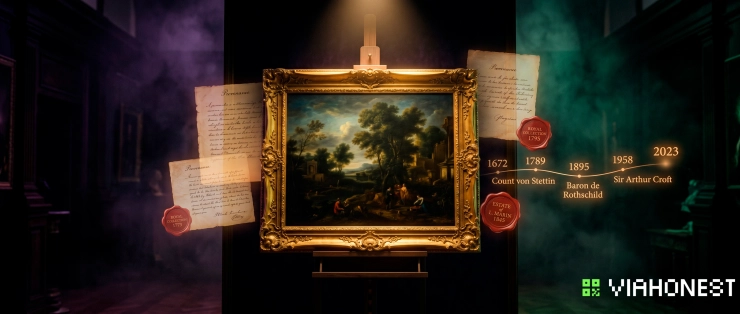
Why? Because the buyer was not purchasing an image. Anyone can download a perfect reproduction of Salvator Mundi for free. The buyer was purchasing the object together with its documented story: the research file, the restoration records, the exhibition history at the National Gallery, the chain of ownership stretching back toward royal collections, and the institutional weight of Christie's standing behind the sale. Strip away that documentation and you have a nice Renaissance-style panel worth a few thousand dollars. The documentation is the value.

What Makes a Painting Worth Millions? It's Not Just the Art
If skill and beauty alone set prices, the rankings would look completely different. What actually drives the price of expensive art is a stack of factors that sit mostly outside the frame:
- Provenance. The documented chain of ownership. A painting that passed through famous collections carries that history as a certificate of importance, and gaps in provenance cut value sharply.
- Authenticity. Verifiable proof that the work is what it claims to be. As Salvator Mundi shows, even a debated attribution supported by strong documentation outweighs a confident attribution with none.
- Scarcity. Leonardo left fewer than twenty paintings. Vermeer left around thirty-five. When supply is fixed and demand grows, prices have only one direction.
- The artist's reputation and place in art history. Record prices go to artists who changed how painting works, not simply painted well.
- Condition and rarity on the market. A work that has not been seen publicly in decades, like Pollock's Number 7A before its 2026 sale, generates enormous demand.
- Cultural fame. Warhol's Marilyn and Munch's The Scream are icons far beyond the art world, and buyers pay for that recognition.
- Trophy dynamics. At the top, sovereign wealth funds and billionaires compete for status objects, and a painting becomes a strategic asset.
Notice what unites the first two, and most important, factors: they are about documentation and trust, not aesthetics. The market pays for verifiable history.
The Artists Behind the Records: Who They Are and Why It Matters
- Leonardo da Vinci (1452 to 1519). The Renaissance polymath whose tiny surviving output makes every attributed work an event. In his lifetime he depended on commissions and patrons, and left many projects unfinished.
- Pablo Picasso (1881 to 1973). The most market-dominant artist in history, with multiple works on every record list. He arrived in Paris as an unknown Spanish immigrant selling canvases cheaply to survive.
- Andy Warhol (1928 to 1987). The commercial illustrator who turned mass culture into fine art. Early Warhols sold for a few hundred dollars; Shot Sage Blue Marilyn brought $195 million in four minutes of bidding.
- Gustav Klimt (1862 to 1918). The Viennese Secession leader whose gilded portraits were once considered scandalous. His Portrait of Elisabeth Lederer, painted for a private patron family, became a $236.4 million record in 2025.
- Jackson Pollock (1912 to 1956). The abstract expressionist who was famously asked by Life magazine in 1949 whether he was the greatest living American painter, while still struggling financially.
The point of these profiles is not nostalgia. Every artist on this list was, at some stage, an independent artist with no guarantees, selling work to early believers. Their reputations, and the paper trails behind their works, were built sale by sale, exhibition by exhibition, over years. The records came later, and mostly went to other people, which brings us to the secondary market.

What Happens to a Painting After It Sells? The Secondary Market Explained
The first sale of an artwork is only the beginning of its financial life. After that, the piece enters the secondary market, where it can be resold at auction or privately, sometimes many times over decades. A few things to understand about how it works:
- The resale is where the big money moves. Salvator Mundi went from $1,175 to $450 million across resales. Basquiat's Untitled skull painting sold for $93,000 in 1984 and $110.5 million in 2017.
- Roughly half of top-tier deals happen privately. As our list shows, works like de Kooning's Interchange and Cézanne's Card Players changed hands in private sales, brokered by dealers and auction houses without a public room.
- Provenance compounds with every transaction. Each documented sale adds a chapter to the work's history, and that history itself raises the value of the next sale.
- The original artist traditionally gets nothing. In the United States there is no general resale royalty, so when a painting resells for a hundred times its original price, the profit goes to collectors and dealers, not the creator or their estate.
- Authentication disputes can freeze value instantly. A questioned attribution or a gap in ownership records can knock millions off a work, which is why documentation is guarded so carefully.
This is the quiet lesson of the record list: the market rewards documented history enormously, but almost none of that reward has historically flowed back to the person who made the work.
How ViaHonest Helps Independent Artists Build Provenance From Day One
For centuries, provenance was a privilege. It took galleries, archives, catalogues, and decades of institutional record keeping, which is exactly why only established names had it. ViaHonest, a Web3 marketplace for verified physical goods and original art, makes that same machinery available to an independent artist from the very first sale:
- A certificate of authenticity from the start. Every piece sold on the platform is paired with an on-chain certificate, so authenticity is provable from day one rather than reconstructed decades later.
- A tamper-proof ownership record. Each sale and resale is recorded, building exactly the kind of documented chain of ownership that the record-breaking works on this list trade on.
- Protection against forgery and disputes. Because the record cannot be quietly rewritten, your name stays permanently linked to your work, and buyers can verify what they are purchasing.
- Royalties on every resale. Unlike the traditional market, where the artist watches resale profits pass by, on-chain terms let you keep earning a share every time your work changes hands.
Collectors benefit from the same system: you can browse verified original art on ViaHonest knowing each piece carries its documented history with it.

Conclusion
So what is the most expensive painting in the world? On paper, it is Salvator Mundi at $450.3 million. But the deeper answer is that the difference between the $1,175 painting and the $450 million painting was never just the name attached to it. It was the documented story: the verified attribution, the restoration records, the exhibition history, the traceable chain of owners. In the world of expensive art, authenticity and ownership history are not supporting details. They are the value.
That used to be out of reach for independent artists. It is not anymore. Today you can start building that documented history from your very first sale. Use ViaHonest to sell your originals with verified ownership, give every piece a provenance record from day one, and earn royalties on every resale, so as your reputation grows, the history of your work grows with it, and this time the artist shares in the upside.