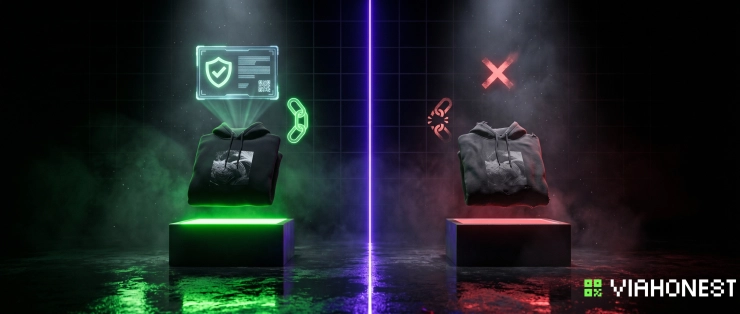
If you want to know how to protect products from counterfeits, the practical answer is simple: give every physical unit its own identity, tie that identity to an authenticity certificate for products, and sell through an anti counterfeit marketplace or another controlled checkout flow where buyers can verify the item before and after purchase. For creators, merch drops, artists, sneaker sellers, and brand-led collaborations, the strongest defense is not a takedown email after the damage is done. It is a trust layer built into the product itself and into the buying journey.
In practical terms, product protection against fakes means linking a specific item to a persistent digital record that can show origin, issuer, ownership, and verification data. Current 2D-barcode guidance from GS1 centers richer product data, stronger traceability, and consumer-facing scanning, while marketplace authentication programs already rely on unique serial codes, inspection steps, or item-specific records because a listing description by itself is not proof.
The stakes are not theoretical. A joint analysis from OECD and EUIPO estimates that counterfeit and pirated goods accounted for up to 2.3% of global trade in 2021, worth an estimated USD 467 billion. Academic research continues to connect counterfeiting with lower profits, weaker brand value and brand equity, lost consumer confidence, and higher firm-exit risk for legitimate businesses.
Why Counterfeits Hurt Creators, Merch Drops, and Brands

Creators and emerging brands feel counterfeit damage faster than legacy companies because scarcity and identity are often the product. A fake hoodie, signed print, collectible sneaker, or limited collab does not just steal a single sale. It teaches the next customer to hesitate. OECD research on illicit trade online found that a snapshot of counterfeit offers on social media showed 30,000 offers in one day, and the same report notes that smaller companies may not have the resources to fight counterfeiting as aggressively as larger ones.
In business terms, fakes usually hurt sellers in four ways:
- They siphon demand with lower "lookalike" prices.
- They compress your premium because buyers are less sure what is genuine.
- They create customer-service and dispute costs that are hard to scale.
- They weaken resale value, which reduces the long-term value of collectible or limited products.
Those effects line up with current research showing that counterfeiting damages profits, brand value, brand equity, and consumer confidence, especially when buyers cannot easily distinguish the real item from the fake.
This is why anti-counterfeit work should not be treated as a legal task only. It is a revenue, reputation, and online brand protection task. It is a revenue and reputation task. The more your positioning depends on originality, community trust, or collectible value, the more expensive "buyer doubt" becomes.
Why Instagram and DM Sales Do Not Protect a Brand
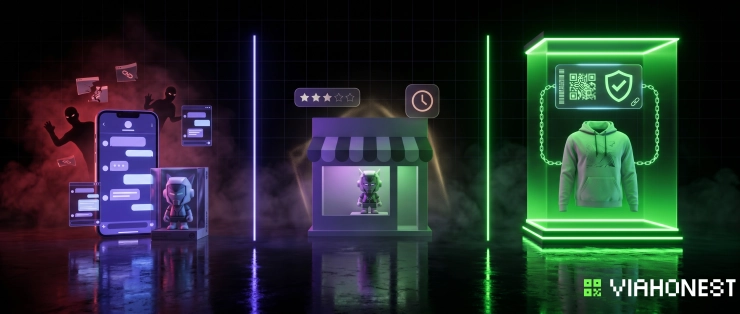
Social platforms are excellent for awareness, community, and launch momentum. They are weak as final proof systems. OECD research shows that social commerce is expanding while online platforms and social media are also abused by counterfeit networks. U.S. consumer-protection guidance separately warns that scam social ads can impersonate real brands, route buyers to fake websites, and result in a cheap fake or no product at all.
The core problem is structural. A DM thread can prove that a conversation happened. It cannot reliably prove that the seller is authorized, that the item is genuine, that the exact unit shipped matches the promise, or that the buyer will still be able to verify authenticity six months later. That is why platform-level anti-counterfeit policies and marketplace authentication programs keep moving toward item-level checks instead of relying on social proof alone.
| Selling path | What the buyer trusts | What counterfeiters exploit | Effect on brand trust |
|---|---|---|---|
| Social posts and DMs | Personality, screenshots, manual payment proof | Impersonation, fake landing pages, unverifiable provenance | Fast attention, weak proof |
| Standard marketplace without item-level verification | Reviews, seller history, platform policy | Seller anonymity, mixed inventory, delayed enforcement | Better than DMs, but still mostly reactive |
| Protected marketplace with item-level identity | Serialised unit, certificate, scannable verification, ownership history | Harder to swap or imitate a unit without detection | Stronger trust and cleaner premium positioning |
This comparison reflects OECD evidence on counterfeit activity in social and e-commerce channels, U.S. scam guidance for social ads, and the market shift toward serial-code and authentication layers used by Amazon, eBay, and ViaHonest.
The smart play is to keep social as the top of the funnel and move the actual transaction to a channel where the product, seller, and proof remain attached to each other. That is the difference between creating demand and protecting a brand.
What an Authenticity Layer Gives Sellers

An authenticity layer is the set of checks that keeps the product and its proof attached to the same unit. At minimum, it should connect a unique item ID, a scannable verification flow, visible issuer information, and a record that still makes sense if the item is resold. That is why even Amazon uses unique serial codes in Transparency and why eBay routes eligible categories through authentication before items reach buyers. ViaHonest applies the same item-level logic by linking a unique certificate and QR code to the physical object.
For sellers, that usually creates five practical gains:
- Higher confidence at checkout because buyers have something objective to verify.
- Better premium protection because the "real" item has visible proof.
- Cleaner resale economics when ownership and royalties stay attached to the item.
- Easier dispute handling because the record is stronger than a screenshot.
- Stronger long-term reputation because trust becomes repeatable, not manual.
Those benefits are exactly why authentication programs have spread from luxury resale into broader commerce and why marketplace operators increasingly treat proof as part of the product experience.
A good system also has trade-offs, and ignoring them is a mistake:
- You still need disciplined labeling, fulfillment, and seller-side setup.
- A plain static QR that only opens a generic webpage is weaker than a unique, live record.
- Verification works best when paired with real moderation, clear shipping, and buyer education.
That last point matters. Guidance on QR security specifically notes that QR codes are useful but more complex to secure than they appear, and safer designs may require private payloads, dedicated readers, or additional safeguards for higher-risk use cases.
If you want to sell unique products online without turning every buyer conversation into a trust negotiation, this is where a protected sales path starts to outperform improvisation. A real brand protection marketplace is not just another storefront. It is the environment where your proof travels with the item. For a first test, Start selling on ViaHonest or review About ViaHonest before your next launch window opens.
How Unique Products, Digital Certificates, and QR Verification Work
Unique productization starts with the unit, not the batch
"Unique productization" means you stop thinking in terms of "a drop of 500 hoodies" and start thinking in terms of hoodie number 184, print number 27, or pair number 12. GS1 guidance for 2D barcodes explicitly describes QR-based labels that carry a product identifier plus a serial number, storing that unit-level identity in a database. In plain English, this is how a product becomes individually traceable instead of generically listed.
What an authenticity certificate for products should actually prove
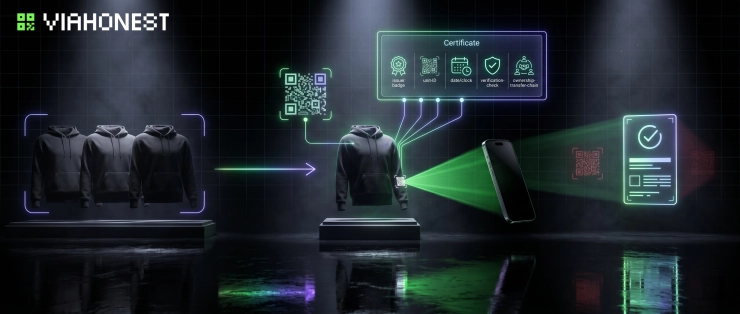
A useful certificate should answer five questions: who issued the item, what exact unit it refers to, when it was created, how authenticity is checked, and what happens if ownership changes. That is the real value of a digital certificate for physical goods. On ViaHonest, the public seller FAQ says that when a product is published, the system creates a unique token certificate linked to the physical object and QR code, and the buyer can scan the tag to see a page confirming the item is authentic and belongs to the seller. In adjacent marketplace examples, eBay's watch authentication program includes an authentication card with details such as model and serial number.
How QR code product authentication should work
Good qr code product authentication is not a decorative sticker. It should support real fake product detection by resolving to a live verification page or controlled record that reflects the exact unit being checked. Security guidance on QR codes makes a useful distinction here: some QR payloads are fully public and readable by any phone camera, while others are designed for dedicated apps or restricted workflows. The right choice depends on the risk level of the category, but the logic is the same: the scan should reveal trustworthy data, not just branding.
This matters because verification is not only defensive. It is commercial. GS1 US says 79% of consumers are more likely to purchase a product with a scannable barcode or QR code that provides the additional information they want, and 62% say they are willing to spend more on a product that offers detailed product information. A QR alone is not a premium. But a live verification flow that explains origin, authenticity, and ownership gives buyers a rational reason to pay for the real item.
In that sense, the job is not simply to "block fakes." It is to make the genuine item easier to trust, easier to verify, and therefore easier to buy at a healthy margin. That is what turns a storefront into a true anti-fake sales channel rather than a reactive moderation problem.
Practical Use Cases for Creators and Brands
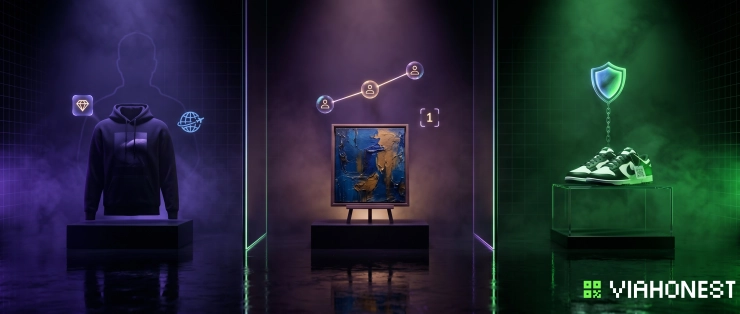
For creator merch, the strongest use case is the limited drop. Fans buy because they want a real connection to the creator, not just a generic product with similar graphics. ViaHonest already frames influencer-drop commerce around verified ownership and traceability, and its merch case-study content positions verified checkout and delivery tracking as part of the offer rather than an afterthought.
For art, prints, and physical collectibles, provenance is part of the value. ViaHonest's art catalog emphasizes verified ownership and transparent provenance, which is exactly what serious buyers need when they are paying for originality, edition control, and future resale confidence.
For sneakers and high-risk collectible categories, proof is even more central because the resale market magnifies fake risk. That is why category-specific authentication programs on major marketplaces cluster around sneakers, apparel, handbags, watches, jewelry, and trading cards, and why ViaHonest presents verified provenance as part of its sneaker experience.
For internal linking around this article, the most natural supporting reads are How to Launch a New Product Successfully, How to Start a Clothing Brand in 2026, How to Sell Merchandise, and Best Influencer Marketplaces. For category pages and future case-study clusters, link into Sneakers, Art, and influencer-drop collections where buyers can already browse verified listings.
If you are ready to launch a protected product instead of another DM-based drop, sellers can list through Start Selling, while buyers can register, browse, and buy through a marketplace built around verified ownership and provenance. That is a much smoother handoff for both sides than asking people to trust a message thread.
Conclusion

Counterfeit protection works best when proof is attached to the unit, not buried in the terms and conditions. For creators and brands, that means moving from reactive moderation to proactive design: serialize the item, document authenticity, make verification easy, and sell in a channel where trust can be checked instead of guessed.
If you are still deciding how to protect products from counterfeits, focus on three layers: unit-level identity, an authenticity certificate for products, and a sales environment where buyers can verify origin and ownership in seconds. That combination is what turns a risky drop into a trusted one, and it is exactly why an anti counterfeit marketplace can protect margin as well as reputation. To put that into practice, Start selling on ViaHonest, read About ViaHonest, book a free demo, or launch your first drop with proof built in from day one.
FAQ
Is ViaHonest free to start?
Yes. ViaHonest says listing is free, and it charges a flat 2.5% service fee only after a successful sale.
How do royalties work?
ViaHonest says the seller sets the royalty once, and each later resale automatically transfers the chosen percentage to the creator through the platform's smart-contract flow.
What can I sell on ViaHonest?
Public site materials position ViaHonest for real and digital goods, and visible categories include sneakers, influencer drops, collectibles, art, and street art.
Can I sell to U.S. buyers?
ViaHonest describes itself as offering global access across a multi-vendor marketplace, and some live listings visibly show "Fast US delivery." For a U.S.-targeted launch, that is encouraging, but you should still confirm category-specific shipping, customs, and compliance details before going live.
Do I need my own website or deep technical knowledge to start?
No on both counts, based on ViaHonest's public materials. The platform presents a built-in seller flow and says no technical Web3 knowledge is required to start. Its About page also says users can register through MetaMask, social accounts, or email and password.
How do buyers verify that an item is real?
ViaHonest says that when a seller publishes a product, the system creates a unique certificate linked to the physical object and QR code. The buyer scans the tag and sees a verification page confirming authenticity and seller association.