
When brands ask how sellers earn more on marketplaces, the usual answers are familiar: improve margin, increase traffic, raise average order value, or cut fees. Those matter, but they still assume a one-time sale. A seller royalties marketplace changes the equation by letting the original seller, creator, or brand keep earning when the same item is resold later. In practical terms, royalties on product resale turn a product's afterlife into a revenue stream instead of a value leak.
That matters because resale is no longer niche. ThredUp says the global secondhand apparel market is projected to reach $393 billion by 2030, while research from Boston Consulting Group and Vestiaire Collective estimates the secondhand fashion and luxury market at $210 billion to $220 billion today, rising to as much as $360 billion by 2030 and growing three times faster than the firsthand market.
So the real strategic question is not just how to win the first transaction. It is how to stay connected to demand after the first owner is gone. In a resale-driven culture, scarcity, authenticity, and community can keep creating value long after launch day. If the original seller is cut out of that loop, the brand funds the hype while somebody else captures the upside. If the platform supports royalties, resale becomes a new layer of monetisation instead of a missed opportunity.
Traditional one-time revenue model
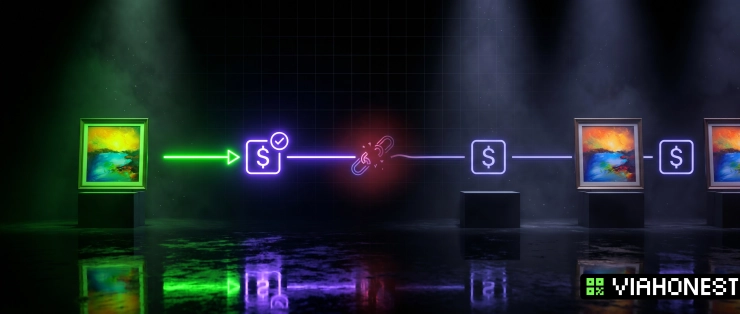
Most ecommerce and marketplace models still reward the original seller only once: at the moment of primary sale. After that, the item may keep circulating through secondary channels, but the economics usually belong to the current owner and the marketplace handling the transaction. The default structure on platforms like StockX, GOAT, and eBay is straightforward: the current seller lists the item, the platform verifies or facilitates the transaction, and the current seller gets paid.
That logic is especially visible in art. The U.S. Copyright Office explains that, under the first sale doctrine, the lawful owner of a work can resell that copy without the creator's authorisation. It also notes that this can leave artists with less financial benefit than downstream collectors and other parties who profit when the work gains value over time. In other words, the one-time revenue problem is not a quirk. It is built into the traditional model.
For brands, that limitation shows up in three ways:
- You create the original demand, but you do not share in later upside. If a product becomes culturally valuable after launch, resale rewards resellers more than the original brand.
- You lose control of trust at the exact moment trust matters most. Secondary buyers care about authenticity, condition, and provenance, yet those signals often live on third-party platforms rather than in your own brand ecosystem.
- You leave money on the table even though resale already influences primary purchase decisions. In BCG and Vestiaire Collective's survey of resale-engaged consumers, 25% of U.S. respondents said they very often or always consider resale value when buying new, and 50% said earning money is a reason they sell secondhand.
This is why the old model feels increasingly incomplete. Sellers are no longer competing only for first-sale conversion. They are competing inside an economy where buyers already think about resale, reputation, and long-term value at the moment of purchase.
Royalty-based model
A royalty-based model adds a simple but powerful rule: when an eligible item is resold, a small percentage of that resale price goes back to the original seller, creator, or brand. In other words, the first sale stops being the end of monetisation and becomes the start of a longer commercial lifecycle. That is the core idea behind resale royalties ecommerce: the product does not stop working for the seller after checkout.
On ViaHonest, the mechanics are explicit. The platform says sellers can set a royalty of 1% to 10%, and with each subsequent resale the smart contract automatically transfers that percentage back to the seller. ViaHonest also ties products to a unique certificate, QR-linked identity, and digital ownership record so later buyers can verify authenticity, provenance, and ownership history.
How it works in practice
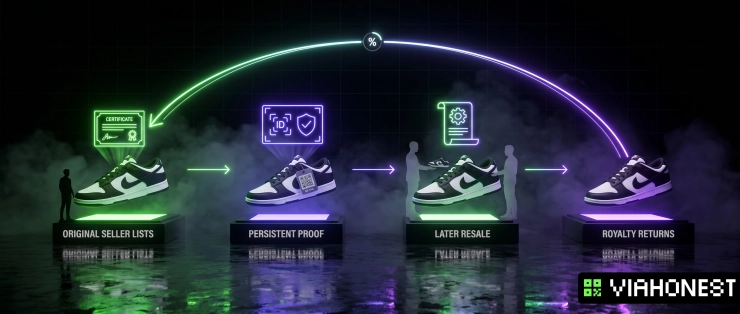
A royalty-enabled resale flow is easiest to understand in four steps:
- The original seller creates and lists the item. The first sale establishes the product's initial value and identity.
- The item carries some form of persistent proof. That can include a certificate, a digital record, or a marketplace-linked identity that helps authenticate it later.
- A later owner resells the item inside infrastructure that can recognise that identity. That is the key step. If the marketplace can see the item's origin and rules, it can also route the economic split correctly.
- The original seller receives a pre-set share of the resale price. That creates recurring revenue for sellers without requiring them to manufacture a second unit or acquire a new customer from scratch.
The concept is not completely new. In art markets, resale rights were created to address the fact that creators often miss the appreciation that happens after the original sale. Outside the U.S., resale-right regimes already exist for eligible art transactions, and in creator marketplaces even digital platforms such as OpenSea distinguish between optional and enforceable creator earnings on secondary sales. The innovation now is applying that logic to broader commerce and making it operationally simple enough for everyday sellers and buyers.
Traditional vs. royalty-based comparison
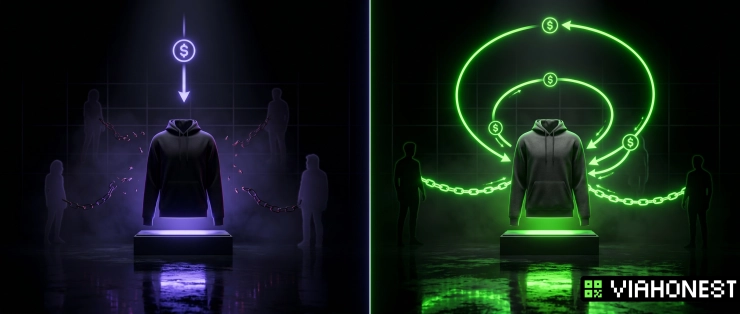
At the business-model level, the difference looks like this:
| Dimension | Traditional one-time model | Royalty-based model |
|---|---|---|
| Revenue event | Seller earns at first sale only | Seller earns at first sale and again on qualifying resales |
| Relationship to secondary market | Mostly indirect; resale happens elsewhere | Direct participation if resale stays inside royalty-aware infrastructure |
| Incentive after launch | Push more new units | Build products that hold value, trust, and community over time |
| Trust signals | Often fragmented across marketplaces | Stronger when identity, history, and authenticity stay attached to the item |
| Best fit | Commoditised, low-resale goods | Scarcity-led, culture-led, collectible, or provenance-sensitive goods |
| Main constraint | Brand does not share in appreciation | Requires resale tracking, marketplace enforcement, and buyer/seller adoption |
This comparison synthesises the resale-right framework from the U.S. Copyright Office, the operational flows used by eBay, StockX, and GOAT, BCG's work on authentication and digital product passports in resale, and official ViaHonest and OpenSea materials on automated or enforceable royalties.
The strengths of the royalty-based model are clear:
- Longer revenue tail. A product can keep generating income after the first owner moves on.
- Stronger alignment between brand and resale value. When sellers share in future upside, they have a reason to invest in authenticity, collectibility, and long-term trust.
- Better fit with the resale economy for creators. Scarcity, story, provenance, and community become monetisable brand assets rather than just marketing language.
- More compelling economics for limited products. If buyers care about resale value when purchasing new, royalty-aware products can strengthen the perceived value of the original purchase.
There are trade-offs too:
- It works best when the item is traceable. Without a persistent product identity, secondary market royalties are difficult to route reliably.
- Not every category has meaningful resale demand. Commodity items usually do not justify the extra infrastructure.
- Enforcement depends on platform design. Even in digital creator marketplaces, royalties can be optional or enforceable depending on how the marketplace and contract are configured.
- The model has to stay buyer-friendly. If trust, convenience, and authenticity do not improve alongside the royalty rule, the extra fee layer alone will not create demand.
Who benefits most
Royalty-driven resale is not equally powerful in every category. It matters most where products have three traits at once: scarcity, identity, and an active secondary market.
Merch and limited collections

Merch is no longer just a T-shirt with a logo. For creators, musicians, streamers, and fan communities, merch often functions as a badge of participation. Limited drops intensify that effect. ViaHonest positions itself directly around creators, influencers, and fan-driven launches, while StockX says limited supply and strategic collaborations remain among the strongest growth drivers in the secondary market. That combination is exactly why resale royalties make sense here: drops can appreciate because of the audience, not just the object.
If you build the demand and the community, the one-time model leaves too much upside with flippers. A royalty-based structure lets the creator or brand retain a stake in that cultural value each time an item changes hands. That is a much stronger answer to how sellers earn more on marketplaces than endlessly chasing more first-time launches.
Streetwear, sneakers, and collectible culture
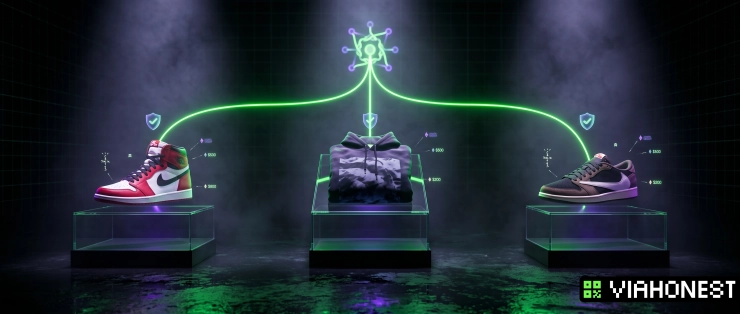
Streetwear and sneakers are already royalty-adjacent categories in spirit because provenance and scarcity drive pricing. StockX says nearly 200 brands set new all-time annual sales records on its marketplace in 2025, spanning sneakers, apparel, accessories, collectibles, and trading cards. eBay's Authenticity Guarantee now covers categories such as sneakers, streetwear, watches, jewellery, and trading cards, while GOAT requires resale products such as sneakers to be verified before delivery. Those are not fringe trust signals. They are indicators of a mature aftermarket where authenticity changes conversion.
That is why streetwear and collectible sneakers are ideal for royalties on resale. The buyer already expects scarcity. The marketplace already needs verification. The seller already benefits from brand story, timing, and drop culture. A royalty simply makes the economics catch up with the cultural reality.
Art and collectible items
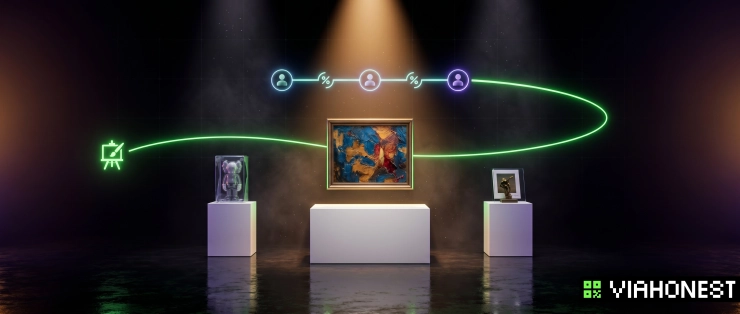
Art is the clearest proof that resale can create enormous downstream value after the original sale. The U.S. Copyright Office explicitly frames resale royalty rights as a response to the fact that visual artists may receive less benefit than downstream collectors when the value of a work rises over time. Meanwhile, DACS says artists and estates have claimed more than £144 million in Artist's Resale Right royalties since 2006.
The same logic increasingly applies to non-art collectibles. When the item is rare, provenance-sensitive, and culturally meaningful, later sales are not random noise. They are part of the product's commercial life. ViaHonest's own marketplace categories focus on sneakers, collectibles, art, and street art, and item-level listings can include royalties. That makes art and collectible goods especially strong candidates for a royalty-enabled model.
If you sell in any of these categories, the low-friction way to test the model is simple: start with one limited product, set a royalty, and see whether authenticated resale creates more trust and more long-tail revenue than a pure one-and-done launch. ViaHonest says sellers can begin with free listing, while buyers can register to browse and purchase through the same ecosystem. Start selling on ViaHonest, book a free demo, or launch your first drop only when the category genuinely fits the model; the point is not to force royalties onto every SKU, but to use them where resale already matters.
Why this becomes a new monetisation layer
Royalty-enabled resale is not just an extra fee rule. It changes how value is created. Instead of treating the secondary market as something that happens after the brand relationship ends, it treats resale as part of the product strategy from day one. That matters because the secondhand market is being reshaped by technology, consumer financial behaviour, and growing brand participation. ThredUp says all three are now driving the next phase of resale, while academic work on branded recommerce notes that platform-enabled resale creates opportunities for stronger brand experience control even as it raises classic cannibalisation questions.
That creates three practical growth levers for sellers. First, royalties can generate recurring revenue for sellers when the item appreciates or simply keeps trading. Second, transparent history and verification can make the initial purchase more compelling because buyers see a clearer path to future resale. Third, every resale creates more data about demand, value retention, and category fit, which can improve future launches. BCG's work on digital product passports points in the same direction: structured product data can reduce friction, improve authentication, and unlock additional value across resale and circular commerce.
There is also a strategic reason this matters in the United States. The U.S. does not have a general statutory resale royalty right for art under current copyright law, which means royalty participation usually has to be created contractually or platform-side rather than assumed by law. That makes marketplace design more important, not less. If royalties are going to work for commerce, infrastructure has to make them practical.
A soft way to introduce ViaHonest into the flow
For sellers, the appeal of ViaHonest is that it packages several hard problems together: free listing, a 2.5% fee after a completed sale, automatic wallet creation, public storefronts, product verification, and seller-set resale royalties. For buyers, the value proposition is just as important: easier registration, scan-based authenticity checks, visible ownership history, and more confidence when purchasing unique goods. That makes it a practical test bed for brands that do not want to build royalty, provenance, and trust infrastructure from scratch.
ViaHonest fits naturally into this model because it works as a resale marketplace that combines several elements usually fragmented across different platforms: product verification, ownership history, and resale royalties in one flow. Instead of building separate systems for trust, resale tracking, and payouts, sellers can test how a royalty-based model works within a single marketplace environment.
Conclusion
The old marketplace promise was simple: sell more units. The new opportunity is smarter: keep participating in the value your product creates after the first sale. That is why royalties matter. They do not replace primary revenue; they extend it. They do not make every product collectible; they reward the categories that already behave like collectibles. And they do not depend on vague theory; they depend on clear rules, product identity, and a trustworthy resale environment.
That is the clearest answer to how sellers earn more on marketplaces today. A seller royalties marketplace turns resale from a leak in the funnel into a new monetisable layer of brand value. For sellers in merch, limited drops, streetwear, art, and collectible goods, that shift can be the difference between getting paid once and building a product that keeps paying back. If the category fits, start selling on ViaHonest, book a free demo, or launch your first drop with one item and one clear royalty rule.
FAQ
Is ViaHonest free to start?
ViaHonest says listing is free and that it charges a flat 2.5% service fee only after a successful sale. It also presents "Start selling for free" and "Book a free demo" as core seller actions.
How do royalties work?
ViaHonest says sellers can set a royalty and receive automatic payouts when an item is resold. Its seller page specifies a 1% to 10% range, and its help content explains that the royalty is set once and then routed automatically on each subsequent resale.
What can I sell?
ViaHonest positions itself around categories where authenticity, scarcity, and provenance matter most. Its marketplace and about pages highlight sneakers, influencer drops, collectibles, art, and street art, and its seller materials also target creators, artists, founders, and resellers.
Can I sell to buyers in the United States?
ViaHonest's launch materials say the platform officially launched in the United States, and its own blog materials describe worldwide shipping support and global sell/buy flows. In practice, sellers should still check category rules, shipping capability, and any compliance requirements relevant to the goods they list.
Do I need my own website?
Not necessarily. ViaHonest says it provides a storefront, seller profile, listing flow, and transaction infrastructure, which means sellers can test demand inside the marketplace instead of building a full standalone commerce stack first.
Do I need technical Web3 knowledge to start?
ViaHonest says no. Its seller FAQ states that registration automatically creates a secure wallet and that the listing process is comparable to uploading a product with a photo, description, and price.
What is the simplest way to test how sellers earn more on marketplaces?
The simplest test is to choose one item that already has the right economics for resale, such as limited merch, streetwear, art, or a collectible, list it with clear proof of authenticity, and add a royalty percentage. That is the practical logic of a seller royalties marketplace: instead of rebuilding your whole retail stack, you validate whether resale participation can improve both the first sale and the revenue tail that follows.