
What are digital products? They’re intangible goods that are sold and delivered online - so the customer receives value through a download, a stream, an email link, or account access rather than a shipped box.
That delivery difference is also the cleanest line between physical goods and digital offerings. Physical products are tangible items you can touch, store, and ship; digital products exist in electronic form and are delivered electronically. As a result, creators trade “inventory and logistics problems” for “access and trust problems,” such as piracy, account sharing, or “I never received it” disputes.
This guide is written for a United States audience and focuses on what works in practice: definitions, proven examples, and a step-by-step approach for creating and selling responsibly.
If you’re planning to create or sell digital products, it can also help to start with a platform that simplifies setup and transactions. You can create an account on ViaHonest and explore how digital products can be listed, verified, and sold securely.
What Is a Digital Product?

At its simplest, a digital product is an item a customer obtains electronically. In ecommerce glossaries, it’s defined as an intangible item delivered electronically - such as music, ebooks, or software - where “anything that can be downloaded and used digitally” can qualify.
If you’re asking “what is a digital product” in an operational or compliance sense, the method of transfer is the core detail. U.S. state guidance often defines these offerings by whether they’re “transferred electronically,” with examples like downloading, streaming, or receiving a product by email.
Terminology varies by industry, and it affects taxation and consumer expectations. In product language, virtual products are often used as a near-synonym for digital items. In tax language, terms can be narrower: the Washington Department of Revenue, for example, defines “digital goods” as electronically transferred data, facts, information, sounds, images (and combinations) and distinguishes them from other “digital products” and from “digital automated services.”
Common formats buyers actually receive
Most digital offers fit into a few fulfillment patterns. You can mix them, but it helps to pick the primary model because it drives your pricing, support workload, and refund/dispute risk.
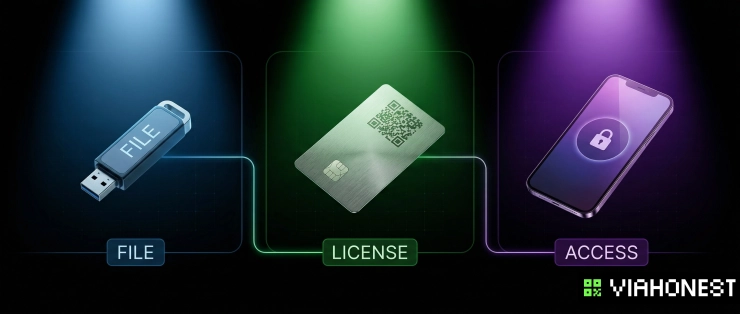
- File delivery. A PDF/ZIP/audio/video file delivered via download or email.
- License delivery. A key/code required to activate or access the product. FastSpring describes a license as a text string (a key/registration code/password) tied to fulfillment and secure download links.
- Subscription. Recurring billing for continued access; state guidance explicitly discusses subscription-based rights to obtain products transferred electronically.
- Access entitlement. Membership-gated content such as newsletters, private communities, or training libraries.
A helpful mental model is to separate the content from the right you’re selling. Many states explicitly discuss sales, leases, licenses, rentals, and subscriptions for electronically transferred products, which is a reminder that a digital sale is often about granting rights (permanent or time-limited), not transferring a “thing” the way a physical shipment does.
Digital vs. physical: what operationally changes
With physical goods, “delivery” is shipping, tracking, and returns handling. With digital goods, “delivery” is access control and proof of access. A buyer might love a workbook but still demand a refund if they can’t locate the download link, don’t understand the usage terms, or expected updates that weren’t included.
There’s also a business-economics shift. Industry research notes that digital products have no physical inventory, packaging, or shipping - and can be reproduced infinitely without additional manufacturing cost - creating materially different business economics than physical goods.
Examples and Types of Digital Products
Examples of Digital Products
Here is an example of digital products creators monetize in the U.S. market - especially when they’re tied to a clear outcome (learn a skill, save time, reduce errors, unlock a capability).
- Online courses (video lessons + templates) that can be sold repeatedly.
- Ebooks/audiobooks that package expertise or storytelling into a portable download.
- Design templates for slides, social posts, or resumes.
- Website themes and digital assets (icons, UI kits).
- Software or plugins sold as a license key or subscription.
- Digital art and graphics (illustrations, packs, custom commissions).
- Music/video access (downloads or streaming-style subscriptions).
- Webinars and replay libraries that keep generating value after the live event.
- Spreadsheets, calculators, and mini-tools that “productize” a workflow.
- Digital codes that unlock electronically delivered content (e.g., digital books or audio).
If you’re deciding among digital products to sell, a reliable heuristic is: start with what your audience already pays you for (time, advice, assets), then standardize it into a repeatable deliverable with clear instructions and predictable access.
Looking for more inspiration? See our full breakdown: “15 Best Digital Products to Sell Online in 2025"
Types of Digital Products
A useful way to classify types is by business model (how customers pay and how you fulfill). Common models include: (1) download-only, (2) license-based, (3) membership/subscription access, and (4) digital + physical bundles.
The model choice isn’t cosmetic - it sets expectations. If you sell a one-time file, buyers expect a clear download; if you sell access, they expect ongoing availability and support. Subscription models can reduce one-time launch pressure but raise the bar for consistent delivery: Subscription models are common across many kinds of digital content and often rely on paywalls such as free trials, metered access, or limited previews.
Why Sell and How to Build a Digital Product Business

Why sell digital products? Because you can scale without manufacturing: the same asset can be delivered to many customers after you create it once, and reproduction doesn’t require new physical production.
If you want to sell digital products sustainably, plan for the “invisible” parts of delivery - access instructions, support, and policies - before you scale traffic.
Key reasons creators choose this model:
- Scale without a warehouse: delivery is electronic, so growth doesn’t automatically require more logistics.
- Fast customer gratification: buyers can receive access instantly after purchase.
- Flexible monetization: choose one-time purchase, subscription, or license.
- Faster iteration: digital items can be updated without reprinting or reshipping.
Even if your product is “just a file,” compliance can be nontrivial. Sales tax rules for electronically delivered products vary by state and by product type (downloads vs. streaming vs. subscriptions), and sourcing can depend on where the buyer first uses the product or their billing information.State-by-state tax guidance and policy analysis from regulatory organizations emphasize that unclear definitions and changing rules can create real risk for sellers who must collect and remit tax.
What is selling digital products day-to-day? It’s largely about trust, access control, and dispute prevention.Industry research highlights piracy and unauthorized sharing as a core challenge, while payment networks note that chargebacks are a consumer-protection mechanism but can also be triggered by misunderstandings such as “never received.”
How to make digital products that customers can actually use:
- Choose a narrow, high-value problem and write a one-sentence promise (“I help X achieve Y without Z”).
- Pick the right model early (download vs. license vs. access).
- Build the smallest useful version first; you can iterate later.
- Package and onboard: a “start here” file, examples, and a simple onboarding checklist reduce confusion.
- Protect access with baseline controls (login requirements, download limits, expiring links). Those controls won’t stop determined piracy, but they do help with the most common real-world issues: accidental sharing, link forwarding, and “I lost my file” requests. Designing a reissue process (for example, generating a new secure link) keeps legitimate customers happy without leaving permanent open links floating around.
- Test the full purchase → access journey before launch. Automated delivery (instant links/instructions) reduces manual work and buyer confusion.
How to sell digital products reliably (operations checklist):
- Choose a channel (own site for control, marketplace for discovery).
- Make the offer easy to evaluate (previews, scope, outcomes).
- Automate delivery and keep proof-of-access records.
- Secure payments and customer data; Payment security standards emphasize PCI DSS-aligned systems and encryption as core elements of secure online payments.
- Plan for state-by-state sales tax complexity and recordkeeping; rules differ, and unclear definitions can increase seller risk.
- Publish a refund/return policy and surface it at checkout; the Federal Trade Commission advises consumers to check return policies and deadlines, while TermsFeed explains a return/refund policy’s role in setting eligibility, timelines, and the refund process.
A useful “minimum viability” standard is to make every order produce (1) a payment receipt, (2) a clear delivery message (link, password, license key, or login instructions), and (3) a support path. This matters because dispute processes often hinge on whether the customer could reasonably access what they bought and whether misunderstandings could have been prevented with clearer delivery and communication.
Common mistakes when selling digital goods (and why they cost you):
- Vague deliverables and unclear scope (buyers don’t know what they’re buying).
- Confusing fulfillment (buyers can’t access, so disputes follow).
- No access protection (easy unauthorized sharing).
- Ignoring licensing details for key-based products (activation confusion, misuse).
- Underestimating tax variation across states.
- Missing or hidden refund/dispute rules (customers don’t know what to expect, and misunderstandings escalate into complaints or chargebacks).
One expert nuance: tax “sourcing” for digital sales can be more complicated than for physical shipments. Wisconsin digital-goods guidance, for example, describes destination-style sourcing hierarchies (e.g., where the purchaser takes first use, delivery instructions, or billing address) and treats subscription timing differently. Designing your checkout and records to capture location signals is part of “selling professionally.”

How ViaHonest Helps You Sell Digital Products Securely
ViaHonest describes itself as a Web3-powered marketplace for secure, transparent transactions, emphasizing tokenized digital identities (including QR-enabled verification), escrow-style protection, and smart-contract royalties on resales.
Its start-selling materials also emphasize fast onboarding (including an auto-generated wallet flow) and position escrow as a way to protect both sides of a transaction.
For creators, its strongest fit appears to be digital releases where authenticity and ownership history are part of the value (for example, limited-edition digital drops or licensed digital collectibles). This is an interpretation of ViaHonest’s stated focus on verified digital authenticity and “digital intellectual property rights.”
How it can support secure selling:
- Escrow protection for both sides. ViaHonest states funds are released after confirmation.
- Verifiable identity and authenticity signals. ViaHonest describes unique on-chain IDs and verification for listed items.
- Royalties on resales. ViaHonest states sellers can set a 1-10% royalty and receive automatic payouts on resales.
- Fee positioning for creator economics. It publicly states no listing fee and a 2.5% fee on completed sales.
- Low-friction onboarding for sellers and buyers. ViaHonest describes multiple registration options (wallet-based and traditional methods) and fast onboarding.
For sellers, this means you can create an account, list quickly, and start testing demand without building an entire ecommerce stack upfront. For buyers, the same onboarding options reduce friction at checkout - important when the main value proposition is “trusted access” rather than shipping speed.
A smooth “start” looks like this: if you’re a seller, register, create a storefront, publish one small listing, and measure conversion before building a catalog. If you’re a buyer, register to complete purchases in a marketplace designed around verification and transaction protection.
Conclusion

Digital products are a scalable online business because there’s no physical inventory to ship and the same asset can be delivered repeatedly. But sustainable success comes from treating access control, policies, and buyer trust as part of the product - not as afterthoughts. Start small, ship fast, and let real customer behavior guide your next iteration.
Start with a simple idea, build a minimal version, and test demand. And when you revisit the core question - what are digital products? - keep it practical: they’re intangible goods delivered online, and the real advantage comes from creating something genuinely useful and selling it safely, with a clean path from payment to access.
If you want to start selling digital products with built-in verification, escrow protection, and simple onboarding, you can create an account on ViaHonest and publish your first listing to test the market.