
User-generated content is content created by customers, users, or communities, and the best user generated content examples show how brands build trust through real experiences - without needing to “sell” so hard.
Brands keep investing in UGC because it solves a core problem in modern commerce: attention is expensive, but credibility is priceless. When shoppers see real people using (and sometimes critiquing) a product, it feels more authentic than polished campaigns, creates social proof, increases engagement, and can lift conversion - especially when reviews include photos, videos, and Q&A that answer the “Will this work for me?” questions.
Before we dive in, it helps to be specific about what is ugc in a trust-and-conversion context: it’s verifiable, experience-based proof that reduces uncertainty at the moment of purchase. That’s exactly what the examples below demonstrate - and what your business can borrow and apply immediately.
What Is UGC

At its simplest, user-created content is publicly shared content made by individuals rather than brands - and it can include text, photos, video, reviews, testimonials, and community contributions.
A widely cited “classic” definition comes from the Organisation for Economic Co-operation and Development: user-created content is (1) made publicly available online, (2) reflects a certain amount of creative effort, and (3) is created outside of professional routines and practices.
In marketing and e-commerce, that definition expands in a practical way: UGC is a system of signals - reviews, visuals, Q&A, user stories, community posts - that helps buyers validate product fit and seller credibility. That “validation layer” is now so important that shoppers often abandon product pages that don’t have enough customer feedback.
What is a ugc creator
A modern complication is that not all “UGC-looking” content is organic. So, what is a ugc creator? In today’s creator economy, a UGC creator is typically someone who produces brand-sponsored content designed to feel authentic and relatable (often short-form video), which the brand then uses on its own channels or in ads.
This isn’t “bad” or “fake” by default - but it does raise a trust requirement: any material connection (payment, free product, incentives) should be disclosed clearly and conspicuously, especially for US audiences, because undisclosed endorsements can be deceptive. If you want to understand how this works beyond theory - and how people actually become UGC creators - our guide What Is UGC Content and How to Become a UGC Creator walks through the process step by step, from creating your first content to working with brands.
Why User-Generated Content Works
UGC works because it reduces perceived risk while increasing perceived honesty. The strongest implementations consistently rely on a few mechanisms:
- Risk reduction through “proof.” Research from the Spiegel Research Center found that displaying reviews can materially lift conversion, and that even a small number of reviews (e.g., five) can significantly increase purchase likelihood versus having none.
- Visual confirmation beats brand photography alone. In a large US consumer survey, PowerReviews reports that shoppers actively seek user-generated photos and videos, and that many say they’re more likely to buy when reviews include this visual content.
- Volume and recency signal legitimacy. Shoppers don’t just want “some” reviews - they interpret the presence of a healthy review base as a credibility indicator, and may leave product pages that have too few ratings and reviews.
- “People like me” social proof. Review research suggests that trust can increase when reviews come from identifiable (named) users rather than anonymous posts - one more signal that the experience is real.
- Two-way answers remove purchase blockers. In a US survey cited by 1WorldSync, a large share of online shoppers regularly read product Q&A, and many find peer answers more authentic than brand-provided information.
- Integrity matters more now that fake reviews are regulated. In the US, the Federal Trade Commission has a final rule targeting fake reviews and testimonials - making trust not only a marketing goal but a compliance requirement.
Together, these forces explain why UGC isn’t just “nice-to-have content.” It’s one of the most efficient ways to compress the trust-building timeline - from weeks of consideration down to a few seconds on a product page.
What Makes a Great UGC Example
Not all UGC builds trust. Some forms increase scepticism (for example, an unrealistic wall of perfect five-star ratings, or suspiciously similar review wording).
A high-quality, trust-building UGC example usually has these characteristics:
- Specificity over hype: it describes situations, constraints, and outcomes (size, use case, durability, shipping experience), not vague praise.
- Context-rich visuals: photos/videos show the product “in the wild,” which is why shoppers rate customer visuals as highly valuable at decision time.
- Identity and verification signals: “verified buyer” cues, named profiles, and authentic activity patterns increase confidence compared with anonymous, unverified feedback.
- Balanced sentiment: a believable mix (including constructive criticism) tends to outperform perfection, which can read as manipulated.
- Clear disclosure when sponsored: if a creator was paid or compensated, transparency protects both trust and compliance.
- Moderation that protects honesty (not vanity): removing spam and harmful content is good; suppressing legitimate negative reviews is risky, and the FTC has signalled heightened scrutiny around deceptive review practices.
A helpful mental model: great UGC doesn’t “sell.” It answers - often with proof.
This is also where infrastructure starts to matter. If you're building a product or marketplace where trust is critical, it’s worth thinking not just about collecting UGC - but about anchoring it to something verifiable. Platforms like ViaHonest are built around this idea, where each item can carry its own identity and history, making user-generated content more than just opinion - it becomes part of the product’s trust layer.
Best Examples of User Generated Content That Build Trust
Photo and video reviews on product pages

One of the strongest trust-building patterns is the combination of star ratings + written reviews + customer photos/videos directly on the product detail page. It works because it lets shoppers validate fit, colour, scale, and real-world usage - exactly the information that reduces returns and regret.
The data backs this up: surveys show many consumers actively seek user-generated visuals before purchasing, and report being more likely to buy when reviews include photos and videos.
Trust takeaway: don’t treat visuals as “extra.” Treat them as part of your product truth layer.
Ratings and review volume used as a credibility signal
Another “classic” UGC example is simply having enough reviews to feel real, and presenting them in a way that helps decision-making (filters, recent-first sorting, “most helpful” votes). The research from the Spiegel Research Center highlights that review presence can increase conversion significantly, and even early review volume matters.
Crucially, trust isn’t about “only five-star feedback.” The same research notes that a perfect rating can trigger scepticism (“too good to be true”), which is why transparent, balanced review ecosystems tend to win long-term.
Trust takeaway: optimise for credible reality, not for a cosmetically perfect rating.
Product Q&A as community-powered objection handling

Product page Q&A is an underused trust lever because it surfaces the questions that buyers are often embarrassed to ask a brand - but comfortable asking other customers.
In a US study shared by 1WorldSync, nearly three-quarters of online shoppers reported regularly reading Q&A sections. Many shoppers also rate peer answers as more valuable than brand answers, especially when answers come from verified buyers.
Trust takeaway: a good Q&A section is basically a “living FAQ” written by your most credible sales team: existing customers.
Apple and the “Shot on iPhone” challenge
Few campaigns illustrate UGC-as-proof better than Apple’s “Shot on iPhone” challenges. The concept is simple: instead of asserting camera quality, the brand features real photos from iPhone users, selected via a contest mechanism and displayed widely (including billboards and stores).
Because the submissions come from real users - and the rules are explicit about how to enter and what qualifies - this style of UGC helps create trust through transparent participation rather than vague brand messaging.
Trust takeaway: make the customer the “demonstration,” not the actor in a script.
GoPro and always-on community sourcing
GoPro’s UGC strategy is often cited because it industrialises authenticity: the brand runs ongoing awards/challenges where users submit photos and videos, and the best content is amplified through the brand’s channels.
The trust mechanism isn’t only “wow footage.” It’s the consistent message that real customers, filming real experiences, are the product proof - at scale and year-round.
Trust takeaway: build a repeatable system that makes sharing (and rewarding) genuine content part of your brand flywheel.
The LEGO Group and co-creation through community voting
UGC doesn’t have to be only marketing - it can be product development. The LEGO Ideas programme invites fans to submit set concepts and rally community support; projects that hit key thresholds can be reviewed for potential production.
This is trust-building for two reasons: it signals deep respect for the customer community, and it creates visible, auditable social proof (“thousands of people supported this”) before the product even exists.
Trust takeaway: when customers can participate in “what gets made,” trust shifts from transactional to communal.
Fan contests that turn consumers into creatives
Fan contests are powerful when they build on something customers already do, then channel it into a clear, branded moment. The Starbucks White Cup Contest, for example, leaned into customer cup doodles by inviting submissions via social sharing - turning everyday behaviour into a visible creative community moment.
A more production-heavy form is creator-made advertising. Doritos revived its “Crash the Super Bowl” format by inviting fans to create an ad for a chance to air during the Super Bowl and win a large cash prize - essentially crowdsourcing the most valuable ad slot in America.
Trust takeaway: contests work when participation rules are clear, incentives are fair, and the brand “shows its work” by featuring real submissions (not just announcing a winner).
Sephora and UGC as a shopping companion
Shopping for beauty is high-risk online (shade matching, skin compatibility, subjective outcomes). Sephora leans into UGC by actively inviting customers to share opinions through its ratings and reviews system, turning product pages into decision-support environments rather than catalogues.
Trust takeaway: UGC can function as “guided selling” when it’s structured, searchable, and clearly connected to products.
How to Use UGC in E-commerce
Most brands already have UGC scattered across review platforms and social media. The difference between “having UGC” and “earning trust with UGC” is operational: collection, governance, and placement.
- Instrument your product pages for validation. Shoppers treat ratings, reviews, customer images, and FAQs as decision factors - and may abandon pages that lack them. Prioritise UGC blocks near price, variants, shipping/returns, and the “Add to cart” area.
- Design for visual reality. Collect photo and video reviews intentionally (post-purchase prompts, simple upload UX). Many shoppers actively seek user visuals and say visuals increase purchase likelihood.
- Build a Q&A engine, not a static FAQ. A strong Q&A section addresses edge cases (“Does this fit a wide foot?” “Does it pill after washing?”). Survey results show Q&A is widely read and can be perceived as more authentic than brand copy.
- Protect trust with review integrity rules. Do not buy fake reviews, incentivise biased feedback, or suppress legitimate negative posts - US regulators have explicitly targeted these practices.
- Repurpose your best UGC across channels (with permission). Site → ads → email → PDP. The same “real customer proof” that converts on a PDP can raise performance in acquisition if disclosures and usage rights are handled properly.
- Measure downstream, not vanity metrics. Track conversion rate, return rate, time-to-purchase, and support tickets - UGC is fundamentally a risk-reduction asset, so measurement should reflect that.
For sellers, the next step is simple: make it easy for customers to contribute that proof. If you're listing products in an environment where reviews, ownership, and transaction history are connected (like on ViaHonest), every completed sale becomes a potential trust signal for the next buyer - without requiring you to “resell” the product from scratch each time.
UGC for Marketplaces and Web3 Commerce

Marketplaces raise the trust stakes because buyers aren’t only evaluating a product - they’re evaluating the seller, the listing, the shipment, and the possibility of fraud. In that environment, UGC is necessary but not sufficient; marketplaces also need stronger verification and transaction structure.
That’s why the “trust stack” for marketplaces increasingly looks like this:
- Experience proof (UGC): reviews, photos, unboxings, Q&A, and post-purchase updates.
- Identity proof: verified buyers/sellers and visible transaction history signals, which shoppers repeatedly say they value.
- Authenticity/provenance proof: especially for collectibles, limited drops, and high-consideration goods where counterfeits and misrepresentation are core risks.
- Safe transaction mechanics: escrow-like flows and clear dispute rules reduce the perceived “I might get scammed” tax that kills conversion.
Web3 commerce adds a twist: it can provide durable ownership records and provenance metadata, but it still needs great UGC to explain real-world condition, shipping outcomes, sizing, and buyer satisfaction. In other words: blockchains can record ownership; customers still judge experience.
How ViaHonest Can Help Brands Use UGC More Effectively
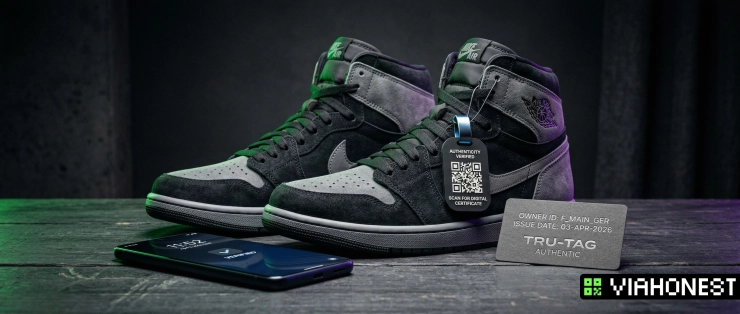
ViaHonest positions itself as a Web3 marketplace for real and digital goods with verified ownership and transparent provenance - exactly the kind of structural trust layer that makes UGC even more meaningful (because reviews sit on top of stronger authenticity signals).
For brands, creators, and marketplace operators, ViaHonest’s model supports trust-building UGC in a few concrete ways:
- Verified authenticity and digital identity: items can be linked to blockchain-based ownership records and verification mechanisms, helping buyer-generated reviews carry more weight (“this is real,” not just “this looks real”).
- Transparent provenance: when transaction history is part of the asset record, UGC becomes a richer narrative - buyers can share not only opinions, but verifiable context.
- Seller-friendly economics: ViaHonest states that listing is free and applies a flat service fee after a successful sale, framing a clearer path for sellers who want to build trust through post-purchase UGC without stacking heavy platform costs.
- Marketplace education: ViaHonest publishes explanatory material about Web3 marketplaces and tokenisation, which can help mainstream buyers understand why “verification + community proof” is stronger than reviews alone.
A practical, non-spammy way to weave this into your growth loop: encourage sellers to onboard and list items, then systematically request photo reviews and Q&A participation after delivery; buyers who register and purchase can then add the exact kind of real-world proof that future shoppers rely on.
Over time, this creates a compounding effect: each transaction doesn’t just generate revenue - it builds a visible layer of trust. For buyers, that means less uncertainty before purchasing. For sellers, it means fewer repetitive questions and faster decisions.
Conclusion

The best user generated content examples work because they show real experience, not polished brand messaging - and they give shoppers credible proof at the exact point of uncertainty. UGC can include reviews, photos, videos, testimonials, and social posts, and it becomes most powerful when it’s structured (PDP placement, Q&A, verification cues) and protected (disclosure, anti-fake-review integrity).
For marketplaces and modern commerce brands, user generated content isn’t merely “content marketing” - it’s a trust and conversion system. And when you pair UGC with stronger authenticity infrastructure (especially in Web3 commerce, where provenance and ownership records can be native), you don’t just persuade customers - you help them feel safe enough to transact.