
Most creators can earn real income — but usually not from a single "magic" source.
A common question people ask is simple: do content creators make money? The short answer is yes — but rarely from just one stream.
In practice, healthy creator monetization blends platform payouts, brand budgets, audience support, and direct sales into a mix that fits your format and your followers’ expectations.
This topic is more than curiosity; it’s a mainstream business question now that the creator economy is scaling fast. Goldman Sachs estimates the creator economy’s total addressable market could roughly double to about $480 billion by 2027. In the US, Interactive Advertising Bureau projects creator economy ad spend to reach $37 billion in 2025, reflecting how marketing dollars have shifted toward creator-led media.
In this guide you’ll learn 12 income streams that creators use today — plus how to choose the right combination, what mistakes to avoid, and how platforms for selling products can help you turn attention into repeatable revenue.
Understanding monetization in content creation

What monetizing content actually means
At its simplest, monetization is turning what you publish — videos, newsletters, streams, podcasts, templates, communities, products — into revenue. Research on the creator economy frames creators as people who generate and post digital content using platforms and tools, often reaching audiences without traditional intermediaries.
In a creator business, income rarely comes from “content” alone. Instead, content functions as a distribution layer: it earns attention and trust, and then channels that trust into a transaction (a purchase, a subscription, a referral, or a contract). That’s why monetization tends to be strongest when your content makes the next step obvious: exactly what you offer, who it’s for, and what outcome it delivers.
Why multiple income streams matter
Relying on one revenue source makes your business fragile. Platforms and policies change, ad markets move in cycles, and one brand client can pause spend overnight — so diversification is risk management, not just a growth tactic. Industry reporting suggests this is already how durable creator businesses operate: creators increasingly build parallel businesses (products, subscriptions, services) that can outlast algorithm changes and shifts in platform priorities.
When content creation becomes profitable
Is content creation profitable? It can be — when you treat it like a business with clear positioning, repeatable offers, and basic financial discipline (pricing, margins, and a plan for taxes and expenses).
So if you’re wondering, do content creators make money consistently? The ones who do build systems: diversified revenue streams, clear value propositions, and offers designed to convert attention into predictable income.
Profitability usually depends on three levers:
- Format economics. Video and livestreaming can unlock ad and fan-funding tools, while newsletters often monetize best through subscriptions and sponsorships.
- Audience fit. A smaller audience with high trust often converts better than a large, general audience — especially for paid newsletters where conversion from free to paid is frequently single digits.
- Business strategy. Many creators earn something, but a large share still earns modest monthly income, which is why productization and diversification matter.
Twelve income streams for content creators

These 12 income streams are building blocks. Most creators don’t use all of them at once; they pick a few that match their strengths and add more over time.
A useful rule of thumb while you’re building momentum is to pair one reach-based stream (ads, performance programs, or brand partnerships) with one relationship-based stream (subscriptions or products). The first grows with views; the second grows with trust. This “two-engine” approach mirrors how many creators actually get paid in practice — stacking brand work, affiliate links, and direct audience support instead of waiting for one platform feature to cover everything.
- Platform advertising revenue share (ad monetization). If you publish long-form video, ads can become a baseline layer. For example, YouTube states that partners who accept Watch Page ads are paid 55% of net ad revenues from ads shown on their videos. Ads can be volatile, but they scale well once your library compounds and viewers keep discovering older videos.
- Platform performance programs (payouts for eligible content). Some platforms pay based on how eligible content performs rather than on direct sales. TikTok describes its Creator Rewards Program as rewarding eligible creators based on the performance of videos that meet program requirements. The upside is faster feedback; the downside is dependence on program rules and metrics you don’t control.
- Brand sponsorships and paid partnerships. Brands pay creators for access to attention, trust, and creative that fits each platform’s native style. eMarketer estimates US influencer marketing spending will hit $10.52 billion in 2025, signaling sustained demand for sponsored content. If you take paid deals, follow disclosure expectations: Federal Trade Commission guidance emphasizes clear disclosures when there is a “material connection” to a brand.
- Affiliate marketing (commission on sales you drive). Affiliates work best when your content includes comparisons, product education, or “what I use” workflows. Commission rates vary by program, and most affiliate networks publish category-based rates depending on product type. The strategic advantage is that affiliate income can scale without inventory — just keep trust by recommending only what you’d genuinely stand behind.
- Fan funding, tips, and digital gifts. Live and interactive formats unlock audience micro-payments. On Twitch, Bits are designed so affiliates receive a share equal to 1 cent per Bit used to cheer for them. On TikTok, Video Gifts allow viewers to react and can help creators collect Diamonds. These tools reward community moments — Q&As, premieres, live coaching, or gameplay sessions.
- Paid subscriptions and memberships (recurring revenue). Subscriptions turn your most engaged followers into predictable monthly income. Instagram explains that Subscriptions let creators offer exclusive content and benefits for a monthly fee. Patreon offers recurring memberships and (for many new creators) charges a 10% platform fee for access to core features like memberships and audience tools.
- Paid newsletters and reader-supported publishing. If your value is insight, curation, or commentary, newsletters can monetize directly through paid subscriptions. Substack states that enabling paid subscriptions applies a 10% platform fee plus payment processing fees. Substack’s own guidance suggests a typical conversion rate of 5–10% from free to paid subscribers — useful for forecasting what “realistic” looks like.
- Digital products (templates, presets, scripts, mini-tools). Digital products are attractive because you create them once and sell them repeatedly. Digital goods are attractive because they have low overhead (no inventory or shipping) and can deliver high margins. Start simple: sell the asset that saves your audience the most time — an editing pack, a pitch-email template, or a workflow checklist.
- Online courses, cohorts, and coaching. Courses work when you offer a clear transformation (before → after) and a repeatable framework. The online education category has scaled into a major part of the creator economy, with many creators earning substantial revenue from structured courses, workshops, and coaching programs. If you’re new, start with a live workshop: the feedback loop improves your curriculum and your marketing copy without months of building in isolation.
- Merchandise and print-on-demand. Merch works when it signals identity (“I’m part of this community”), not when it’s just your logo. Print-on-demand can reduce risk because items are produced only after an order is placed, which helps you avoid holding inventory. Focus on quality control and IP basics — because merch is a real product business, not a side joke.
- Services and consulting (productized expertise). Many creators earn more from “doing the thing” than from talking about the thing — at least at first. Creator economy research explicitly includes service providers among creators. A smart move is productizing your service (clear scope + price + timeline), then using content to attract inbound leads while you build scalable products.
- Licensing your work (royalties from reuse). If you create high-quality photos, video, or design assets, licensing can generate royalties when others reuse your work. Many stock and licensing marketplaces pay contributors a percentage of licensing revenue, and earnings can increase as your portfolio grows and your work gets downloaded more often. Rights management can also be a revenue layer at scale; for example, major video platforms publish copyright transparency reporting showing that automated rights systems have paid billions to rightsholders over time.
How to choose the right monetization strategy

Choosing income streams is easier when you stop thinking in “platform features” and start thinking in “business mechanics”: what you sell, who buys it, and why they trust you.
A practical selection framework:
- Start with your strongest conversion trigger. Education creators often sell courses, templates, or consulting; entertainment creators often lead with ads, fan funding, and merch.
- Decide what you want to fulfill. If you hate customer support and shipping, lean into subscriptions, affiliate content, or licensing; if you love product craft, build digital/physical offers.
- Aim for one scalable stream + one stable stream. Example: ads (scalable) + memberships (stable), or brand deals (scalable if you raise rates) + digital products (stable).
- Build owned distribution early. Email and community reduce dependency on algorithmic reach.
- Add a “ladder,” not random offers. A ladder might be: free content → $29 template → $249 workshop → $1,500 coaching. This keeps marketing simple and gives your audience a clear next step.
- Test like a product manager. Run short experiments (30–60 days): one offer, one channel, one metric, then iterate.
Common monetization mistakes to avoid

A lot of creators stall not because they lack talent, but because they treat monetization as an afterthought — adding “buy my thing” after the content is already published, with no clear offer logic.
Common pitfalls that slow growth:
- Building only on platform-dependent revenue. If all income comes from one algorithm, your business becomes unstable when policy and distribution shift.
- Under-disclosing paid relationships. The FTC expects clear disclosures when there is a material connection to a brand.
- Pricing without a value story. If your audience doesn’t understand the outcome, they default to “free.”
- No system for repeat buyers. One-off sales are fine, but subscriptions, email, and product ladders create compounding revenue.
- Ignoring IP and licensing realities. If you sell merch or reuse media without rights, you can trigger takedowns; in the US, the DMCA framework includes notice-and-takedown procedures that platforms follow.
- Letting fulfillment crush your content schedule. Overpromising perks or shipping timelines can kill consistency — the very thing that keeps your funnel alive.
How ViaHonest helps creators earn from products
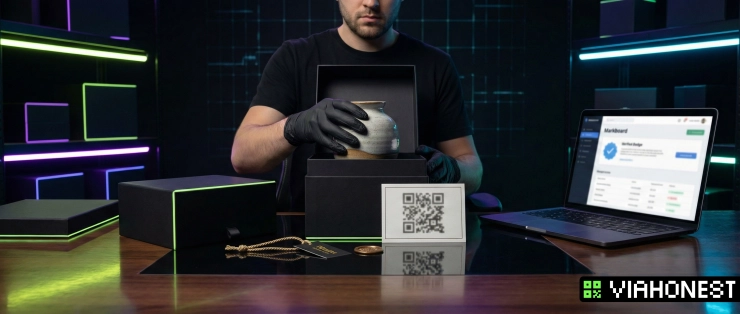
Most income streams eventually hit the same bottleneck: trust at the moment of purchase. Viewers might love your content, but hesitate when they can’t verify authenticity, worry about scams, or fear counterfeits — especially for limited drops and physical goods.
ViaHonest positions itself as a Web3-powered marketplace that bridges physical goods and digital identity. The platform describes creating a unique digital identity for items through tokenization and QR codes so buyers can verify origin, authenticity, and ownership history. For creators, that can turn “trust” into a feature: you’re not just saying your drop is authentic — you’re pointing fans to a listing where authenticity is verifiable.
From a creator-business perspective, three platform mechanics stand out:
- Lower friction to start selling. ViaHonest says it does not charge a listing fee and takes 2.5% after a sale, while also describing storefront setup and escrow protection.
- Royalties on secondary sales. ViaHonest states sellers can set a royalty of 1–10%, and a smart contract automatically sends your share when items are resold — useful if your merch or collectibles develop a resale market.
- Buyer-friendly onboarding options. ViaHonest describes registration options including connecting MetaMask, social login, or email/password, which can reduce friction for both sellers and shoppers.
A practical way to use this without overcomplicating your workflow: list one “hero” product first (your most requested item), write a short FAQ for your audience (shipping, authenticity, perks), then promote it in a single high-intent piece of content rather than spamming links everywhere.
Conclusion

Creators earn money when they package attention into something valuable — distribution for brands, convenience for buyers, belonging for members, and outcomes for students. The most resilient creator businesses treat revenue as a portfolio: combine a few streams that scale with audience growth and a few that stay stable when algorithms or ad budgets fluctuate.
If you want a practical answer to how to make money as a content creator, start by picking two streams, testing them for 60 days, and then adding a third once you can forecast results. And if product sales are part of your plan, registering on ViaHonest gives you a place to list items as a seller — and a marketplace where your audience can sign up as buyers and shop with more confidence.