
If you’re wondering what is ecommerce, the short answer is simple: it’s the buying and selling of goods and services over the internet. In practice, ecommerce can be as straightforward as a customer clicking “Buy now” on a product page, paying digitally, and receiving the item at their door - or downloading a digital product instantly.
At a high level, online commerce works like this: a seller lists products online, a customer discovers them through search/social/ads/email, the customer completes checkout, and the seller fulfils the order (shipping, delivery, or digital access), while handling support and returns. That loop is repeatable - and scalable - when you build the right systems for payments, inventory, and customer experience.
Ecommerce keeps growing because consumers are comfortable buying online, and because businesses can reach customers far beyond their local area with comparatively low “storefront” overhead. In the US, the U.S. Census Bureau reported that ecommerce accounted for 16.6% of total retail sales (seasonally adjusted) in Q4 2025, and total ecommerce sales for 2025 were estimated at $1,233.7B. At the global business level, UN Trade and Development (UNCTAD) highlights that business ecommerce sales grew nearly 60% from 2016 to 2022, reaching $27 trillion.
For people searching how to get into ecommerce, the key is remembering that you don’t need a perfect brand, a huge inventory, or a complex tech stack on day one - you need a clear offer, a reliable way to collect payment, and a fulfilment plan you can actually execute. The rest comes from iteration. This article is written as one of those practical ecommerce guides: it prioritises decisions, trade-offs, and real launch steps over buzzwords.
Ecommerce fundamentals
What Is Ecommerce?
A strong, measurement-friendly definition comes from Organisation for Economic Co-operation and Development guidance: ecommerce transactions are classified by how the order is placed or received, and it does not depend on the payment method or delivery channel. In other words, if the order happens over computer-mediated networks, it counts - even if the product is delivered physically later.
A simple way to explain ecommerce to a first-time founder is:
- Ecommerce is a digitally ordered transaction.
- The storefront can be your own site, a marketplace listing, or even a social storefront - what matters is that the customer can place an order online.
- The selling “engine” is a combination of product presentation (photos, price, offer), trust signals (policies, reviews, verification), and a payment + fulfilment workflow.
Who participates in a typical ecommerce transaction:
- Seller: creates the offer, sets pricing, fulfils, supports.
- Buyer: searches, compares, pays, receives, reviews/returns.
- Platform(s): the store builder or marketplace, payment processor, shipping carriers, customer-service tooling.
How does ecommerce work?

Most ecommerce businesses look different on the surface (handmade goods vs. electronics vs. digital files), but behind the scenes the workflow is surprisingly consistent:
- Traffic generation: SEO, ads, social, email, affiliates, marketplaces.
- Landing + product discovery: category pages, search, product pages.
- Conversion: cart → checkout → payment authorisation.
- Order management: confirmation emails, fraud checks, inventory updates.
- Fulfilment: pick/pack/ship or digital delivery.
- Post-purchase: tracking, support, returns/exchanges, retention marketing.
One practical performance note: mobile experience is not optional. Google warns that research indicates 53% of visits are likely to be abandoned if pages take longer than 3 seconds to load - a direct hit to conversion if your store is slow.
Business models and examples
Types of ecommerce business models

There are two useful ways to classify ecommerce models: who sells to whom and how fulfilment happens.
The “who-to-who” models (helps you understand pricing power and customer expectations):
- B2C (Business to Consumer). Brands selling directly to individual shoppers (common for DTC and most online stores).
- B2B (Business to Business). Wholesalers, manufacturers, SaaS-like ordering portals, repeat procurement workflows.
- C2C (Consumer to Consumer). Marketplaces enabling individuals to sell to individuals (often resale/collectibles).
- DTC (Direct to Consumer). A B2C strategy where the brand controls the customer relationship (data, margins, retention).
Operational models (decides cash needs, complexity, risk):
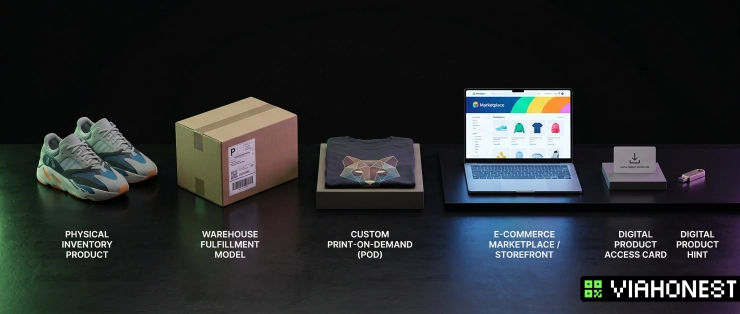
- Inventory-led. You buy/produce stock, store it, ship it (higher capital, more control).
- Dropshipping. You sell, a supplier ships (lower upfront inventory cost, but lower control and often tighter margins).
- Print-on-demand. A special case of dropshipping for custom-printed items.
- Digital products. Fulfilment is instant; your “cost” is usually marketing + platforms + refunds/support.
- Marketplace-first. You sell inside existing platforms to borrow demand, then expand to your own site.
Examples of ecommerce businesses
These examples are useful because they map to different “go-to-market” strengths:
- Marketplace giants (instant traffic, higher fees, less control): large global marketplaces offer significant built-in demand, but typically charge subscription and selling fees.
- Creative and handmade marketplaces: platforms focused on handmade or vintage goods often charge a transaction fee on each sale.
- General resale marketplaces: resale-focused platforms are commonly used by new sellers to test demand, with fees varying by category and order value.
- Brand-owned storefronts: independently managed online stores typically prioritise brand control and long-term customer relationships.
- Content-driven commerce: stores built on flexible, content-first systems are common when SEO and long-form content are central; core tools may be free, with costs shifting to hosting, themes, and extensions.
Why start an ecommerce business

The case for starting now is not “because ecommerce is trendy” - it’s because the distribution and tooling are mature, and demand is proven.
Key reasons to start:
- Large, growing demand. Ecommerce is a meaningful share of US retail sales, and the market continues to expand over time.
- Lower fixed costs than physical retail. You can launch without leasing space or staffing a store, especially with digital goods or dropshipping.
- Broader reach: you can sell nationally (or globally) from day one, depending on logistics and compliance.
- Fast experimentation: you can test product-market fit with small batches, limited drops, or single-SKU offers before expanding.
- Data feedback loops: ecommerce gives you measurable signals (traffic, conversion, AOV, refunds) that help you improve faster.
How to start an ecommerce business step-by-step guide
If you want a repeatable launch process, think in phases: validate → build → launch → improve.
- Pick a business model that matches your constraints. Decide upfront whether you’re inventory-led, dropshipping, digital, or marketplace-first. Your model determines cash needs, margins, and risk.
- Choose a niche based on “pain + willingness to pay”. A niche is not just a category (“fitness”). It’s a specific buyer with a specific job-to-be-done (“home kettlebell buyers who need apartment-friendly storage”). Validate by checking: existing competitors, pricing ranges, and whether people search for the problem.
- Define your core offer (one sentence). Example framework: “I sell X to Y, so they can achieve Z, without pain point A.” A clear offer makes every other step easier: product pages, ads, email, and even customer support.
- Build trust before you build complexity. The fastest way to lose conversion is to look untrustworthy. Prioritise: clear product photos, transparent shipping/returns, and a checkout that doesn’t feel risky.
-
Choose your selling channel(s). A practical approach is to start with one primary channel and one secondary:
- Primary. Your store (brand control) or a marketplace (fast demand).
- Secondary. Social or email for retention.
- Set up payments with realistic fee expectations. Payment processors typically charge a percentage + fixed fee per transaction. For example, many payment processors charge around 2.9% + a fixed fee per successful card transaction, depending on region and provider. Some payment providers publish fee structures that can include a percentage plus a fixed fee per transaction, depending on the payment method.
- Design fulfilment like a promise, not a task list. Decide: processing time, packaging, carrier options, tracking, and your returns policy. Overpromising shipping speed is one of the fastest ways to generate chargebacks and negative reviews.
- Launch with a measurable, time-boxed plan. A strong first launch is usually a 2-4 week sprint with one clear goal: first 25-100 orders or first $X revenue, then review. Instrument your basics: conversion rate, AOV, CAC (if paid ads), return rate.
- Iterate: improve conversion before scaling ads. If your product page converts poorly, buying more traffic just buys more disappointment. Fix speed and mobile UX (again: slow pages lose visitors), tighten your offer, and remove friction in checkout.
If your category depends heavily on authenticity and provenance (collectibles, limited drops, premium goods), your startup path can also include choosing a marketplace where verification is built in. That’s where platforms like ViaHonest can be strategically useful for early trust-building.
Best Ecommerce Platforms and What They Cost
There is no single “best” platform - only the one that fits your business model, technical ability, and growth goals.
Broadly, ecommerce platforms fall into several categories:
- All-in-one store builders: designed for fast setup with integrated hosting, payments, and management tools. Ideal for beginners and growing brands.
- Flexible open systems: more customizable solutions suited for content-heavy or SEO-driven businesses, often requiring additional setup and maintenance.
- Scalable commerce platforms: designed for larger operations, offering advanced features such as multi-store management, international selling, and complex catalogs.
- Marketplaces: platforms with built-in demand where you can start selling quickly, but with less control over branding, customer data, and margins.
- Website builders with ecommerce features: simple tools for launching smaller stores with a strong focus on design and ease of use.
Practical rule:
- Start with a marketplace if you need demand immediately
Costs of starting an ecommerce business
The cost of starting an ecommerce business depends on your approach - whether you build your own store or sell through existing platforms.
A practical way to think about costs is to divide them into three categories: setup, ongoing, and per-transaction.
Common cost categories:
- Storefront and platform costs. Subscription fees vary depending on the type of platform, from basic plans for new sellers to advanced tiers for scaling businesses.
- Marketplace fees. Marketplaces typically charge a combination of listing fees, transaction fees, and category-based commissions.
- Payment processing fees. Most payment providers charge a percentage of each transaction plus a fixed fee. These costs apply to every sale and directly impact margins.
- Domain and infrastructure. Domains are usually billed annually, while hosting and security may be bundled into all-in-one platforms or require separate setup.
- Logistics and operations. Packaging, shipping, returns, and customer support are ongoing costs that are often underestimated early on.
- Marketing and acquisition. Content, ads, influencer collaborations, and email tools become the largest expense as you scale.
Key takeaway:
You can start with relatively low upfront costs, but every order carries variable expenses. Sustainable ecommerce businesses are built by managing margins, not just generating sales.
Common mistakes to avoid
Most failed ecommerce attempts aren’t caused by one big mistake - they’re caused by a few small ones compounding.
- Starting with too many products instead of one clear hero offer (creates inventory, content, and support chaos).
- Ignoring unit economics: if fees + shipping + returns eat your margin, more sales can make you less profitable.
- Weak trust signals: unclear policies, thin product pages, or no verification mechanism for high-risk categories.
- Slow mobile experience: page speed directly impacts abandonment risk.
- Over-reliance on a single acquisition channel (e.g., only ads) before product-market fit is proven.
- Underestimating fulfilment (late shipping, poor packaging, no returns workflow).
- Treating “launch” as the finish line: the real work is post-launch iteration - conversion, retention, and operations.
ViaHonest can help sellers and buyers start ecommerce

Most ecommerce platforms solve “how do I list and take payment?” ViaHonest’s positioning focuses on a slightly different - but increasingly important - problem: trust in online transactions, especially for unique, premium, or authenticity-sensitive items.
How ViaHonest can help you start as a seller:
- Lower upfront friction: ViaHonest states that listing is free, and it charges a flat 2.5% service fee only after a successful sale, with no monthly subscriptions.
- Built-in authenticity signals: the platform describes verified digital authenticity and linking physical goods with digital identity through tokenization and QR codes, enabling verification of origin, authenticity, and ownership history.
- Royalties and resale mechanics: the “start selling” page explicitly highlights automatic royalties as a platform feature - useful if your product has a secondary market.
- Marketplace context: ViaHonest describes itself as a multi-vendor marketplace for buying and selling unique items with verified ownership and provenance - positioning that can help sellers who need a trust narrative alongside their product.
How ViaHonest can help buyers (and why that matters for your conversion rate):
- Transparency as a product feature: ViaHonest’s “About” positioning emphasises helping buyers make informed decisions by providing more visibility into origin and ownership context.
- Verification-forward shopping: the marketplace messaging centres on verified ownership and provenance, aiming to reduce “is this legit?” hesitation that often prevents checkout in resale and premium categories.
A light, practical way to integrate ViaHonest into your launch: if you’re a creator or brand selling authenticity-sensitive products, register as a seller so you can list a small initial drop and learn demand quickly; and if you’re on the buyer side, registering lets you purchase within a system that emphasises provenance and verification.
Conclusion

At its core, what is ecommerce? It’s a scalable way to sell online - because ordering, payment, and fulfilment can be systematised and repeated. You can start with minimal investment by keeping scope tight (one niche, one offer, one channel), then expand as your numbers prove demand.
The most reliable path is still the simplest: choose a niche, launch with a clear value proposition, and treat this ecommerce startup guide mindset as ongoing iteration - measure, improve, and scale what works.