Naïve Authenticity and Punk-Grunge Texture: Navigating 2026 Art Trends
Contemporary art is becoming rough again. Surfaces look scratched, figures reject correct anatomy, text fragments interrupt composition, and spontaneous brushwork remains visible instead of being corrected. After years of polished digital imagery, friction has returned as a visual language. The naive art trend is not a nostalgic retreat into primitive mark-making. It is a deliberate refusal of excessive control.
This refusal is becoming increasingly relevant among painters, street artists, mixed-media creators, and digital authors. Audiences now encounter an endless stream of immaculate images that can be generated, adjusted, and replicated within seconds. Technical smoothness is no longer rare. As perfection becomes easier to produce, evidence of human hesitation acquires greater cultural and emotional value.
That is why the emerging art trends 2026 conversation is moving toward visible texture, distortion, improvised symbols, raw canvas, and materials that preserve the history of their application. Collectors are not simply looking for an attractive image. They are looking for an object with resistance, physical presence, and an identifiable artistic position.
Jean-Michel Basquiat remains central to this discussion because he demonstrated how abrasion, language, repetition, and visual chaos could carry intellectual force. Robert Nava offers a more recent model of naive authenticity, using deliberately unstable creatures and urgent lines to turn apparent simplicity into psychological tension. Their work should not be treated as a catalogue of effects to imitate. It should be studied as evidence that emotional precision does not require academic polish.
For independent artists, this shift creates an opportunity. Raw authenticity art can stand apart from generic digital content, but only when material decisions, conceptual intent, and authorship remain connected. The goal is not to make a painting look unfinished. The goal is to preserve the energy that overfinishing usually destroys.
The Cultural Rebound Against Digital Perfection
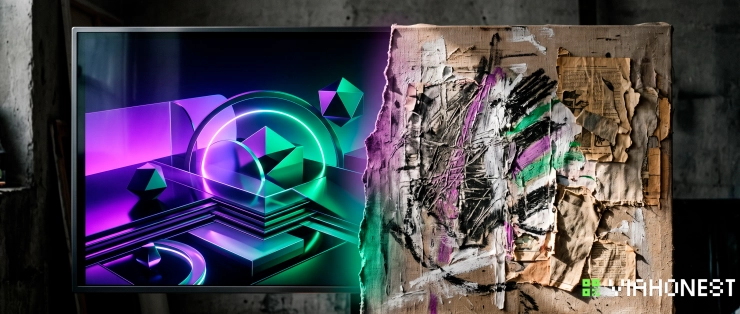
Every dominant aesthetic eventually generates its opposite. The clean visual culture of the past decade prioritized seamless gradients, controlled lighting, precise geometry, polished branding, and surfaces without physical history. These qualities once communicated technical sophistication. Today, they can also suggest interchangeability.
The cultural rebound against digital perfection does not mean that digital art is disappearing. It means that smoothness is losing its monopoly on perceived quality. A technically flawless image may attract immediate attention, yet a scarred surface or unstable figure can hold that attention longer because it refuses instant interpretation.
This is the digital smoothness counterpoint shaping the naive art trend. The more frictionless visual production becomes, the more artists and collectors value friction itself. A crooked line, exposed correction, uneven pigment deposit, or torn paper edge can operate as proof of encounter. It records a decision made by a particular person at a particular moment.
Rawness, however, cannot be reduced to mess. Random damage is not automatically meaningful, just as polished execution is not automatically empty. The strongest contemporary works use imperfection with purpose. Their surfaces may appear impulsive, but composition, rhythm, contrast, and symbolic repetition hold the disorder together.
The Demand for Visible Human Touch
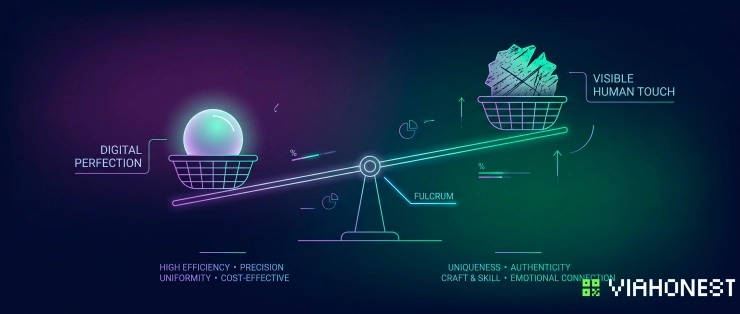
Visible human touch has become a form of scarcity. Generated content can reproduce styles, moods, and established visual codes at enormous speed. What it struggles to replace is the physical sequence of decisions embedded in an original object: the pressure of an oil stick, the drag of dry pigment, the stain that entered unprimed fabric, or the area where a figure was painted over and partially recovered.
Collectors increasingly respond to this opacity of process. They want to see that a work has been constructed, questioned, damaged, and redirected. The finished image matters, but so does the route taken to reach it. Visible texture allows the surface to function as a record rather than a neutral support.
In a neo expressionism painting, a thick contour may carry more than descriptive information. It can reveal speed, aggression, fear, humor, or uncertainty. A scratched layer can expose a previous color and create a compressed sense of time. A badly aligned collage fragment can disturb the hierarchy of the composition. These choices give the object a memory.
This demand also affects art market demand. When digital images circulate without clear context, collectors need stronger reasons to value a specific work. Material specificity, recognizable gesture, documented authorship, and coherent bodies of work help establish that difference. A painting made from raw linen, spray pigment, oil stick, charcoal, and pasted paper cannot be fully understood through a small screen preview. Its scale, texture, and physical irregularity become part of its collectible identity.
For artists, the lesson is not to manufacture artificial flaws. Forced authenticity is quickly recognizable. Instead, build a process in which uncertainty is allowed to remain visible. Avoid correcting every awkward contour. Let one layer contradict another. Preserve marks that reveal the speed of the first idea. The objective is to retain psychological truth without abandoning formal judgment.
A useful question is not, "Does this look finished?" It is, "Has the work reached the point where further refinement would reduce its force?" In raw authenticity art, stopping is often the most difficult technical skill.
Basquiat's Legacy: Abrasion, Text, and Visual Chaos
Basquiat's legacy extends far beyond crowns, skeletal heads, and graffiti-like lettering. His deeper influence lies in the way he transformed collision into structure. Anatomy, commerce, race, history, jazz, advertising, street language, and private notation occupy the same visual field. The paintings feel immediate because the artist does not resolve these systems into a single polite message.
A basquiat style texture is often misunderstood as a combination of dirty backgrounds, words, and energetic lines. Copying those surface features produces imitation rather than urgency. The important principle is that every mark behaves like an interruption. Text competes with image. Repetition turns a word into rhythm. Crossing something out can make it more visible. Abrasion prevents the surface from becoming passive.
Basquiat's fragments of language also demonstrate that writing inside a painting does not have to explain the image. Words can function as sound, accusation, inventory, interruption, or visual weight. They can be legible without being transparent. A phrase may suggest meaning while refusing to complete it.
Contemporary artists can apply this principle through personal vocabulary rather than borrowed symbols. Use fragments taken from lived experience, local signage, family phrases, technical language, overheard speech, or private research. Repeat terms that carry emotional pressure. Obscure some passages and expose others. Allow language to generate rhythm across the surface instead of placing a quotation in the center as decoration.
Abrasion can be approached with similar intention. Sanding, scraping, wiping, staining, and overpainting should reveal conflict between layers. If every distressed area looks identical, the treatment becomes a filter. A convincing surface needs variation. Some marks should penetrate deeply, while others barely disturb the upper layer. Some corrections should remain obvious. Others can survive only as faint evidence beneath new paint.
Visual chaos works when it contains internal hierarchy. Basquiat's compositions may appear explosive, but recurring colors, directional lines, repeated signs, and shifts in density guide the eye. Artists pursuing punk-grunge texture should therefore distinguish between active and quiet zones. If every centimeter shouts, the work loses tension. Rawness becomes more powerful when it meets restraint.
Deconstructing the Modern Naïve Aesthetic
The modern naïve aesthetic does not depend on a lack of education. Many artists who use awkward anatomy and simplified forms understand conventional draftsmanship perfectly well. Their distortion is a choice. They reject proportion because proportion would weaken the emotional function of the image.
This distinction is essential to the naive art trend. Childlike does not mean childish. A simple figure can carry anxiety, violence, vulnerability, satire, or myth. The apparent directness of the form allows the viewer to encounter the emotion before analyzing technique.
The strongest works in this field balance immediacy with control. Their lines may wobble, but the placement of those lines is decisive. Their figures may be anatomically impossible, but the distortion establishes character. Their materials may clash, but the clash supports the psychological temperature of the work.
Naïve Authenticity: Nava, Shrigley, and Stik
Robert Nava's creatures are valuable to study because they resist the assumption that sophistication must look refined. Dragons, sharks, angels, and hybrid monsters emerge through blunt outlines, unstable proportions, and fast color. They appear accessible at first, yet their emotional tone remains uncertain. They can be comic and threatening, clumsy and monumental, familiar and impossible at the same time.
The lesson is not to imitate Nava's monsters. It is to understand how distortion can become a personal grammar. An artist might stretch hands to emphasize helplessness, flatten a face to remove individuality, enlarge teeth to convert humor into danger, or compress a body until it feels trapped by the canvas. Emotional distortion should respond to the subject rather than function as a fashionable effect.
David Shrigley demonstrates a different form of naïve authenticity. His economical drawings use awkward lines and blunt language to expose absurdity, insecurity, and social discomfort. The visual simplicity is inseparable from timing. A line of text and an apparently crude figure create tension because neither behaves like polished illustration.
Stik shows how reduced figures can acquire social and spatial power. Minimal bodies, circular heads, and direct gestures become recognizable across walls and public spaces. Reduction does not eliminate meaning. It concentrates meaning into posture, distance, and relation.
Together, these approaches reveal that naïve authenticity is not one style. It is a method of removing academic habits that obstruct direct communication. For one artist, that may mean simplifying the figure. For another, it may mean introducing deliberately incorrect perspective. For a digital author, it may mean preserving rough input marks rather than allowing automated smoothing to standardize every contour.
To develop a credible visual language, repeat forms without making them identical. Build a vocabulary of figures, symbols, colors, and gestures that can evolve across multiple works. A recognizable practice is created through continuity, not through copying the most visible traits of an established artist.
Artists should also protect the difference between spontaneity and carelessness. Spontaneous brushwork carries commitment. Careless brushwork avoids decisions. The first has direction, pressure, and rhythm. The second merely fills space. Even the roughest painting benefits from moments of revision, distance, and critical looking.
Mixed-Media Tactics: Layering Spray Paint, Oil Sticks, and Raw Canvas
Mixed media is one of the most effective ways to create surfaces that resist digital uniformity. Spray paint creates atmospheric expansion and hard-edged interruptions. Oil sticks produce dense, immediate lines. Charcoal contributes instability. Paper introduces a separate material history. Raw canvas absorbs liquid pigment and leaves stains that cannot be fully reversed.
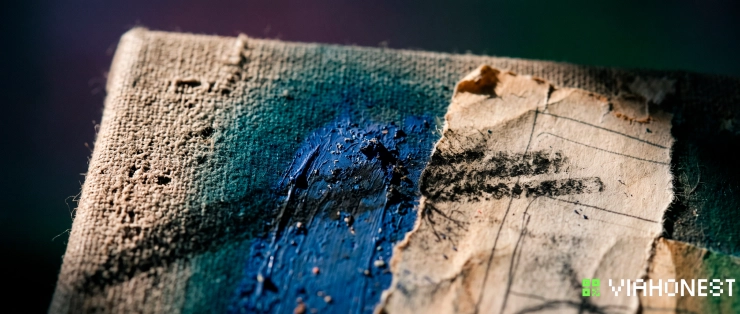
Begin by considering the support as an active visual element. Unprimed canvas produces a dry, exposed character and allows stains to spread into the fibers. It can also be more vulnerable than a conventionally prepared surface, so artists should understand the long-term behavior of their chosen materials. Experimentation is strongest when it is informed rather than accidental.
Build the first layer quickly and avoid defining the final image too early. A stain, broad spray field, or sequence of loose marks can establish atmosphere without fixing the composition. Allow empty fabric to remain visible. Raw support can function as color, pause, and evidence of process.
Introduce drawing while the composition is still unstable. Oil sticks and charcoal can create lines with different levels of authority. Press heavily in areas that need structural weight, then use broken, dry contact where the image should feel uncertain. Avoid tracing every form with the same pressure. Uniform emphasis destroys the nervous energy associated with neo expressionism painting.
Layer incompatibility can generate productive tension. A translucent stain beneath an opaque pastel mark produces depth. Spray paint crossing a rough oil line creates a conflict between atmosphere and body. Torn paper interrupts continuous gesture. Scraped paint reveals what the latest layer attempted to conceal.
Drying time should become part of the composition. Working wet into wet creates contamination and unpredictable blending. Waiting between layers preserves sharper contradictions. Neither method is superior. The decision depends on whether the painting needs fusion or collision.
Text and symbols can enter after the first visual structure has formed. Write with the same attention used for drawing. Vary scale, orientation, legibility, and repetition. Cross out a phrase only when the act of cancellation adds meaning. Decorative censorship weakens the surface, while genuine revision can intensify it.
Finish by editing rather than polishing. Remove weak areas, cover predictable passages, and protect the marks that carry the original emotional charge. A final layer should not simply make the work busier. Sometimes one flat color block, one erased figure, or one exposed section of canvas is enough to restore tension.
Applying Raw Aesthetics across Physical and Digital Formats
Raw aesthetics are not limited to physical painting. Digital artists can build convincing visible texture, but the process must preserve irregularity rather than simulate it with a repeated distressed overlay. The difference is crucial. Repeated texture becomes wallpaper. Responsive texture behaves like material.
Create digital brushes from original marks whenever possible. Ink blots, charcoal drags, scratched pigment, dry bristles, folded paper, and stained fabric can become source material. Preserve uneven edges, gaps, pressure changes, and accidental deposits. A useful brush should not produce the same mark at every scale or speed.
Within a Spaces workflow, texture sources can be imported through image input nodes, isolated through mask or background-removal nodes, adjusted with contrast and threshold controls, and converted into reusable monochrome mark assets. Transform and blend nodes can vary rotation, scale, opacity, and interaction between layers. Controlled variation prevents the texture from appearing mechanically stamped.
The digital smoothness counterpoint becomes stronger when clean and rough elements coexist. A perfectly rendered gradient beside a scratched figure can create more tension than a composition where every surface is distressed. Keep some zones precise so that roughness retains visual authority.
Digital distortion should also carry meaning. Instead of applying random warping, connect deformation to character or narrative. Stretch the body where pressure is felt. Break the outline where identity becomes uncertain. Compress text where communication fails. Use displacement, masking, and layered opacity to produce emotional structure rather than generic glitch aesthetics.
Hybrid workflows offer another route. A digital composition can be printed, marked physically, photographed again, and returned to a Spaces workflow for further layering. Alternatively, physical textures can enter the process early and influence the entire image. Each transition between formats creates translation errors, and those errors can become part of the work's identity.
Resolution deserves special attention. High resolution preserves subtle fibers and scratches, but excessive clarity can make every layer feel equally important. Selective softness can create depth and prevent the work from becoming a flat archive of detail. Texture should guide perception, not overwhelm it.
Artists working across physical and digital formats should document their process. Record materials, dimensions, edition status, creation stages, and the relationship between digital files and physical objects. In a market increasingly concerned with authorship, this documentation supports trust and helps collectors understand what makes a work specific.
The final objective is not to make digital art pretend to be painting. Digital media have their own forms of rawness, including broken masks, abrupt transparency, imperfect scans, pixel disruption, unstable repetition, and visible compositing logic. Authentic digital texture emerges when the artist exposes the medium's construction rather than hiding it behind seamless finish.
Join the New Wave of Contemporary Creators
The naive art trend is opening space for artists who value directness over decoration and emotional clarity over academic obedience. Yet visibility alone is not enough. For a raw, experimental work to enter serious collecting contexts, it needs professional presentation, clear authorship, and a coherent relationship to the artist's wider practice.
ViaHonest gives independent contemporary creators a place to present exclusive original art within a marketplace built around verification and collector confidence. For artists working with neo-expressionist painting, street-influenced imagery, mixed media, physical texture, or hybrid digital formats, this context matters. The platform allows the work to be encountered not as disposable content, but as a documented artistic object.
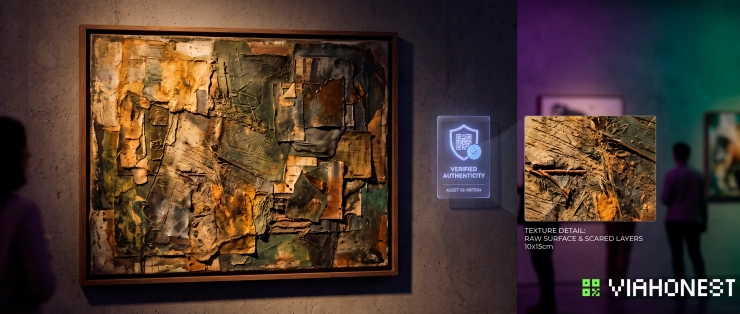
Artists can apply for verification and consideration for ViaHonest's curated selections. A strong application should communicate more than surface style. Show a focused body of work, explain the conceptual role of distortion and materials, and provide accurate information about dimensions, medium, edition status, and authorship. Detailed images are especially important for textured work because collectors need to see scratches, pigment deposits, collage edges, and transitions between matte and reflective areas.
Verification also strengthens the relationship between experimental aesthetics and market credibility. Raw presentation does not require vague documentation. In fact, the more unconventional the material process becomes, the more valuable clarity can be. Accurate records allow collectors to understand what they are acquiring while preserving the mystery and force of the work itself.
ViaHonest can help artists position their originals for an audience seeking distinctive contemporary practices. Inclusion in curated selections offers an opportunity to connect individual works with broader conversations around emerging art trends 2026, material authenticity, new expressionism, and the cultural reaction against automated perfection.
Apply to ViaHonest for artist verification and consideration for curated contemporary art selections. Present your strongest original works, document your process, and show how your visual language moves beyond imitation. Collectors do not need another copy of an established aesthetic. They need the next artist capable of turning raw material, personal symbolism, and emotional distortion into a world of their own.
Conclusion
The return of raw texture is not a temporary preference for dirty surfaces. It reflects a deeper change in how artistic value is perceived. As polished imagery becomes abundant, visible human decisions become more significant. Scratches, corrections, stains, unstable lines, and exposed layers offer something frictionless production cannot easily supply: a traceable encounter between thought, body, and material.
Basquiat's legacy shows how language, abrasion, and visual chaos can hold historical and psychological pressure. Robert Nava demonstrates how apparently naïve figures can become emotionally complex and culturally resonant. Shrigley and Stik prove that reduction can intensify meaning rather than diminish it. Their influence matters most when it encourages artists to reject inherited rules and develop personal systems.
The naive art trend of 2026 rewards courage, but it also demands discipline. Rawness must be structured. Distortion must communicate. Mixed media must create relationships between materials rather than superficial noise. Digital texture must respond to gesture instead of functioning as a filter.
This is the central challenge of raw authenticity art: preserve the first emotional impact while building enough formal strength to make it last. Do not polish away every contradiction. Do not confuse imitation with influence. Let the surface record the struggle of making, then document the resulting work with professional clarity.
For contemporary creators ready to bring that position into the market, ViaHonest offers a path toward verification, curated visibility, and collector trust. Apply with a coherent body of original work and join the new wave of artists turning imperfection into presence, texture into evidence, and naïve authenticity into one of the defining visual languages of 2026.