Oil painting has existed for over five hundred years. Digital art has existed for about sixty. Yet it is the digital artist who can today sell a finished work to a buyer on another continent in five minutes, with no gallery, no middlemen, and no shipping crate. That contrast is the heart of the digital art vs traditional art conversation, and it is why the question matters far beyond aesthetics.
In this guide we answer what is digital art and what traditional art means, break down the key differences between them, look honestly at the advantages of each, settle the "is digital art real art" debate as it stands in 2026, and help you decide which path fits you if your goal is to create and to sell.
What Is Digital Art?
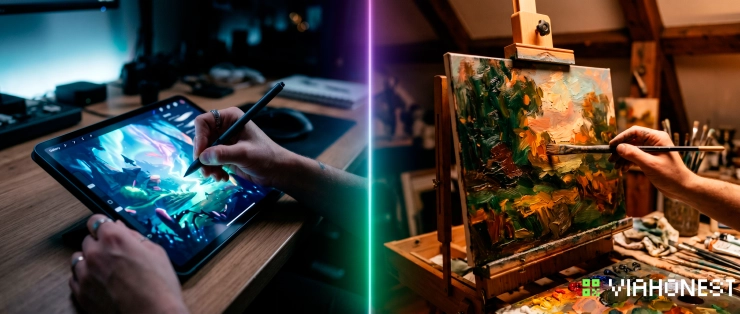
The simplest digital art meaning: artwork created or completed using digital technology, where the file itself is the original work. Instead of pigment on a surface, the artist works with software, a stylus, and a screen. Digital art includes:
- Digital painting and illustration. Made in tools like Procreate or Photoshop, often indistinguishable in style from traditional media.
- Vector art and graphic design. Scalable illustration built from paths and shapes.
- 3D modeling and rendering. Sculptural and architectural work created in three-dimensional software.
- Pixel art. A deliberate aesthetic built from individual pixels.
- Generative and algorithmic art. Works created with code or AI tools, where the artist designs the system and curates the output.
- Digital collage and photo manipulation. Composited works assembled from multiple sources.
What unites them all: the work is born as data, can be reproduced perfectly, and can travel anywhere instantly. Those three facts drive almost every difference that follows.
What Is Traditional Art?
The traditional art meaning is equally straightforward: artwork made by hand with physical materials, where the finished object is the artwork. This is the entire lineage of art history, including:
- Painting. Oil, acrylic, watercolor, gouache on canvas, panel, or paper.
- Drawing. Graphite, charcoal, ink, pastel.
- Printmaking. Etching, lithography, screen printing, woodcut, made in limited physical editions.
- Sculpture. Stone, metal, wood, clay, and mixed media in three dimensions.
- Textile and craft media. Weaving, ceramics, glass, and other material practices.
What unites these: each work is a unique physical object (or a small physical edition), it occupies space, it ages, and it can be owned in a way a file cannot be. One original exists, and whoever holds it holds the only one.
Digital Art vs Traditional Art: Key Differences
| Aspect | Digital art | Traditional art |
|---|---|---|
| The original | A file, perfectly reproducible | A unique physical object |
| Materials cost | Near zero after hardware and software | Ongoing: paint, canvas, tools |
| Corrections | Undo, layers, versions | Limited; mistakes are often permanent |
| Scarcity | Must be created deliberately | Built in by nature |
| Delivery | Instant, worldwide | Shipping, insurance, logistics |
| Sales formats | Downloads, prints, licenses, verified editions | Originals, physical prints, gallery sales |
| Proof of authenticity | Requires a verification layer | Signature plus provenance documents |
| Aging | Never degrades, never changes | Ages physically, needs care |
Notice the symmetry: digital art's greatest strength, perfect reproducibility, is also its greatest commercial weakness, because value in art has always been tied to scarcity. Traditional art's greatest weakness, physical friction in production and delivery, is also the source of its value, because friction creates rarity. Everything about selling each medium follows from this trade.
Advantages of Digital Art
The advantages of digital art explain why it has grown from novelty to a dominant creative medium in a single generation:
- Low cost of production. After the initial tablet and software, each new work costs nothing in materials. Experimentation is free.
- Speed and flexibility. Undo, layers, and versioning make iteration dramatically faster. Client revisions that would ruin a watercolor take minutes on a screen.
- Infinite perfect copies. One work can become downloads, prints, merchandise, and licensed images simultaneously, with no loss of quality.
- Instant global delivery. A collector in Tokyo receives the work seconds after purchase. No crates, no customs, no damaged corners.
- Multiple income streams from one piece. Print-on-demand royalties, licensing, commissions, and limited verified editions can all run from the same file.
- Modern discovery channels. Digital work is native to the platforms where audiences already live: Instagram, portfolio sites, online marketplaces.
Advantages of Traditional Art
Traditional media hold advantages that no software can replicate, and the market prices them accordingly:
- Inherent uniqueness. One original exists. Scarcity does not need to be engineered; it is the nature of the object.
- Physical presence. Texture, scale, brushwork, and the way a surface holds light create an experience no screen reproduces. Collectors pay for standing in front of the real thing.
- Established market and prestige. Galleries, auctions, fairs, and five centuries of collecting culture are built around physical works. Every record-setting price in history belongs to a physical object.
- The value of the hand. Evidence of human touch, including its imperfections, carries emotional and market weight that grows as digital images become abundant.
- Longevity as an asset. A well-made physical work is a durable store of value that can be insured, appraised, inherited, and resold for generations.
- Provenance tradition. The physical art world invented ownership history as a value mechanism, and buyers expect and reward it.
Is Digital Art "Real" Art? The Debate in 2026
The short answer in 2026: the debate is functionally over, and digital art won its legitimacy, though with nuances worth understanding.
- Institutions have moved. Major museums exhibit digital and generative work, and Christie's and Sotheby's sell digital art alongside Old Masters. When a major auction house dedicates entire sales to digital and AI-assisted work, the "is it art" question has left the building.
- The market has moved. Digital originals with verified scarcity have sold for prices that rival physical works, proving collectors will treat a file as a collectible when its authenticity and ownership are provable.
- The real debate shifted. The serious 2026 conversations are not about whether digital art is art, but about adjacent questions: how much human authorship AI-assisted work contains, how to verify originals in an age of infinite copies, and how artists get paid fairly when work is resold.
- What actually determines "realness" for buyers. Not the medium, but intent, skill, and verifiable authorship. A lazy work is lazy in oil or in pixels; a masterful work is masterful in either. Buyers in 2026 ask "is it genuinely yours and genuinely scarce," not "was it made with a brush."
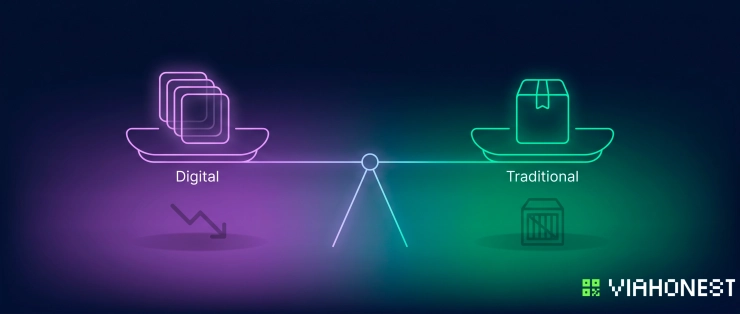
Perhaps the strongest evidence that the war is over: most working artists no longer pick a side. Painters sketch compositions digitally before touching canvas, digital illustrators sell physical prints of screen-born work, and printmakers combine hand-pulled editions with digital layers. The boundary between the two camps is now a workflow choice, not an identity.
How ViaHonest Supports Both Digital and Traditional Artists
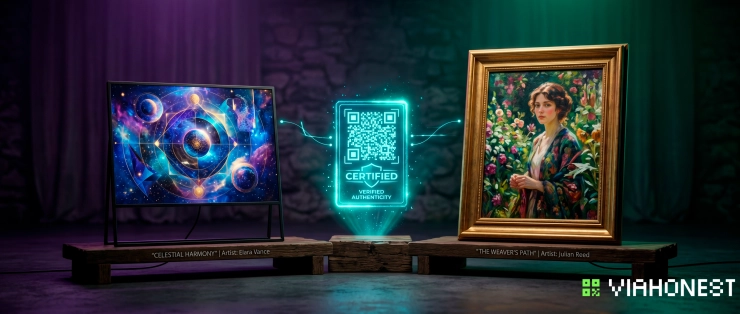
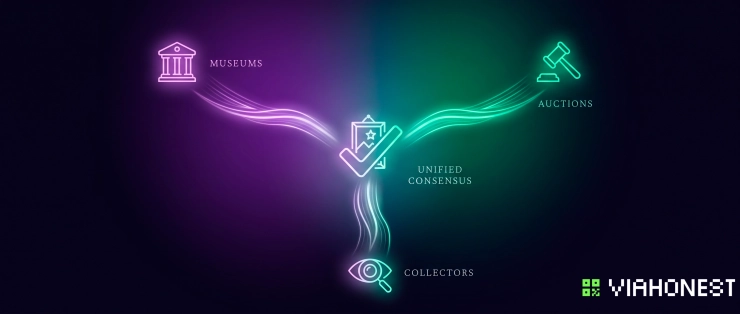
Here is the insight both camps arrive at eventually: whatever the medium, value comes from verified authenticity and documented ownership. ViaHonest, a Web3 marketplace for verified originals, provides that layer for both:
- For traditional artists: every physical work is paired with an on-chain certificate of authenticity, giving your originals the provenance infrastructure that used to require galleries and decades, starting from your very first sale.
- For digital artists: the same certificate turns a perfectly copyable file into a verifiably scarce original. Copies may circulate, but only one verified original exists, and the market can always tell the difference.
- For both: transparent ownership history builds with every sale, secure transactions protect both sides of every deal, and royalties on every resale mean you keep earning as your work appreciates and changes hands.
- For collectors: every piece, physical or digital, can be verified before purchase, which is precisely what makes them willing to pay original prices instead of poster prices.
Whichever medium you work in, you can start selling verified originals on ViaHonest, and collectors can browse the catalog knowing each work carries its documented history.
Conclusion
So which one actually sells better? The honest answer is that digital art and traditional art are not competitors. They solve different problems for different artists and different buyers. Digital gives you speed, scale, low costs, and a global market measured in minutes; traditional gives you uniqueness, physical presence, and an asset with centuries of collecting culture behind it. Many working artists deliberately use both: digital for volume and reach, physical originals for prestige and price.
And there is one principle that unites them, the answer hiding inside the whole digital art vs traditional art question: verified authenticity and documented ownership history raise the value of any work, digital or physical. That is what separates a collectible object from just a picture. So whichever side of the canvas or the screen you work on, use ViaHonest to sell with verified ownership and earn royalties on every resale, regardless of the medium you choose.