Picture the moment every independent artist knows: a buyer loves the piece, agrees on the price, and then hesitates right before paying. "How do I know it's an original?" That hesitation kills more art sales than pricing ever does. A certificate of authenticity for art is not a bureaucratic formality; it is the document that turns that doubt into confidence and closes the deal. It answers the buyer's last question before it is asked.
In this guide we cover everything an independent artist needs to know: what is a certificate of authenticity exactly, why it matters to both sides of the sale, what it must include, the difference between paper and digital certificates, how a certificate affects the value of your work, and how to create one correctly.
What Is a Certificate of Authenticity for Art?
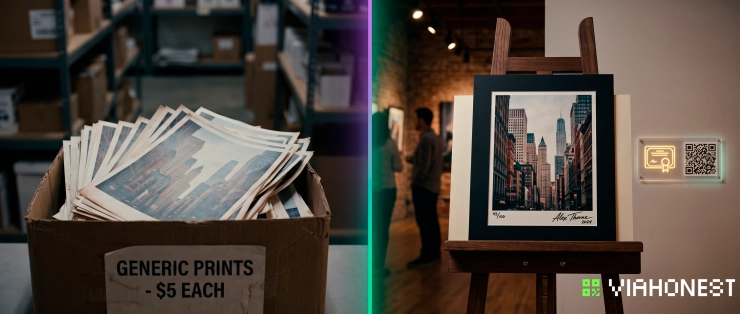
A certificate of authenticity (COA) is a document that confirms an artwork is genuine and identifies its origin: who made it, what exactly it is, and, in its stronger forms, where it has been since. Think of it as the artwork's passport. The painting carries the image; the certificate carries the proof.
A proper art certificate of authenticity does three jobs at once:
- It identifies the work precisely, so this certificate can never be attached to a different piece.
- It attests authorship, connecting the work to the artist by declaration and signature.
- It begins the provenance record, the documented ownership history that the art market has used to establish value for centuries.
A COA is issued by the artist (or the artist's authorized representative or gallery) at the time of sale, one certificate per work, and it stays with the piece through every future owner.
Why Independent Artists Need a Certificate of Authenticity
Famous artists have galleries, archives, and auction records vouching for their work. An independent artist has, by default, nothing but their word. A certificate changes that equation on every level:
- It closes sales. The certificate answers the buyer's core fear, "is this genuine?", before it becomes an objection. For many collectors, no COA simply means no purchase.
- It justifies original pricing. A documented original can be priced as an original. An undocumented one competes psychologically with prints and posters.
- It protects your authorship. A signed record that you created this specific work, dated and described, is your evidence in any future dispute or forgery situation.
- It builds your market. Every certified sale adds to a documented body of work. As your career grows, that paper trail is what lets early works appreciate and resell credibly.
- It signals professionalism. A certificate tells the buyer they are dealing with an artist who runs a serious practice, which changes how they treat your prices, your terms, and your future drops.
What Should a Certificate of Authenticity Include?
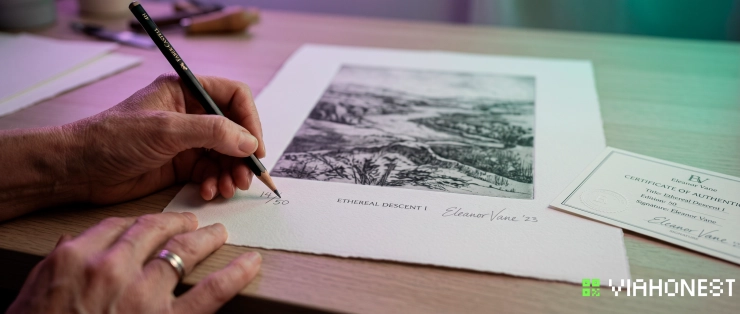
If you are wondering what does a certificate of authenticity look like, the answer is: less like a diploma, more like a precise record. A complete COA contains:
- Artist's full name and, ideally, contact or studio information.
- Title of the work.
- Year of creation.
- Medium and materials. For example, oil on linen, or archival pigment print.
- Exact dimensions.
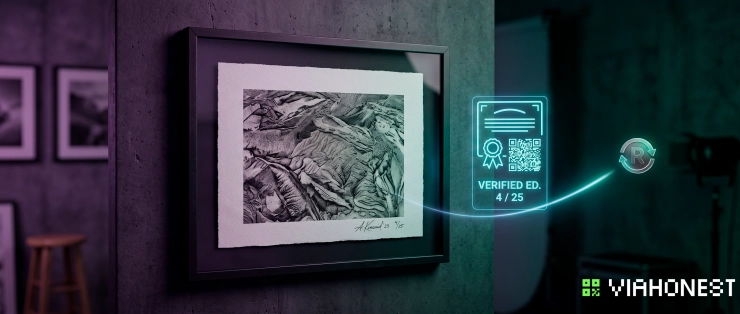
- Edition information. "Unique original (1/1)" or "Edition 4 of 25, signed and numbered." Unstated edition status is the most common and most damaging omission.
- A high-quality image of the work, so the certificate is visually tied to the piece.
- A unique identifier. A certificate or inventory number that matches your records.
- Date of sale or issue.
- The artist's handwritten signature. An unsigned certificate is a description, not an attestation.
- Optional but valuable: a statement of authenticity ("I certify that this work is an original creation by..."), care instructions, and copyright note (the buyer owns the object, the artist retains reproduction rights unless agreed otherwise).
One certificate per artwork, no exceptions. A generic certificate that could describe any of your pieces protects none of them.
Paper Certificate of Authenticity vs Digital Certificate: What's the Difference?
The traditional COA is a printed, signed page. It still works, but it inherited every weakness of paper:
- Paper can be lost or damaged. Decades from now, the certificate's absence will read as a provenance gap, and gaps cost money.
- Paper can be forged. A convincing fake certificate is far easier to produce than a convincing fake painting, which is why sophisticated buyers treat unfamiliar paper COAs with caution.
- Paper does not update. It records the first sale and nothing after. Every resale, the moments that actually build provenance, happens off the record.
- Paper cannot be verified remotely. An online buyer cannot inspect a paper certificate before wiring money to a stranger.
A digital certificate, particularly one recorded on-chain, addresses each weakness directly:
- It cannot be lost, because it exists as a permanent record tied to the work, not a page in a drawer.
- It is tamper-resistant. An on-chain record cannot be quietly rewritten or duplicated, which makes forgery impractical.
- It updates with every sale. Each change of ownership adds to the record, so provenance accumulates automatically instead of evaporating.
- It verifies instantly, from anywhere. A buyer on another continent can confirm authenticity before paying, which is precisely what online art sales have always lacked.
The practical takeaway: paper is better than nothing, digital is better than paper, and a digital certificate with ownership history is the strongest version that exists today.
How a Certificate of Authenticity Increases the Value of Your Art
A certificate is not just protection; it is an economic instrument. Here is how a certificate of authenticity art buyers can trust translates into higher value:
- It removes the risk discount. Buyers unconsciously subtract the risk of inauthenticity from what they are willing to pay. Verified authenticity removes the discount, and the full price becomes payable.
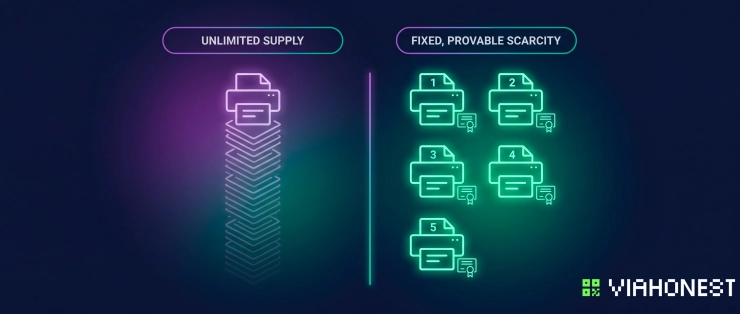
- It makes scarcity real. "One of one" is a claim; a certificate with edition information makes it a documented fact, and documented scarcity is what collectors actually pay for.
- It compounds through provenance. In the established art market, works with clean, documented ownership history consistently outperform identical works without it. Your certificate is page one of that history.
- It enables resale. A certified work can be resold credibly, which makes buying it a better investment, which in turn supports your primary prices. Collectors pay more for work they know they can sell.
- It anchors your painting certificate of authenticity to your career. As your reputation grows, every certified early work appreciates with it, because the connection to you is provable rather than anecdotal.
How to Create a Certificate of Authenticity as an Independent Artist
You can start certifying your work this week:
- Build a template once. A clean, single-page layout with your name or logo and every field from the checklist above. Any document editor works.
- Fill it per work, not per batch. Each certificate describes exactly one piece with its unique number. Keep a master inventory list matching numbers to works.
- Print on quality paper and sign by hand. If you sell physical work with a paper COA, the tactile quality of the certificate quietly reflects on the art.
- Photograph and archive everything. Keep digital copies of every certificate and records of every sale: date, buyer, price. You are building your own catalogue raisonné in miniature.
- Deliver it with the work. Attach the certificate to the final invoice or ship it with the piece, and tell the buyer to keep it; its absence at resale will cost them.
- Or issue it digitally from the start. Selling through a platform that generates a verifiable digital certificate with each sale removes the manual work and the paper risks in one step, which brings us to the strongest option available.
How ViaHonest Takes the Certificate of Authenticity Further
ViaHonest, a Web3 marketplace for verified original art, treats the certificate not as an accessory but as the core of every sale:
- An on-chain certificate with every work. Each piece sold on the platform is automatically paired with a tamper-resistant digital certificate of authenticity, permanently linking the work to you as its creator.
- Ownership history built in. Every sale and resale is recorded, so the certificate grows into full provenance over time, exactly the mechanism that drives value in the traditional art market, automated.
- Instant verification for buyers. Any collector can confirm a work is genuine before paying, which converts the hesitant buyer from our introduction into a confident one.
- Protection that follows the work. Because the record cannot be rewritten, copies can never pass as your originals, and your authorship stays provable forever.
- Royalties on every resale. The same on-chain infrastructure that verifies the work also pays you a share each time it changes hands, turning your certificate into an income instrument as well as a trust instrument.
If you are ready to certify and sell your work properly, list your originals on ViaHonest, where every piece comes with a digital certificate from day one. Collectors can browse the catalog and verify any work before buying.
Conclusion
A certificate of authenticity is not bureaucracy. It is a working tool that protects the artist, convinces the buyer, and builds long-term value into every piece you sell. It costs minutes to issue and pays for itself on the first hesitant collector it converts.
And keep the trajectory in mind: a paper COA is the beginning. A digital certificate with ownership history is what turns an original artwork into a collectible asset, one whose provenance grows with every sale and whose value grows with your career. Use ViaHonest to sell your original works with a digital certificate of authenticity built into every deal, and earn royalties on every resale for as long as your work keeps finding new homes.