Ask most working artists how they pay the bills, and you will hear everything except selling art: teaching classes, freelance design, print shops, merch stores. All legitimate, all covered in this guide. But the most underrated income stream in the whole conversation about how to make money as an artist is hiding in plain sight: the original works themselves, sold properly. Most advice treats originals as a lucky occasional windfall and builds the business around everything else. We are going to flip that order.
Below is the complete answer to how to make money with art: every real income stream, from the fastest to the most long-term, with honest numbers and trade-offs for each. And we will show why originals with verified ownership are not just a sale, but an asset that grows in value and can keep paying you every time it changes hands.
Sell Your Original Artwork: The Most Underrated Income Stream
Why do most artists undervalue selling originals? Three reasons: originals feel hard to sell ("who would pay hundreds for my work?"), each sale seems like a one-time event, and without infrastructure, every deal is an awkward DM negotiation. All three problems are fixable, and fixing them changes the economics of an entire career.
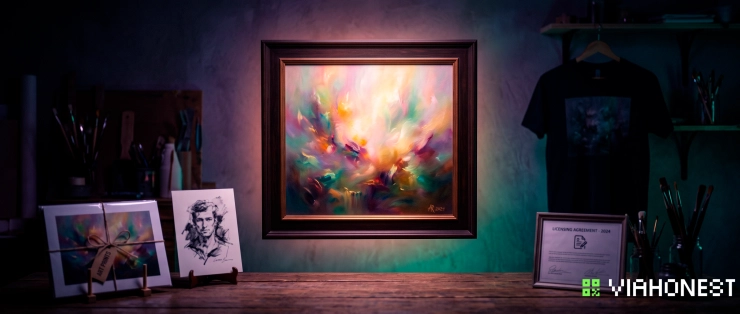
Start with the original versus print difference. A print is a reproduction: pleasant, affordable, infinite. An original is the one object the artist actually made. That distinction alone supports a price gap of four to ten times or more, because the buyer of an original is purchasing scarcity and connection, not just an image.
What turns an original into a collectible, rather than just an unsold painting with a hopeful price tag, is documentation:
- A certificate of authenticity. Verifiable proof the work is genuine and yours.
- Ownership history. A documented record of every sale, the same provenance mechanism that drives value at the top of the art market.
- Real scarcity. One-of-one, or a small numbered edition, stated and provable.
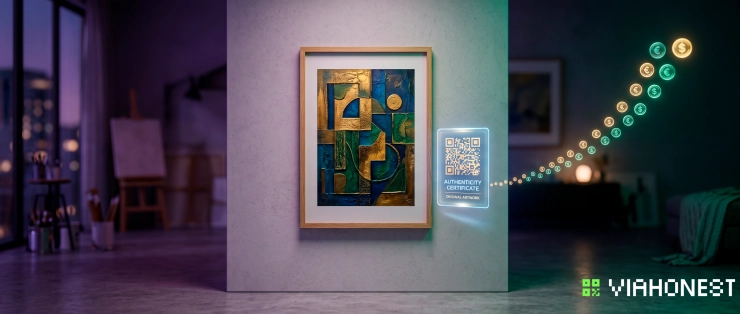
And here is the part almost nobody tells emerging artists: sold correctly, one original can become long-term income. On a platform with on-chain resale royalties, when your early collector resells your work in three years at twice the price, you automatically earn a share. Your first sale stops being the end of the story and becomes the first chapter of an appreciating asset.

Sell Art Prints and Limited Editions
Prints are the classic bridge between free followers and original buyers:
- Open edition prints sell for roughly $20 to $60 and monetize the audience that loves your work but cannot buy a $900 original.
- Limited editions, signed and numbered runs of 10 to 50, command far more per copy because scarcity returns to the equation. Document the edition and it behaves like a small collectible.
- Keep the hierarchy clear. Prints at 10% to 25% of the original's price protect the original's value while catching the rest of the demand.
- Print quality matters. Archival paper and inks justify premium pricing and repeat purchases.
Sell Digital Art and Digital Products
If you work digitally, or can scan what you make, digital products are near-pure margin:
- Digital downloads. Printable wall art, illustrations, patterns, and templates at $2 to $10 per file, or curated bundles at $10 to $50. Passive after listing.
- Digital originals. Your strongest digital pieces, sold as verified one-of-ones or small editions at original-art prices rather than download prices.
- The catch. Download marketplaces are crowded, so a clear niche and cohesive collections matter more than volume of uploads.
Take on Art Commissions
Commissions are the most reliable direct income for a skilled artist:
- Typical ranges run from $25 to $200+ per piece depending on complexity, size, and rights, with pet portraits, family portraits, and album or book art in steady demand.
- Price by scope, not hope. Define size, revisions, timeline, and usage rights in writing before starting. Scope creep is the commission killer.
- Take a deposit. Half up front is standard and filters out non-serious clients.
- The trade-off is that commissions are active income: they pay well per hour but stop the moment you stop.

License Your Artwork to Brands and Companies
Licensing rents your art out while you keep the rights:
- Stock platforms like Adobe Stock pay small per-download royalties that add up across a large portfolio.
- Direct licensing to brands, publishers, and packaging pays hundreds to thousands per deal, priced by usage scope: a local blog license is not a national ad campaign.
- The rule that protects you: license usage, never sell copyright outright unless the price genuinely reflects giving up all future income from that image.
Teach Art Online and Offline
Teaching monetizes your expertise, not just your output:
- Formats that work: pre-recorded courses on Skillshare or Teachable, live Zoom workshops, YouTube ad revenue and sponsorships, and Patreon memberships for process content and community.
- Teaching compounds. Students become followers, and followers become buyers. A good class is also a funnel: the audience that learns from you is the warmest possible audience for your originals.
- Honest earnings note: teaching income scales with audience size, so it starts slow and grows with your following.
- The trap to avoid: teaching can quietly eat your art practice. If courses become the whole business, you become an educator with a hobby. Keep creating and selling work as the center, with teaching as the amplifier.
Sell Merch with Your Art (Print-on-Demand)
Print-on-demand puts your art on t-shirts, mugs, tote bags, and posters with no inventory and no logistics:
- How it works: upload your design to Printful, Redbubble, or Society6, and the platform prints and ships each order while you collect a royalty, typically 15% to 25% of the sale.
- The pros: truly passive, zero risk, and it monetizes fans at the $15 to $40 price point.
- The cons: modest margins per item and crowded discovery, so merch income is a function of your existing audience more than the platform's traffic.
- The right frame: merch does not replace originals and should not try. It is an excellent supplementary channel that spreads your art into daily life and often introduces future collectors to your work.
Build Multiple Income Streams: How to Combine Everything
The artists who earn steadily almost never rely on one stream. A proven structure:
- Foundation: originals. The center of the business, priced with confidence, sold with documentation, generating both immediate income and long-term resale royalties.
- Volume layer: prints, downloads, merch. Passive channels that monetize the audience below original prices and fund the studio between original sales.
- Active layer: commissions. Reliable direct income you can dial up or down as needed.
- Amplifier layer: teaching and licensing. Streams that grow with your reputation and feed audience back to the foundation.
- The discipline: add streams one at a time, only after the previous one runs without daily attention. Four half-built streams earn less than two finished ones.
Notice how everything points back to originals. Every stream either funds them, promotes them, or builds the audience that eventually buys them, which is exactly how artists make money sustainably rather than sporadically.
How ViaHonest Helps Independent Artists Earn More from Their Original Work
If originals are the center of the business, they deserve better infrastructure than DM negotiations and PayPal screenshots. ViaHonest, a Web3 marketplace for verified original art, provides it:
- A professional page for every work. Full details, transparent pricing, and a certificate of authenticity with documented ownership history, replacing back-and-forth messages with a listing that sells while you sleep.
- Escrow protection. Payment is secured for both sides of the deal: the artist does not ship into uncertainty, and the buyer does not pay into a void. The trust barrier that stalls first-time original sales simply disappears.
- Resale royalties. Because ownership and terms live on-chain, you automatically earn a share every time your work is resold. The collector's gain becomes your gain, sale after sale.
- The bigger shift: ViaHonest turns your first sale into the beginning of long-term income instead of the end of a transaction. Every verified original you sell becomes a documented, appreciating asset with your name permanently attached.
List your original work on ViaHonest: sell with verified authenticity and earn royalties every time it resells. Collectors can browse and verify every piece in the catalog before buying, which is exactly why they pay original prices with confidence.
Conclusion
Real artist income is built on multiple streams: prints and downloads for volume, commissions for reliability, licensing and teaching for reach, merch for fun and visibility. Use as many as fit your practice. But the center of the system should be your original works, because among all the ways to make money with art, only originals create collectible value that grows over time.
Keep the key distinction in mind: a print sells once. An original with a documented ownership history and resale royalties is an asset that keeps producing income after every resale, for as long as your work circulates and appreciates. That is how to make money from art in a way that compounds instead of resets to zero every month. Use ViaHonest to sell your originals with verified authenticity and earn royalties on every resale, and build the one income stream that grows with your career instead of alongside it.